
20 Networking Tips for Entrepreneurs
What Makes Business Networking Actually Work?
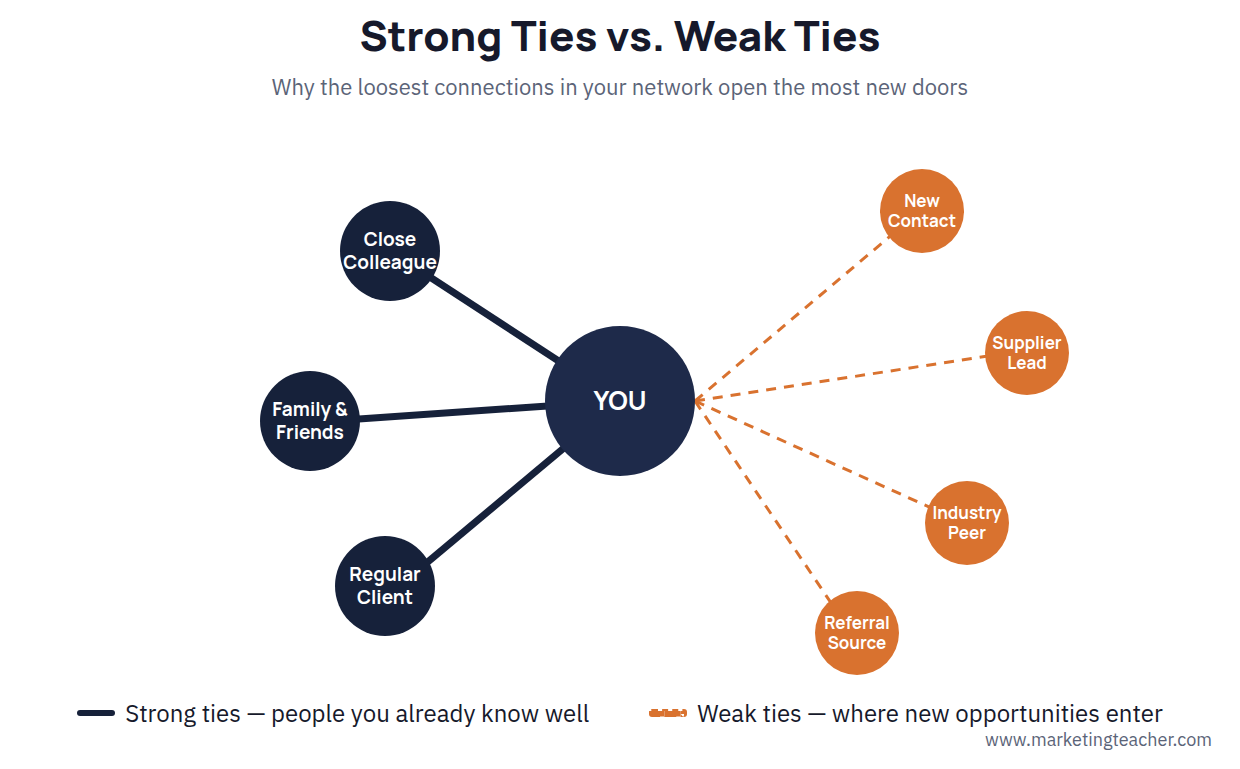
Networking for entrepreneurs and small business owners means deliberately meeting new contacts and developing existing relationships, usually at a purposefully organised event run by a local trading body, trade association, or industry group. Granovetter (1973) showed that more distant acquaintances, so-called weak ties, are often more valuable than close friends and family for surfacing genuinely new information and opportunities, because a weak tie bridges into a social circle an entrepreneur would not otherwise reach. That is the real case for attending events full of people you barely know: the payoff is not in deepening ties you already have, but in building the wider, looser network that eventually surfaces a lead, supplier, or customer you would never have found otherwise.
Before the Event: Research and Preparation
Preparation is what separates a productive networking session from an afternoon of small talk. Research the event beforehand and try to find out who is likely to attend, checking their websites for a little insight into their businesses. Have a wide network in mind rather than a narrow one, and find out in advance where your trade or market association typically meets. Prepare a short elevator pitch, a few focused sentences that explain in plain language what you do and why you are there, and set a realistic goal for the event, such as making two genuinely useful new contacts rather than trying to work the entire room.
During the Event: Making the Right First Impression
Arriving on time, or a little early, gives you a chance to meet the organisers and the other early arrivals before the room fills up. A firm handshake, direct eye contact and a genuine smile still matter more than any scripted opening line. Dress appropriately for the setting, since misjudging the dress code sends an unintended signal before you have said a word. Carry business cards, but hand them out selectively to people who will genuinely value them, and note on the back of any card you receive why that contact matters, since a name alone is easy to forget by the following morning.
During the Event: Having Real Conversations
Sounds obvious, but you are there to talk. Build rapport quickly with an open question such as “tell me about your business” or “how do you find new customers,” and have two or three of these ready before you arrive. Listen as closely as you talk: ask a follow-up question that shows you actually understood the other person’s pitch, rather than waiting for your turn to speak. Do not be afraid to listen in on a nearby conversation and join if there is a genuine common interest, and expect others to do the same with yours. Keep your own elevator pitch ready, but resist turning it into a sales pitch. You are networking, not closing a deal in the room. Be willing to end a conversation politely once it has run its course, explaining that you would like to meet a few more people, then move on rather than monopolising one contact’s whole evening.
After the Event: Following Up Properly
The value of an event is decided in the days that follow it, not during it. Review your new contacts promptly while the conversation is still fresh, and follow up quickly, adding useful people to a professional network like LinkedIn or to your own contact database along with the notes you made. Use social media the same way you used your business cards at the event: selectively and with a clear reason for each connection, rather than trying to add everyone at once. Once a relationship is genuinely established, develop it deliberately: send a relevant sample, propose a short meeting, or invite the contact to become a customer or supplier where it makes sense.
Becoming a Host, Not Just a Guest
Once regular attendance at other people’s events starts paying off, consider organising one yourself, or volunteering to help run an existing one. Carson, Cromie, McGowan and Hill (1995) note that informal networks and word-of-mouth contact are a disproportionately important source of new business for small firms precisely because owner-managers rarely have the marketing budget of a larger competitor, which makes the effort invested in hosting or supporting an event, rather than only attending them, a genuinely worthwhile use of an entrepreneur’s limited time.
Summary
Networking rewards preparation and follow-through far more than charisma alone. Researching an event and setting a realistic goal beforehand, making genuine two-way conversation rather than a rehearsed sales pitch during it, and following up quickly and selectively afterward are what turn a room full of strangers into a working network of contacts. For an entrepreneur with limited time and budget, that steady discipline, applied consistently across many small events, is often a more reliable source of new business than any single big campaign.

