
Blogging as an Entrepreneur: Getting Started and Becoming an Expert Voice
What Is a Blog, and Why Does It Matter to an Entrepreneur?
A blog is essentially a regularly updated online journal, a shortened form of the term web log, through which a person or business shares expertise, opinions and updates. Blogs began as informal, personal diaries, but the format has since become a serious part of an entrepreneur’s content marketing, giving a small business or start-up founder a direct channel to demonstrate expertise and build a following without needing to buy advertising space to be heard.
Setting Up Your Own Blog
Getting started involves a handful of concrete choices rather than any special technical skill. A blogging platform needs to be chosen first, and a business that already has a website can usually simply add a blog section to it, while a business starting from nothing needs to arrange hosting and a domain name as well. A theme, sometimes called a skin, gives the blog a distinct visual identity rather than a generic default look, and once the basic setup is in place, tools for adding social sharing buttons or building a mailing list can usually be added without much extra effort.
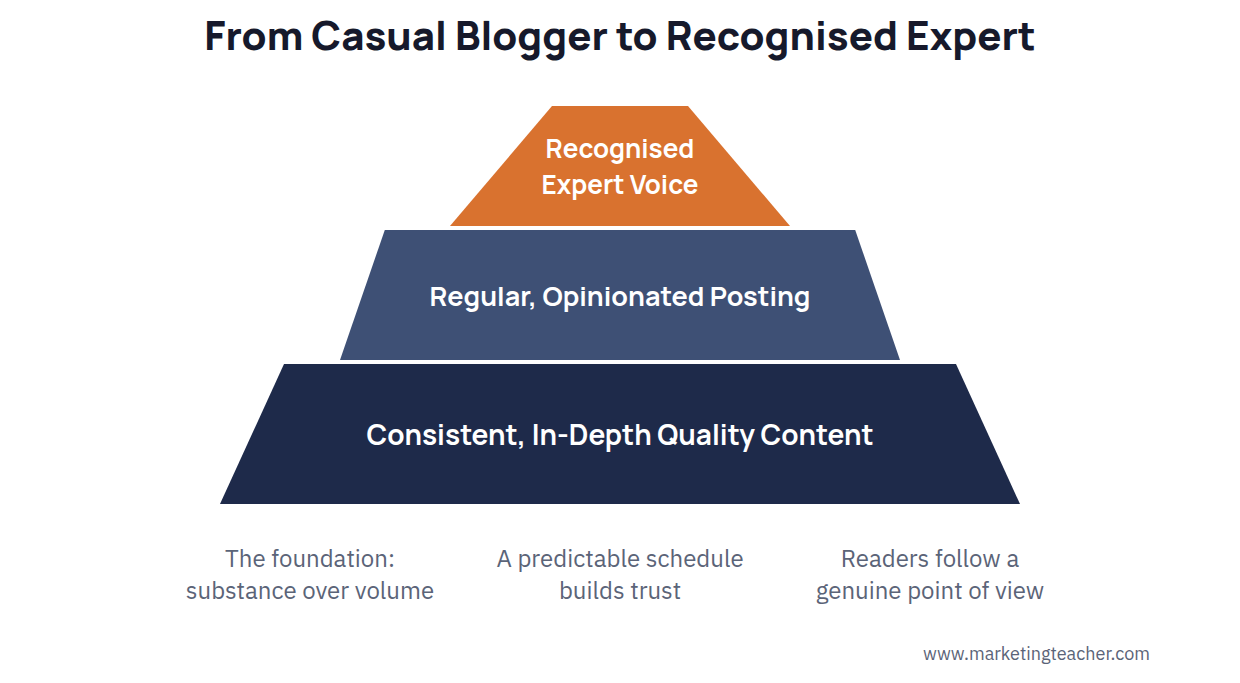
Quality Content Is the Real Foundation
Choosing a platform and a theme is the easy part; the content itself is what actually builds a readership. A blog only earns repeat visitors if each post offers something genuinely useful, whether that is practical advice, an insider’s view of a craft or industry, or an honest opinion on a topic readers care about. Without that foundation of real substance, none of the technical setup choices make much difference to whether anyone keeps reading.
Becoming an Expert Voice in Your Field
Readers naturally expect a blogger to write with some authority on their chosen topic, so an entrepreneur blogging about their own trade needs to either demonstrate that expertise directly or be comfortable pointing readers toward other genuine experts when a topic goes beyond their own knowledge. Pulizzi (2013) argues that a consistent publishing cadence, rather than occasional bursts of activity, is one of the central habits that turns a business’s content into a genuine source of audience loyalty over time, since a reader who finds one useful post has no particular reason to expect another unless a pattern is clearly established.
Writing With Genuine Depth and a Real Point of View
In-depth, substantial posts do more to build a reputation than superficial ones, since they demonstrate real command of a subject rather than a surface-level familiarity with it. Pulizzi (2013) describes this as finding a genuine “tilt”, a distinct angle or depth of coverage a competitor’s content is not already providing, rather than repeating generic advice already available everywhere else. A post built as a simple list, without any real analysis behind it, rarely achieves the same effect. Taking a clear, specific position on a topic, rather than hedging every claim to avoid disagreement, is also part of what makes a blogger worth following: readers return to a voice that actually says something, not one that carefully avoids saying anything at all.
Turning Readers Into an Actual Audience
A blog only becomes a genuine marketing asset once its readers turn into a recognisable, returning audience rather than a series of one-off visitors arriving from a single search result. Encouraging readers to subscribe by email, follow the business’s social accounts, or simply bookmark the blog for regular return visits is what converts scattered traffic into a dependable channel a business can rely on to reach people directly, without needing to buy advertising space every time it has something to say.
Handling Other People’s Information Responsibly
A post drawing on a case study, a client’s story, or details about another organisation needs permission before it is published, particularly where it includes photos or identifiable personal or business details. Getting this right protects both the blogger’s professional reputation and the relationships that made the content possible to write in the first place.
Summary
A blog gives an entrepreneur a direct, low-cost channel to share expertise and build an audience, and the technical steps of setting one up, choosing a platform, adding a theme, and getting the basic tools in place, are the easy part. The harder and more valuable work is consistently publishing in-depth, opinionated content that demonstrates genuine expertise, since that is what actually turns an occasional blogger into a recognised expert voice readers choose to follow.

