
What Is a Social Media Tactical Plan?
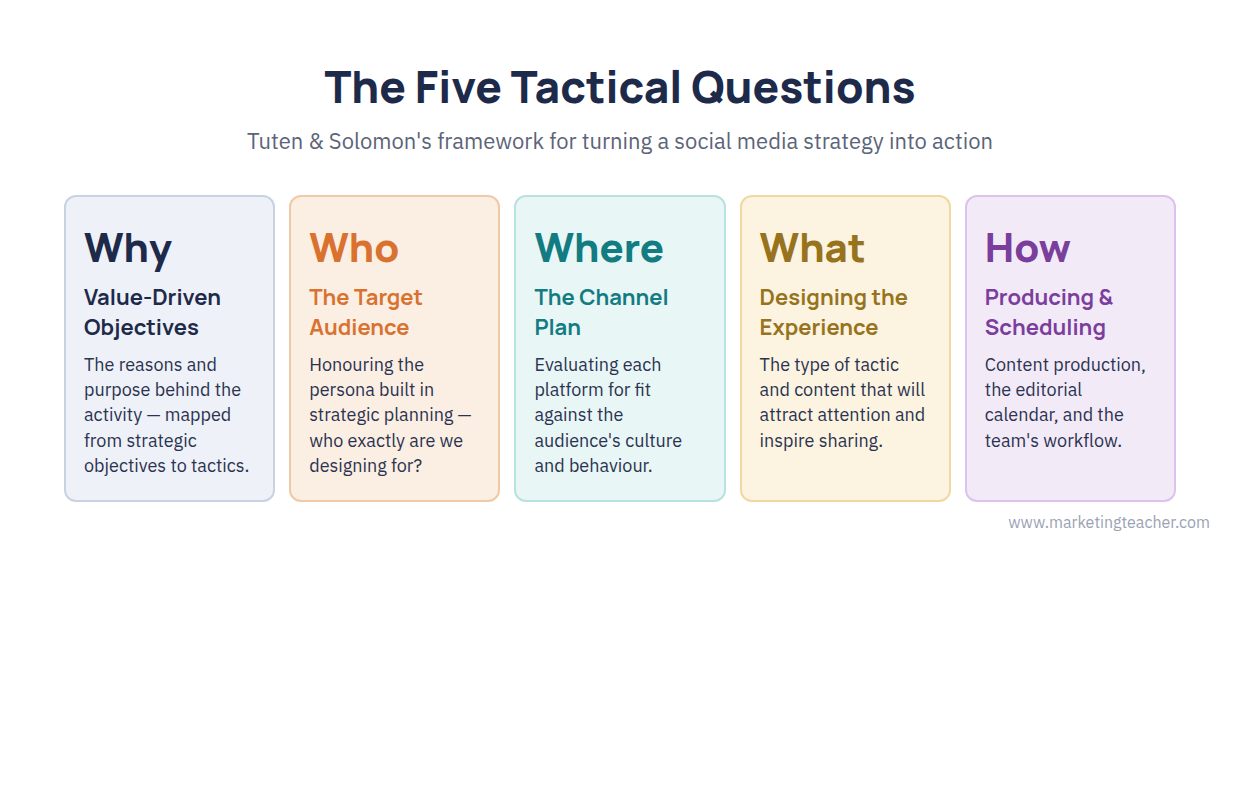
A strategic plan sets the destination: objectives, target segments, chosen channels, the experience the brand wants to create. A tactical plan is what actually gets a brand there. Tuten and Solomon (2018) describe tactical planning as the stage where a team works out, in practical detail, the why, who, where, what and how of social media marketing — the everyday decisions about which content to create, which channels to post it on, and how the work actually gets produced and scheduled. Skip this stage and even the best strategy stays a slide deck; work through it properly and the strategy becomes a routine a team can actually run week after week.
Why: Keeping Tactics Tied to Objectives
Every tactical decision should trace back to an objective set in the strategic plan. Tuten and Solomon (2018) frame this as the “why” of tactical planning: the reasons or purpose behind the social media effort, whether that is building awareness, driving engagement, generating leads, or supporting customer service. A brand chasing awareness might prioritise reach-building tactics like influencer partnerships or shareable video; a brand chasing service efficiency might prioritise responsive community management instead. The point is not to run every popular tactic available, but to pick the ones that actually serve the stated objective.
Who and Where: Revisiting the Audience and Choosing Channels
The “who” returns to the audience personas built during strategic planning (see Lesson 2) and asks what kind of experience will genuinely engage this specific audience — what they want to do, see, or feel when they encounter the brand. The “where” then works out, channel by channel, whether that experience actually fits. Tuten and Solomon (2018) suggest evaluating each candidate channel against a consistent set of questions: who uses it and for how long, what kind of content performs well there, whether the brand can make a genuinely valuable contribution to that community, whether competitors are already active there, and whether the channel offers paid options to extend reach. A channel plan records the outcome — which platforms the brand will use, and what role each one plays.
What: Designing Content People Actually Want
The “what” covers the content itself: the type of tactic, the content type, and the underlying content strategy. Tuten and Solomon (2018) note that the ideal experience sits at the point where the audience’s own interests intersect with the brand’s identity — content that is only about the brand rarely earns attention on its own. One widely used planning tool here is the content marketing matrix, developed by digital marketing consultant Bosomworth (2014) and adopted by Tuten and Solomon (2018) as a way to map content types along two axes: whether the message is emotional or rational, and whether the audience is in a passive or active stage of the buying process — helping teams choose the right content type for the right moment rather than defaulting to whatever is easiest to produce.
A related discipline is the content mix itself. Tuten and Solomon (2018) describe an 80/20 industry guideline: roughly 80% of a brand’s posts should be genuinely audience-focused — useful, entertaining, or interesting on the audience’s own terms — with only around 20% directly promoting the brand or a product. Content that takes the audience’s point of view earns real engagement; content that only serves the brand’s point of view rarely does.
How: Producing and Scheduling the Work
The final question is practical: how does the content actually get made and published on time? Tuten and Solomon (2018) describe teams using creative briefs to specify the requirements for each content unit — word counts, required links, image sizes, campaign hashtags — so that whoever produces the piece knows exactly what is expected. Good content is also catalogued for reuse, a practice Tuten and Solomon (2018) call atomization: a single strong idea can be repackaged as a long-form article, a short video, a series of images and a handful of standalone posts, extending its reach without proportionally increasing the production workload.
Scheduling is organised through a content calendar — typically a shared spreadsheet or a dedicated social media management tool — recording, at minimum, the publish date, the topic, the author, the owner responsible for seeing it through to publication, and its current status. Larger teams often layer several views of the same calendar: a year-at-a-glance for seasonal themes and campaigns, monthly views for content in production, and weekly views for the actual day-to-day posting schedule.
Summary
Tactical planning is where a social media strategy becomes a working plan of action. Answering why, who, where, what and how in sequence — objectives, audience, channels, content, and production — gives a social media team a repeatable process rather than a series of one-off decisions, and a content calendar keeps that process running on schedule (Tuten & Solomon, 2018).

