
What Is Inclusivity in Marketing?
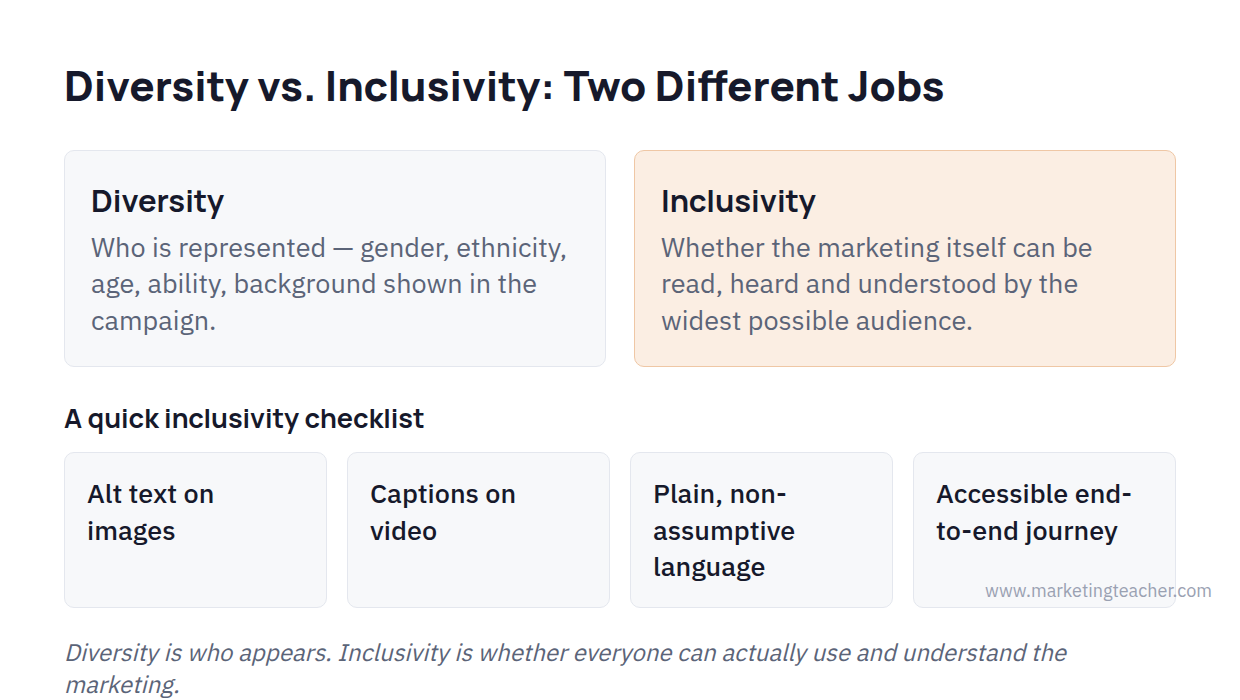
Inclusivity in marketing is often confused with diversity, but the two are different jobs. Diversity is about who appears in a campaign: the range of genders, ages, ethnicities, abilities, and backgrounds represented in the people a brand chooses to show. Inclusivity is about whether the marketing itself actually works for the widest possible range of people who encounter it – whether they can read it, hear it, understand it, and feel it was made with them in mind. A brand can cast a diverse set of models and still produce marketing that is not inclusive, if a screen-reader user cannot navigate the landing page, a video has no captions, or the copy quietly assumes a household looks a certain way. Research on how consumers actually react to these efforts shows the response is not one-size-fits-all: reactions depend heavily on whether the effort feels authentic and well-executed, not just on whether it exists at all (see our companion lesson on diversity in marketing for the representation side of this picture).
Inclusive Design in Marketing Materials
Practically, inclusivity shows up in a handful of concrete, checkable choices. Accessibility basics: sufficient colour contrast between text and background, alt text on every image, captions or transcripts on video content, and layouts that work with a screen reader and a keyboard alone, not just a mouse. Language choices: plain, jargon-free copy, and wording that does not quietly assume a single family structure, gender, age bracket, or physical ability as the default customer. Sensory and format range: offering more than one way to consume the same content (text and audio, for example) so a hearing, sight, or reading difference does not lock someone out entirely.
One well-studied area is gender-neutral marketing – communications that deliberately avoid binary gender categorisation and stereotypes. This is not simply a cosmetic change: research using field experiments and eye-tracking has found that gender-neutral marketing measurably reduces how much consumers rely on gendered aesthetic stereotypes when evaluating a product, with the effect varying by brand personality and the social context in which the product will be used. In other words, inclusive language and framing can change how people actually process an offer, not just how a brand appears on the surface.
Why Inclusivity Matters Commercially
This is not purely a compliance or goodwill exercise. Studies of inclusive advertising featuring people with disabilities have found it increases both hedonic well-being (how pleasant the experience feels) and eudaimonic well-being (how meaningful it feels) among viewers, and that this spills over into stronger brand engagement and purchase intention compared with equivalent non-inclusive adverts. The effect was strongest for viewers’ sense that the advertising was meaningful, not just enjoyable – suggesting audiences give real credit for effort that visibly removes barriers, rather than just efforts that look good.
Common Pitfalls: Performative Inclusivity
The research is equally clear about the downside. When an inclusion effort is perceived as inauthentic, tokenistic, or motivated purely by self-interest rather than genuine care, it can damage brand perception rather than help it. A typology of consumer reactions to diversity and inclusion advertising found that most audience segments are sensitive to exactly this: whether the brand’s broader behaviour is consistent with the inclusive message it is putting in front of them. A single accessible advert from a company whose products, stores, or customer service remain inaccessible is likely to read as performative. Inclusivity works best as an operational standard applied consistently, not a campaign applied once.
A Simple Inclusivity Audit
Before a campaign goes live, it is worth running it through a short, repeatable check rather than relying on instinct. Ask: can every image be understood without seeing it (alt text), can every video be understood without hearing it (captions), does the copy avoid assuming a single family shape, gender, age, or ability as “normal,” and can the whole customer journey – not just the advert – be completed by someone using a screen reader or keyboard alone? A campaign that passes on the first three points but fails the fourth is still incomplete, because the mismatch between an inclusive advert and an inaccessible product or checkout is exactly the gap that makes inclusion efforts look performative.
Summary
Inclusivity in marketing means designing communications that the widest possible range of people can access, understand, and act on: accessible formats, plain and non-assumptive language, and consistency between the message and the underlying customer experience. It is measurably linked to stronger brand engagement and purchase intention when done well, and measurably damaging when it comes across as performative. Treat it as a standing checklist applied to every piece of marketing, not a one-off campaign theme.

