
What Is an Annual Report, and Who Reads It?
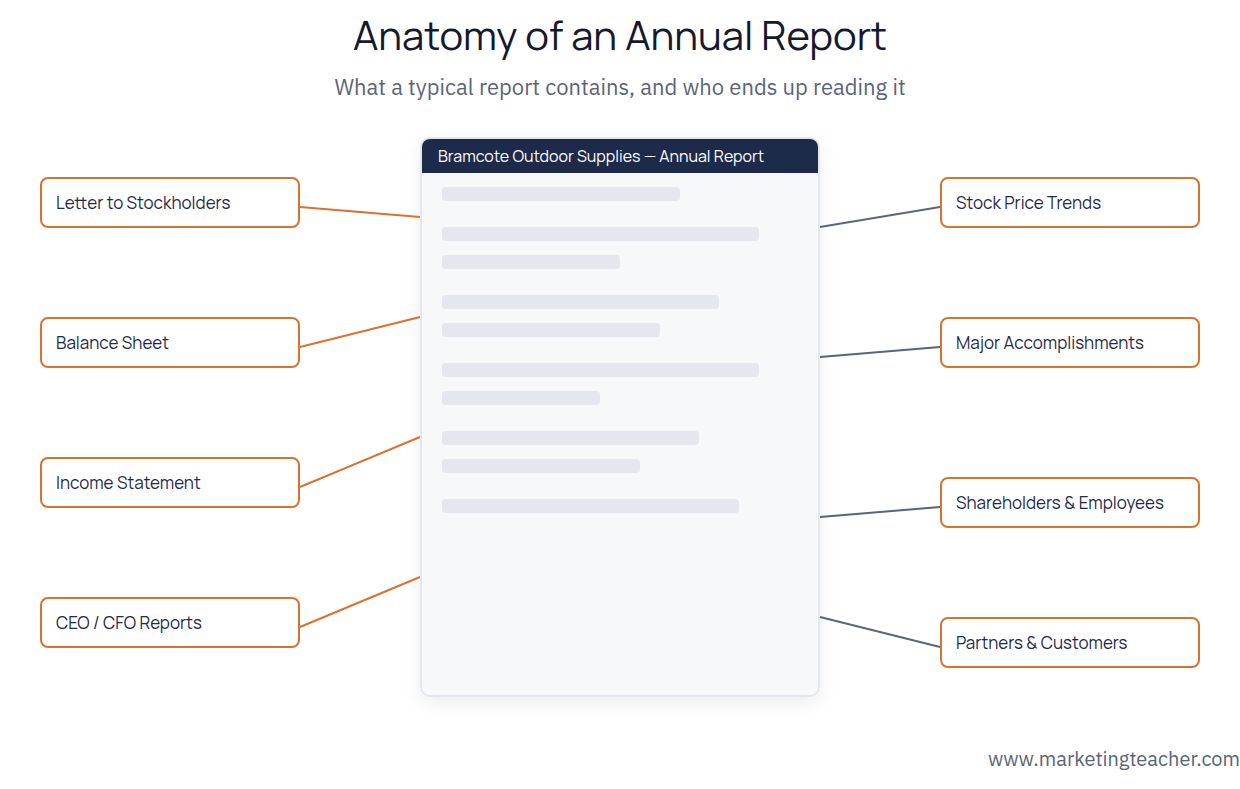
An annual report is a document prepared once a year by a publicly traded company, summarising its financial results and operational achievements over the previous twelve months. Producing one forces a business to review its own performance in detail, which has real internal value quite apart from the external reporting obligation. It also reaches a wider audience than most marketers assume: current and potential shareholders read it to judge whether to hold or buy the stock, but so do employees checking on job security, customers assessing a supplier’s stability, potential business partners doing due diligence, and government bodies confirming regulatory compliance.
What Goes Into an Annual Report
The exact contents vary by industry and by company size, but a typical annual report includes a balance sheet, an income statement, a summary of company stock pricing trends, a letter to stockholders, separate reports from the Chief Executive Officer and Chief Financial Officer, and a review of major accomplishments from the past year. The financial sections are audited by a certified accountant before publication, which is what gives the figures their credibility with an external reader who has no other way of verifying them.
Why the Content Became More Standardised
In the United States, annual report content became considerably more rigorous after the Securities Exchange Act of 1934, which created the Securities and Exchange Commission and gave it the power to require periodic reporting from companies with publicly traded securities (U.S. Securities and Exchange Commission). Before that Act, some companies had been selective, and in a few cases outright deceptive, about what they disclosed. The requirement for regular, audited, standardised reporting was designed to give every category of stakeholder — not just large institutional shareholders — a fair, comparable picture of a company’s financial position, and equivalent disclosure regimes now exist in most other developed markets.
Why This Is a Marketing Opportunity, Not Just a Filing Obligation
Most people picture an annual report as a dry stack of financial tables, but an astute marketer can treat its narrative sections — the CEO letter, the accomplishments summary, the company overview — as a genuine promotional opportunity. Just as a campaign gets tailored to the segment it’s targeting, an annual report’s tone and emphasis can be tailored to whichever audience is reading it that year: reassurance and stability for nervous existing shareholders, growth and opportunity for prospective investors, credibility and longevity for a business partner weighing a long-term contract. The financial figures are fixed by the audit; the story built around them is not.
Reading Someone Else’s Annual Report as a Marketer
The same document is also useful in the other direction. Before pitching a large prospective client or evaluating a potential supplier, reading their most recent annual report — specifically the CEO letter and the accomplishments section — gives a fast read on what that organisation currently cares about and is willing to say publicly about its own priorities. A supplier whose annual report leans heavily on sustainability messaging, for instance, is signalling something worth matching in a pitch aimed at winning their business, quite apart from whatever the balance sheet says about their ability to pay.
A Word of Caution on Selective Emphasis
There’s an obvious limit to how far narrative framing should be pushed. The financial figures in an annual report are audited and cannot be altered to suit a story, and regulators take a dim view of a narrative section that contradicts or obscures what the numbers actually show. The useful version of this skill is choosing which true, positive facts to lead with — not disguising a weak year as a strong one. A marketing team that oversells a difficult year in the CEO letter, while the balance sheet tells a different story a page later, damages the same credibility the whole disclosure regime exists to protect, and sophisticated readers notice the gap immediately.
Summary
An annual report combines audited financial statements — a balance sheet, an income statement, stock price trends — with narrative sections like the CEO and CFO letters and a summary of the year’s accomplishments, produced to meet disclosure standards that tightened significantly after the Securities Exchange Act of 1934 (U.S. Securities and Exchange Commission). For a marketer, the real opportunity lies less in the fixed financial figures and more in how the surrounding narrative is framed for the specific stakeholders — shareholders, employees, partners, customers — reading that year’s edition.
The slides, worksheet, lesson plan and poster for this lesson are free to download and free to use in your course — no sign-up, no permission needed. See the teacher resources →
Assign this lesson to your class:
Using Canvas, Blackboard or Moodle? Copy the link and paste it into your course page or assignment. More ways to add lessons to your LMS.

