
What Is a Balance Sheet, and Why Does It Balance?
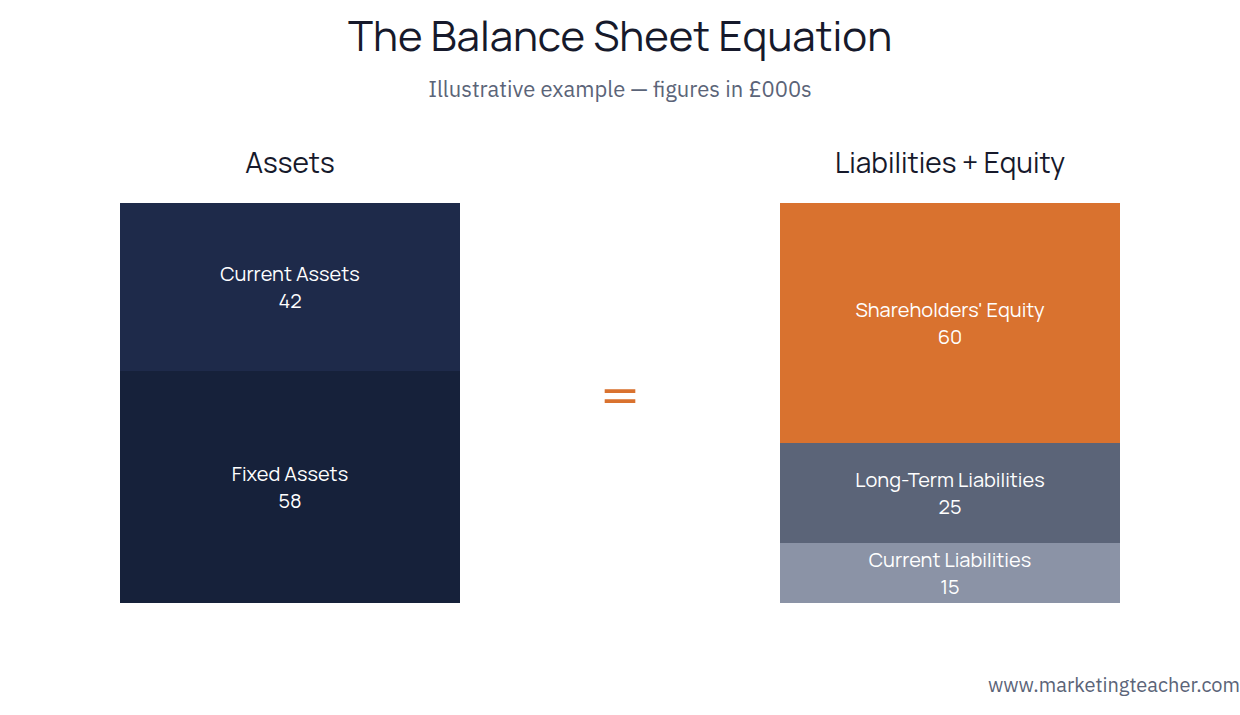
A balance sheet is a snapshot, at a single point in time, of what a business owns, what it owes, and what’s left over for its owners. It holds information of real interest to bankers and investors, because a careful read of it can forecast a company’s ability to pay its bills and shows how much money has actually been invested in the business. A balance sheet is called that because its two sides are always required to be equal: total assets on one side, and the combined total of liabilities and shareholders’ equity on the other. This equal-by-definition structure — assets equal liabilities plus equity — is set out in the international accounting standard that governs how a balance sheet must be presented (IFRS Foundation, 2024).
The Asset Side: What the Business Owns
Building a balance sheet starts with listing the firm’s assets, which typically fall into two groups. Current assets are cash and anything expected to convert to cash within a year — cash on hand, accounts receivable (money owed by customers), and the value of inventory not yet sold. Fixed assets are longer-term holdings such as equipment, a building, or land, expected to help the business generate profit over more than one year; depreciation, which spreads a fixed asset’s cost over its useful life, is also recorded under this heading. Adding current and fixed assets together gives total assets — one half of the balance sheet equation complete.
The Other Side: Liabilities and Shareholders’ Equity
The second half covers liabilities and shareholders’ equity. Liabilities are amounts owed to others, and are usually split into current liabilities — obligations due within a year, such as accounts payable for ongoing professional services like accounting or legal fees — and long-term liabilities, such as a multi-year bank loan. Shareholders’ equity is made up of capital the owners have invested plus retained earnings: profits that have been reinvested into the business rather than paid out. Add liabilities and shareholders’ equity together and, by definition, the result equals total assets.
Why This Matters to a Marketer
A marketer rarely builds a balance sheet, but understanding one changes how a marketing budget gets pitched. A large upfront spend on a new product launch, a rebrand, or a website rebuild is a use of cash that shows up first as a reduction in current assets, before any revenue it generates arrives to offset it. A finance team reading a proposal will naturally think in these terms — what does this do to our current assets and our liquidity in the short term — even when the marketer pitching it is thinking purely in terms of expected return. Framing a spending request with at least a passing awareness of that balance sheet impact tends to land better than treating it as a pure profit-and-loss argument.
A Quick Way to Read Financial Health
Two simple checks make a balance sheet easier to interpret without any specialist training. The first is the split between current and fixed assets relative to current liabilities: a business whose current assets comfortably exceed its current liabilities can generally cover its near-term bills, while one where the two are close, or reversed, may struggle with short-term obligations even if it looks solid overall. The second is the balance between liabilities and shareholders’ equity — a business funded mostly through debt carries more financial risk than one funded mostly through owner investment and retained profit, since debt has to be repaid on a fixed schedule regardless of how trading is actually going. Neither check replaces a proper financial review, but both give a fast first impression of how much cushion a business actually has.
Good Record Keeping Is the Foundation
An accurate balance sheet depends heavily on good record keeping throughout the year, not just at the point the statement is prepared. A running ledger of accounts provides the summary figures a balance sheet reports, which is also why a balance sheet is best read alongside a business’s other financial statements — its cash flow statement in particular, since a business can hold healthy assets on paper while still facing a short-term cash squeeze.
Summary
A balance sheet lists what a business owns (current and fixed assets), what it owes (current and long-term liabilities), and what’s left for its owners (shareholders’ equity), with the two sides always required to balance under the standard that governs its presentation (IFRS Foundation, 2024). For a marketer, the value of understanding a balance sheet isn’t building one — it’s recognising how a spending proposal will actually be read by whoever holds the purse strings.
The slides, worksheet, lesson plan and poster for this lesson are free to download and free to use in your course — no sign-up, no permission needed. See the teacher resources →
Assign this lesson to your class:
Using Canvas, Blackboard or Moodle? Copy the link and paste it into your course page or assignment. More ways to add lessons to your LMS.

