
What Are Annual Accounts, and How Do They Differ From a Basic Annual Report?
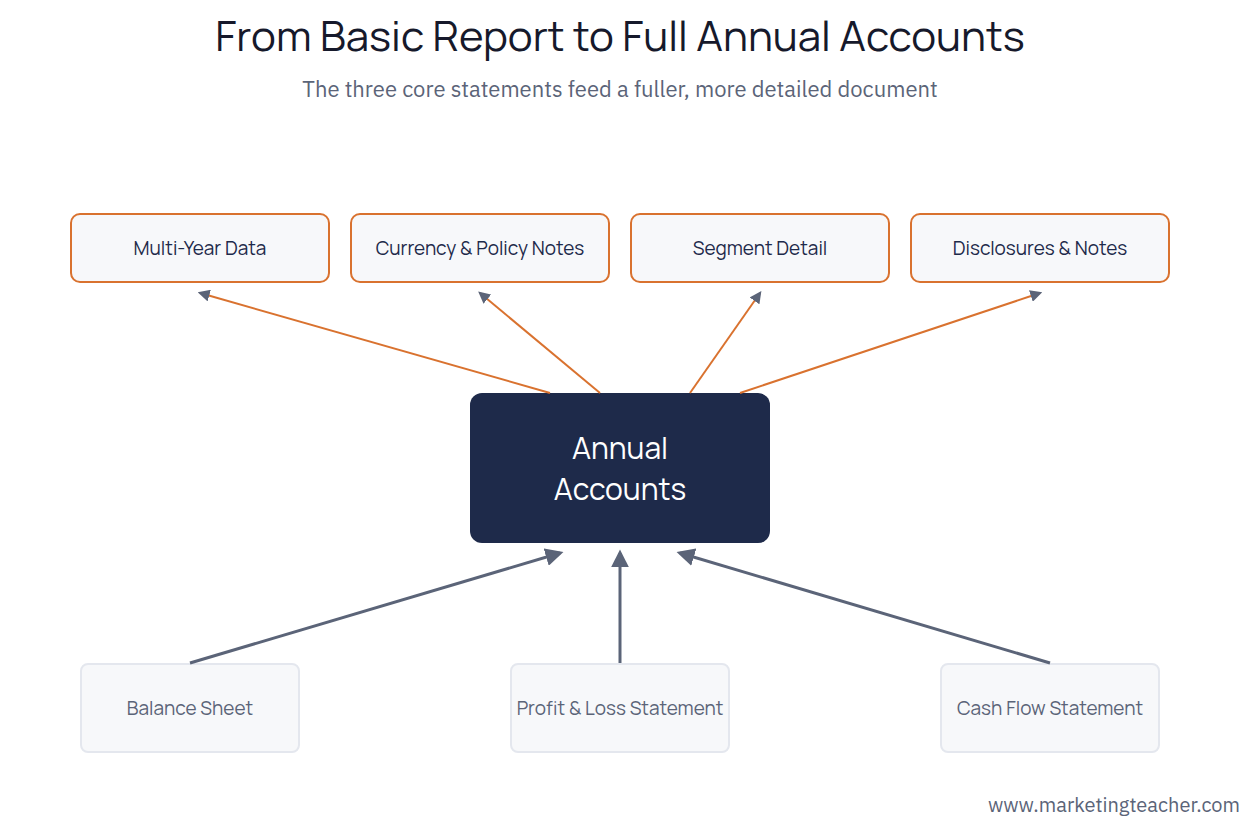
The standard components of a basic annual report — a balance sheet, a profit and loss statement, and a cash flow statement — give shareholders and other interested parties the key financial information they need for a straightforward business. But some organisations are not straightforward: a company with subsidiaries, joint ventures, or operations spread across multiple countries needs a level of detail those three statements alone can’t provide. That fuller, more detailed reporting is what’s meant by annual accounts, and its required structure and content are shaped by accounting standards such as those set out by the International Accounting Standards Board, alongside relevant national securities regulation (Elliott and Elliott, 2024).
What Extra Detail Shows Up in Annual Accounts
Annual accounts typically show figures across multiple years rather than a single period, so a reader can see the trend rather than just a snapshot. They also disclose the exchange rates used for converting results from different currencies, and explain any changes in accounting policy from one year to the next — because a change in policy can shift reported figures even when the underlying business hasn’t changed at all, and stakeholders need that explained rather than left to guess at. Beyond the headline statements, annual accounts commonly include detailed notes and disclosures covering items such as deferred taxation, interest on borrowings, and a fuller breakdown of specific assets and liabilities than the basic balance sheet shows on its own.
Who Has to Produce Them, and Why It’s Not Optional
The level of detail required isn’t a matter of company preference. Larger organisational forms — limited liability companies, insurance companies, savings banks, and other regulated entities — are typically required by law or by industry regulation to produce this fuller set of accounts, along with explicit explanations of every significant accounting policy they’ve applied. The purpose is consistency and fairness: when a company’s ownership includes many different shareholders, lenders, and regulators, all of them need to be working from the same fully explained picture rather than a simplified summary that could be read several different ways.
This has practical consequences for anyone reading the accounts of a company they’re considering as a partner, supplier, or acquisition target. A business that’s legally required to produce full annual accounts is generally easier to assess with confidence, precisely because the disclosure requirements limit how much can be left unexplained. A smaller business that only produces the basic three statements isn’t doing anything wrong, but a marketer or business owner evaluating that smaller company — as a potential partner or supplier, say — has correspondingly less independently verified detail to go on, and should factor that gap into how much weight to place on the headline figures alone.
Where Marketing-Relevant Detail Actually Sits
For a marketer, the most useful parts of a set of annual accounts are often the supplementary schedules rather than the headline statements. Reports such as income by customer, sales by item, or profit and loss by job break results down in ways that can reveal exactly which products, customer segments, or campaigns are actually driving performance — information the combined top-line figures conceal. A marketing team preparing a case for next year’s budget will usually find a far stronger argument in a segment-level breakdown buried in the accounts’ notes than in the single headline revenue or profit number reported at the top.
Reading Notes and Disclosures Critically
Because annual accounts often contain estimates, judgement calls, and policy choices explained in the notes, it’s worth reading those notes rather than skipping straight to the summary figures. A change in how revenue is recognised, or how a particular cost is allocated between segments, can make year-on-year comparisons misleading unless the accompanying explanation is read alongside the numbers. Annual accounts are built to be transparent about exactly this kind of judgement — the transparency only pays off for a reader willing to look past the headline totals.
Summary
Annual accounts exist because a basic annual report’s three core statements aren’t detailed enough for larger, more complex organisations — those with subsidiaries, multiple currencies, or regulatory obligations that demand fuller disclosure (Elliott and Elliott, 2024). The extra detail includes multi-year trends, policy explanations, and segment-level schedules, and it’s precisely that segment-level detail — income by customer, sales by item, profit and loss by job — that a marketer preparing a budget case is most likely to find genuinely useful.
The slides, worksheet, lesson plan and poster for this lesson are free to download and free to use in your course — no sign-up, no permission needed. See the teacher resources →
Assign this lesson to your class:
Using Canvas, Blackboard or Moodle? Copy the link and paste it into your course page or assignment. More ways to add lessons to your LMS.

