Marketing to Your Own Staff First
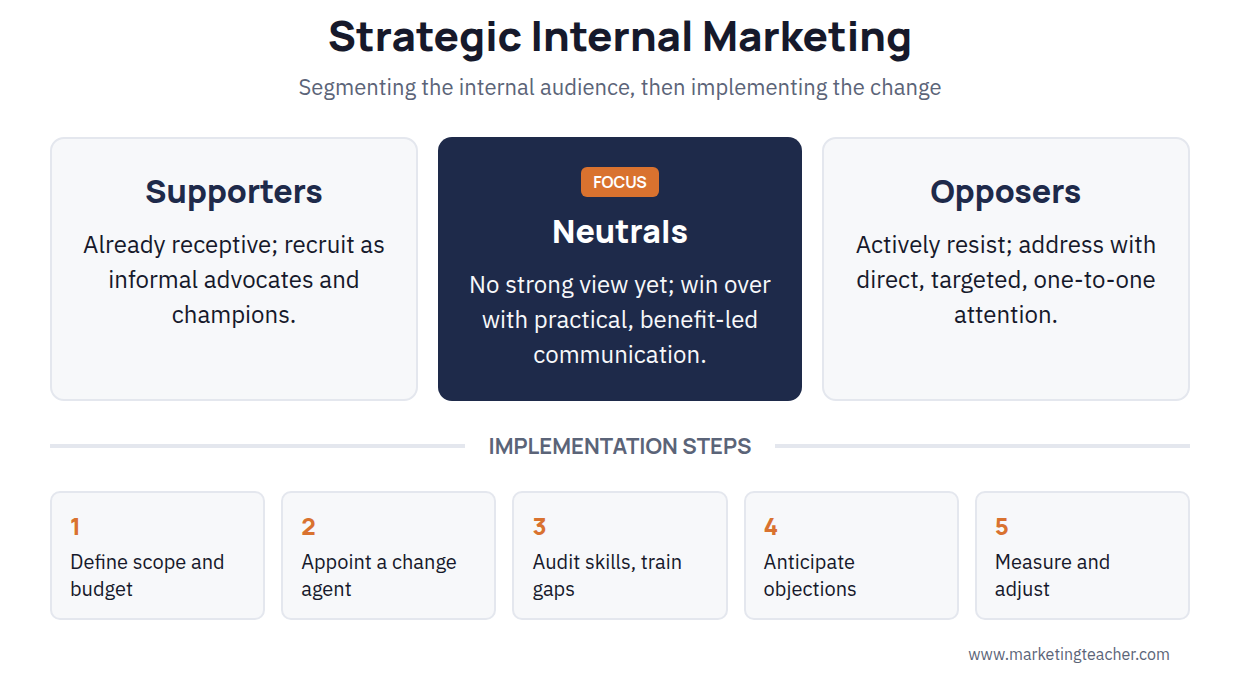
Jobber (2009) defines internal marketing as the application of marketing techniques to staff rather than to a company’s external customers, treating employees as an internal market that must understand and buy into a change before it can be delivered externally. Colorado Ricardo’s mistake was standard: it briefed advertising contacts and retail partners in full detail, but left its own showroom and factory staff to find out about the launch from a customer’s question, rather than from the company itself.
What Colorado Ricardo Should Do Before Launch
Worked example
A practical, low-cost step is a short internal briefing session and a one-page fact sheet for every factory and showroom employee, covering the e-mountain-bike’s key features, price point and answers to the questions customers are most likely to ask – delivered before any external advertising goes live, not after. Jobber (2009) sets this out as a number of practical steps handled in sequence: inform staff of the change, explain why it matters, and give them the specific knowledge or skills the change requires of them.
Key point
Jobber (2009) notes that staff who are not properly briefed are likely to respond to a proposed change with confusion or indifference, precisely what happened when the workshop technician gave a customer the wrong answer. Internal marketing is not a courtesy step; it is what determines whether front-line staff can actually deliver the external promise the launch campaign is making.
This should be planned alongside the external Promotion mix, so staff are never the last to know what customers are being told.
Teaching this topic?
The slides, worksheet, lesson plan and poster for this lesson are free to download and free to use in your course — no sign-up, no permission needed. See the teacher resources →
Assign this lesson to your class:
Using Canvas, Blackboard or Moodle? Copy the link and paste it into your course page or assignment. More ways to add lessons to your LMS.
Online course · certificate on completion
Study a full online course — and earn a certificate
Three courses that turn the free lessons into ordered modules, written at university Levels 4 to 6, with a short quiz after each.


