
New-Product Pricing: Skimming or Penetration?
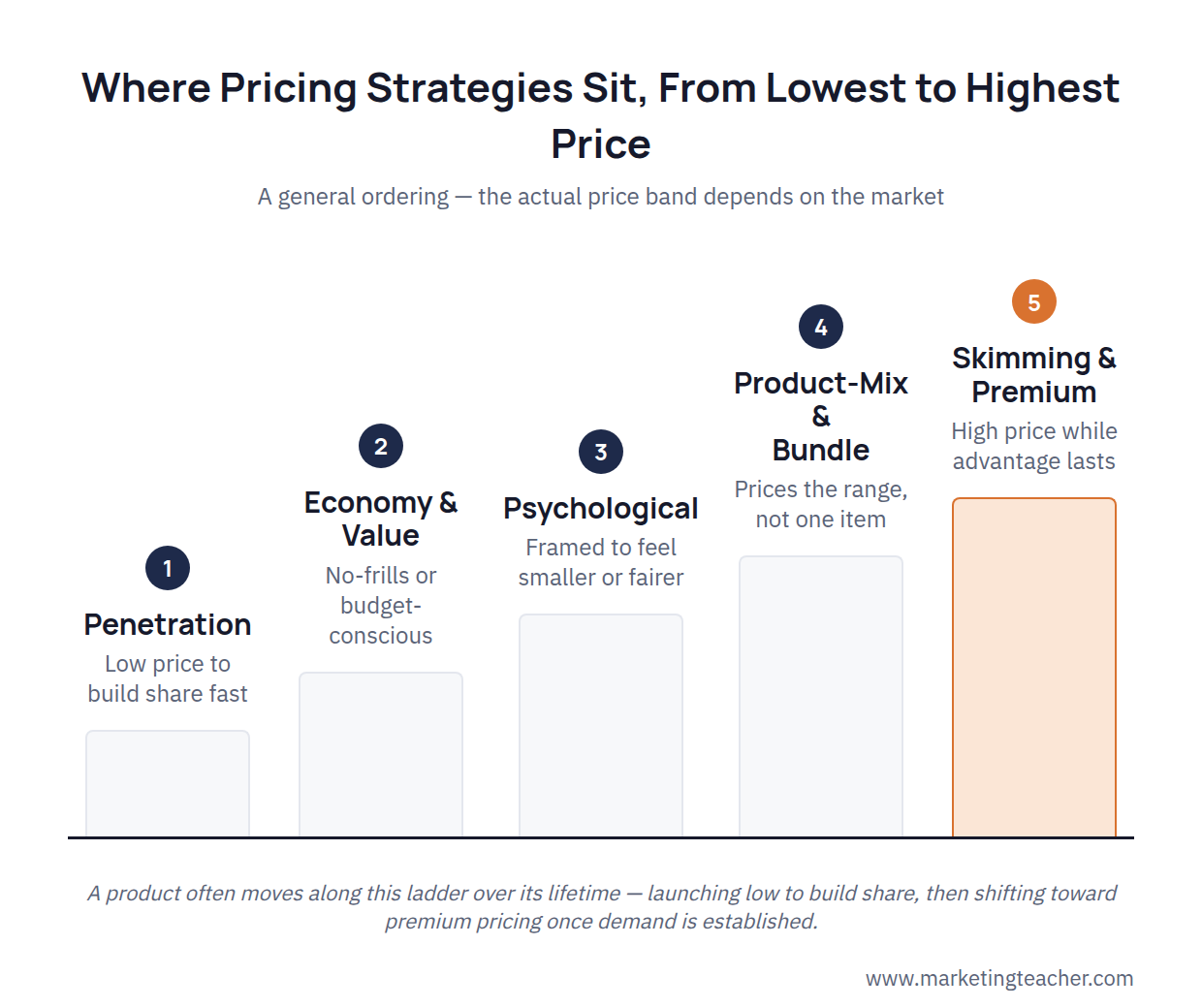
Kotler and Armstrong (2018) set out two opposite strategies for pricing a genuinely new product. Market-skimming pricing sets a high initial price to earn strong margins from customers willing to pay for novelty and quality, then lowers price gradually. Market-penetration pricing does the opposite: a low initial price is used to build volume and market share quickly, on the assumption that costs will fall as volume grows.
Applying It to Colorado Ricardo
Other Pricing Tactics Worth Considering
Psychological pricing ($2,999 rather than $3,000) makes the price feel meaningfully lower without changing the margin. Product line pricing could also be used for accessories – for example, offering the upgraded battery as an optional extra rather than bundling it into the base price, so budget-conscious customers still have an entry point into the range.
Pricing decisions should be checked against the underlying cost structure – see the Contribution Analysis exercise – and against how the product is positioned for its target segment, in the Positioning exercise.
The slides, worksheet, lesson plan and poster for this lesson are free to download and free to use in your course — no sign-up, no permission needed. See the teacher resources →
Assign this lesson to your class:
Using Canvas, Blackboard or Moodle? Copy the link and paste it into your course page or assignment. More ways to add lessons to your LMS.

