
What Determines a Business’s Pricing Strategy?
Price is the only element of the marketing mix that produces revenue directly — product, place and promotion all represent costs. Kotler and Armstrong (2018) define price as the amount of money charged for a product or service, or the value customers exchange for the benefits of owning or using it. Because that value is felt differently by every customer and every market, businesses have developed a wide toolkit of pricing strategies rather than relying on a single formula. These strategies broadly split into two groups: strategies used to set a price when a product first launches, and strategies used to adjust an established price afterwards to fit a particular customer, situation or market condition.
New-Product Pricing: Skimming vs Penetration
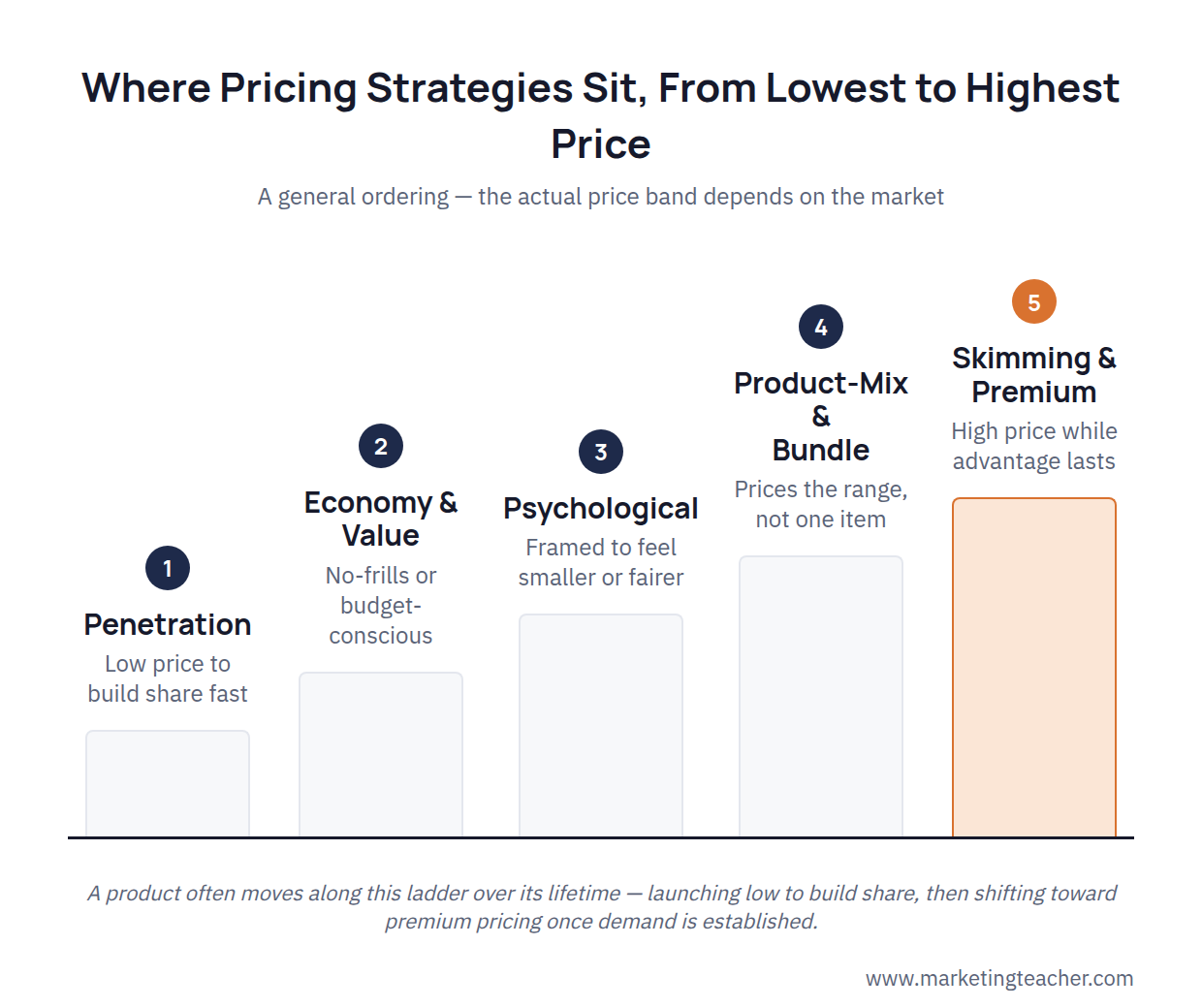
When a genuinely new product launches, a business usually chooses between two opposite strategies. Price skimming sets a high initial price to “skim” maximum revenue from customers most willing to pay, while the product still enjoys a competitive advantage few rivals can match. Kotler and Armstrong (2018) note that this advantage is rarely permanent — the high price and healthy margin attract competitors, supply increases, and the price is gradually lowered as the market matures. Penetration pricing does the opposite: it sets a deliberately low initial price to build market share and a large customer base quickly, then raises prices gradually once that base is established. A new streaming or broadband service often uses this approach, offering a heavily discounted first year to win subscribers before moving them onto standard pricing.
Psychological and Promotional Pricing
Once a price is set, businesses often adjust how it is presented or applied. Psychological pricing appeals to a customer’s perception rather than their strict arithmetic — pricing an item at $9.99 rather than $10 is a classic example, and in an unfamiliar market a customer will often use price itself as a signal of quality, choosing a mid-priced option over the cheapest or most expensive simply to avoid an uncertain decision. Promotional pricing takes a different approach, temporarily reducing price to drive short-term sales through tools such as buy-one-get-one-free offers, money-off vouchers, and seasonal sales. Because promotional pricing is easy to overuse, many countries regulate how long a product must be sold at its normal price before it can legally be marked down as “discounted.”
Pricing the Product Mix: Line, Optional, Captive and Bundle Pricing
Kotler and Armstrong (2018) group this set of approaches together as product mix pricing strategies: where a business sells a range of related products, it prices the whole range as a system rather than pricing each item in isolation. Product line pricing sets a series of price steps across a range — a basic, mid-tier and premium version of the same service — that customers perceive as fair relative to each other, even though the cost of producing each version rarely rises in the same proportion as the price. Optional-product pricing then adds extras on top of a base price, such as an airline charging separately for a reserved seat or extra luggage. Captive-product pricing goes further still, pricing a core product low precisely because the business recoups its margin on a required complementary item — a razor sold cheaply so that replacement blades can be priced at a premium, or a printer priced low knowing that ink cartridges are not interchangeable. Finally, product bundle pricing combines several items into a single package priced below the sum of buying each separately, which is also a useful way to move slower-selling stock alongside a popular item.
Choosing the Right Pricing Strategy
Beyond these core approaches, businesses also adjust price geographically, charging different amounts in different markets to reflect shipping costs, local taxes, or how rare a product is perceived to be, and through value pricing, deliberately offering a lower price during a downturn or intense competition so customers feel they are getting a lot of product for their money. Choosing between all of these options depends on where a product sits in its life cycle, how strong its competitive advantage really is, and how price-sensitive its target customers are — a young, unique product can often support a skimming or premium approach, while a mature product competing in a crowded market usually needs some combination of value, promotional or product-mix pricing to hold its position.
Summary
Pricing strategies fall into two broad groups: new-product strategies such as skimming and penetration, used when a product first launches, and price-adjustment strategies such as psychological, promotional, product-mix and geographical pricing, used to fit an established price to a specific customer or situation. Because a product’s ideal price shifts as it moves through its product life cycle, pricing is rarely a one-off decision — it is revisited constantly alongside the other elements of the marketing mix as a product, its competitors, and its customers all change.

The slides, worksheet, lesson plan and poster for this lesson are free to download and free to use in your course — no sign-up, no permission needed. See the teacher resources →
Assign this lesson to your class:
Using Canvas, Blackboard or Moodle? Copy the link and paste it into your course page or assignment. More ways to add lessons to your LMS.

