Climbing Past the First Sale
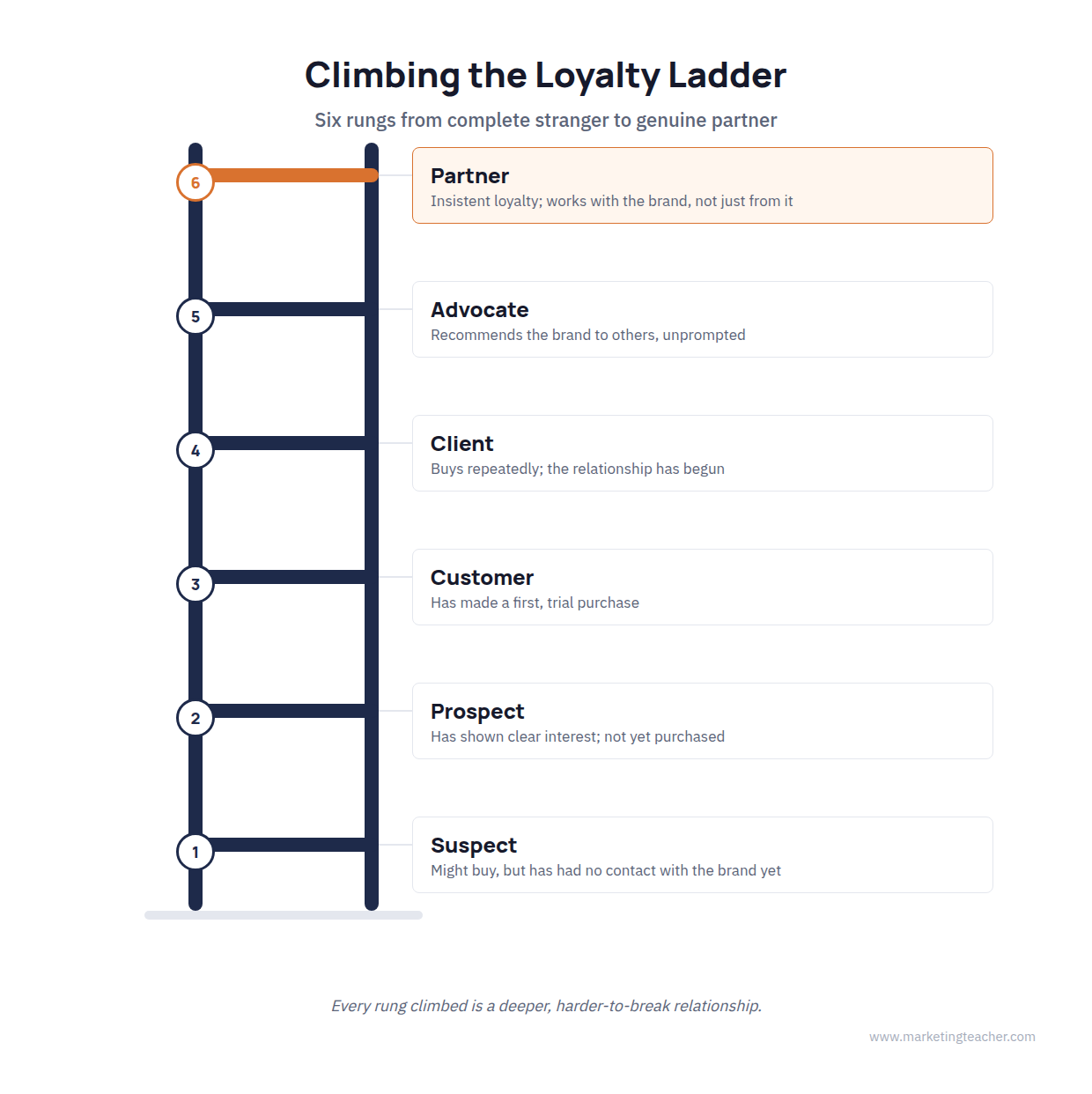
The loyalty ladder, developed by Christopher, Payne and Ballantyne (1991), sets out a series of rungs a relationship can climb: prospect, customer, client, supporter, advocate, and (for a business’s own promoters) partner. A first-time buyer who has just completed a purchase is only a customer – the relationship has barely started, and Ricardo’s assumption that the job is done at that point leaves most of the ladder unclimbed.
Moving Colorado Ricardo Customers Up the Ladder
Worked example
To move a first-time buyer from customer to client, Colorado Ricardo could follow up after the sale with a personal service reminder and an invitation to a group ride – turning a one-off transaction into a repeated relationship. From client to supporter, offering existing owners early, discounted access to the e-mountain-bike before the public launch converts satisfied owners into people who feel genuinely invested in the brand’s success. From supporter to advocate, the “Colorado Ricardo Riders” club referred to elsewhere in this course gives loyal owners a reason to actively recommend the brand rather than simply not complain about it.
Key point
Reichheld (1996) found that customers retained over a longer relationship tend to be significantly more profitable over time, largely because the cost of serving them falls and their willingness to buy again, and to refer others, rises. Climbing the loyalty ladder with existing owners is therefore not a distraction from winning new customers for the e-mountain-bike – loyal advocates are one of the cheapest ways to reach them.
This complements the augmented-product thinking in the Three Levels of a Product exercise.
Teaching this topic?
The slides, worksheet, lesson plan and poster for this lesson are free to download and free to use in your course — no sign-up, no permission needed. See the teacher resources →
Assign this lesson to your class:
Using Canvas, Blackboard or Moodle? Copy the link and paste it into your course page or assignment. More ways to add lessons to your LMS.
Online course · certificate on completion
Study a full online course — and earn a certificate
Three courses that turn the free lessons into ordered modules, written at university Levels 4 to 6, with a short quiz after each.


