
Who Actually Has a Relationship With Your Business?
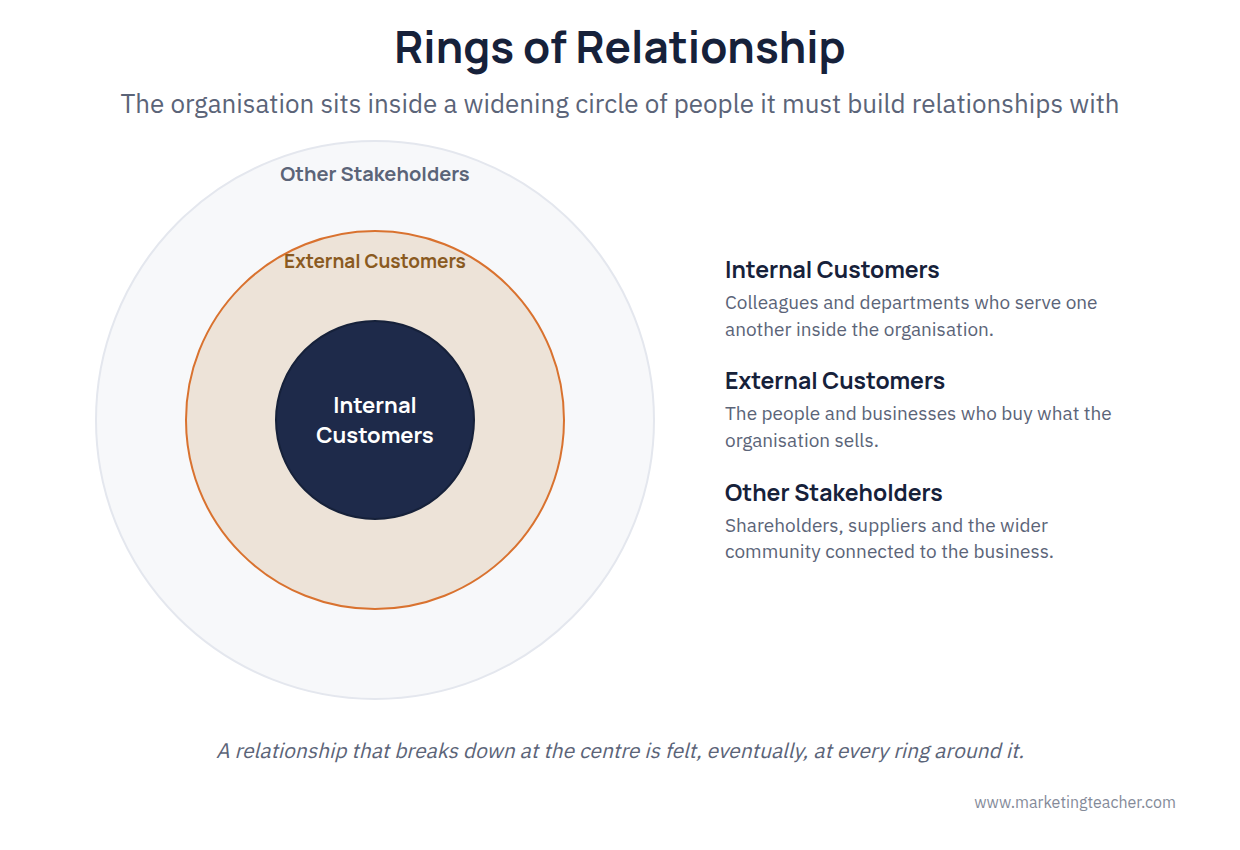
When people talk about “the customer,” they usually mean the person who pays for a product or service — but a business actually has to maintain relationships with several distinct groups at once, and treating them all the same is a common mistake. Freeman (1984) uses the term stakeholders for anyone with a genuine interest in an organisation’s success: not just paying customers, but employees, shareholders, suppliers and the wider community the business operates in. Maintaining a customer relationship in the fullest sense means paying attention to more than just the person handing over money.
Internal Customers
Internal customers are the colleagues and departments inside your own organisation who depend on each other to get work done. A warehouse team is, in effect, a customer of the goods-inward department; a customer service team is a customer of the product team that decides what actually gets sold. This idea connects directly to internal marketing: when employees are treated well and given what they need internally, that quality tends to flow through to how they treat external customers. A business that neglects its internal customers rarely manages to delight its external ones for long.
External Customers
External customers are the people and organisations outside the business who actually buy what it sells. This is the relationship most marketing activity is aimed at, and it is the one covered in detail in The Customer Relationship and Customer Relationship Management (CRM). External customers are not one uniform group either — some are new, some are loyal repeat buyers, and some are business customers rather than individual consumers, each requiring a slightly different relationship-building approach.
Other Stakeholders
Beyond internal and external customers sits a wider group Freeman (1984) calls other stakeholders: shareholders who have invested in the business, suppliers who depend on it for orders, and the local community that lives alongside its operations. These groups don’t buy the product, but a damaged relationship with any of them — an unhappy supplier, a community upset by a factory’s environmental record — can eventually damage the customer relationships a business cares about most directly.
Not All Customers Deserve Equal Attention
Maintaining every one of these relationships equally well, all the time, is rarely realistic — which is where the Pareto principle becomes useful. Named after the economist Vilfredo Pareto, it observes that a large share of outcomes often comes from a small share of causes — in a business context, this is frequently summarised as roughly 80% of profit coming from around 20% of customers. This does not mean the other 80% of customers should be ignored, but it does mean a business maintaining its customer relationships needs a clear sense of which relationships matter most, and needs to invest its limited time and attention accordingly.
Moving Customers Up, Not Just Keeping Them
Deciding which customers deserve the most attention is only half the job — the other half is having a plan for moving a given customer to a more valuable stage of the relationship. This is exactly what the Loyalty Ladder is designed to map: the stages a customer climbs from a first-time buyer through to a genuine advocate for the business. Read together, the Pareto principle tells a business roughly where its most valuable relationships already sit, and the Loyalty Ladder gives it a framework for helping more customers climb toward that position.
Rings of Relationship
The diagram above shows why these relationships are best thought of as rings rather than a simple list. The organisation sits at the centre, surrounded first by the internal customers who make it function, then the external customers it exists to serve, then the wider stakeholders connected to it. A problem at the centre — poor internal relationships — tends to ripple outward and eventually reach the customers a business cares about most.
Summary
A business maintains customer relationships with more than just the people who buy from it. Internal customers keep the organisation functioning day to day, external customers are the paying relationship most marketing is aimed at, and other stakeholders — shareholders, suppliers, the local community — sit further out but remain genuinely connected. Because not every relationship can receive equal attention, tools like the Pareto principle and the Loyalty Ladder help a business decide where to focus its limited effort for the greatest return.
The slides, worksheet, lesson plan and poster for this lesson are free to download and free to use in your course — no sign-up, no permission needed. See the teacher resources →
Assign this lesson to your class:
Using Canvas, Blackboard or Moodle? Copy the link and paste it into your course page or assignment. More ways to add lessons to your LMS.

