
What Does a Cash Flow Statement Actually Show?
A cash flow statement’s main purpose is to help a business owner plan and control the flow of money in and out of the business so that scheduled financial obligations — payroll, rent, loan repayments — can be met on time. It also helps lenders and investors judge a company’s financial health, because a business can be profitable on paper and still run out of cash if money coming in doesn’t arrive fast enough to cover money going out. This distinction matters directly for marketing decisions: a campaign that will clearly pay off in six months is still a bad idea to fund this month if it leaves the business unable to make payroll in the meantime. The cash flow statement’s basic structure — cash from operating activities, investing activities and financing activities — is set out in the international accounting standard that governs how these statements are prepared and presented (IFRS Foundation, 2024).
The Three Building Blocks: Inflows, Outflows, and the Running Balance
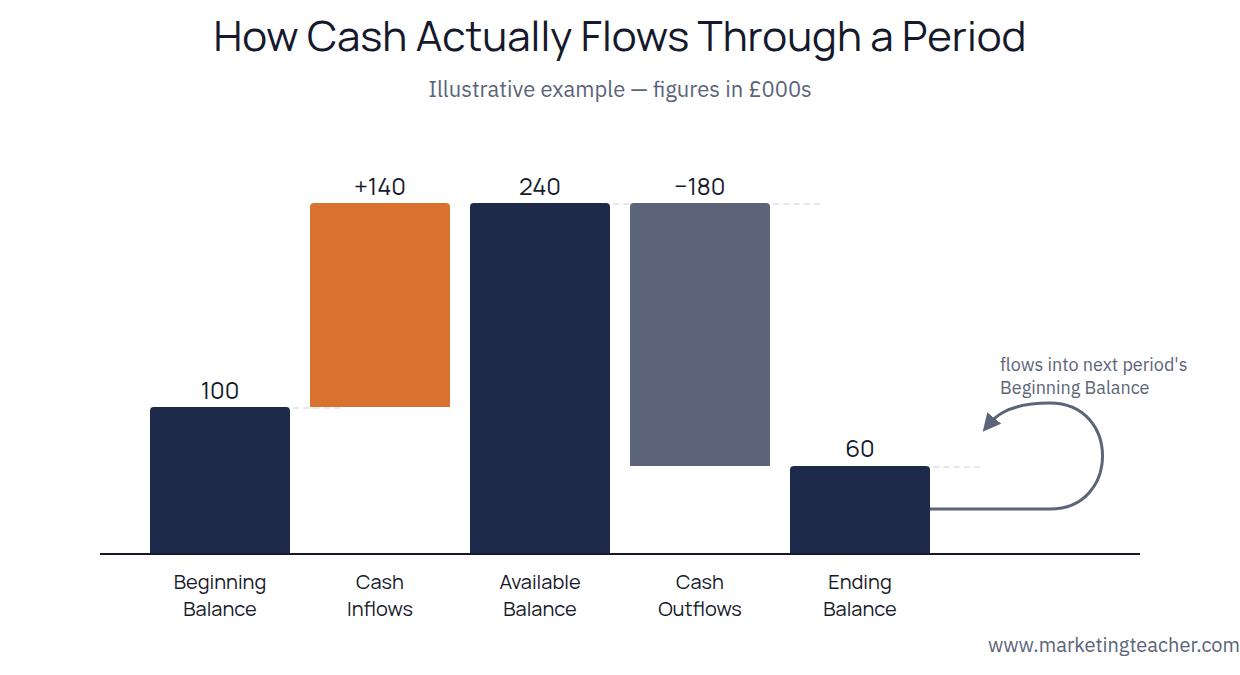
A cash flow statement works like a running ledger rather than a single snapshot. Each period starts with a beginning cash balance, carried over from the end of the previous period. Cash inflows — money actually received, such as customer payments, loan proceeds, or other receipts — are added to get an available cash balance. Cash outflows — every operating expense, from payroll and rent to advertising and supplies, plus other outflows like loan principal repayments or owner’s withdrawals — are then subtracted to arrive at the ending cash balance for that period. That ending balance becomes next period’s beginning balance, which is what makes the statement “flow” from one column to the next.
Not every figure in a cash flow statement is drawn from a completed transaction. A statement prepared in advance — a cash flow forecast — will unavoidably contain estimates and projections alongside actual recorded figures, and this is exactly what makes it useful: it’s one of the best tools available for forecasting a business’s working capital needs before a shortfall actually happens, rather than after.
| January | February | March | |
| Beginning Cash Balance | 15,000 | 20,548 | 22,296 |
| Total Cash Inflows | 185,955 | 180,955 | 185,955 |
| Available Cash Balance | 200,955 | 201,503 | 208,251 |
| Total Cash Outflows | 180,407 | 179,207 | 184,757 |
| Ending Cash Balance | 20,548 | 22,296 | 23,493 |
Where the Figures Come From
An accurate cash flow statement depends on good record keeping. The more the figures are drawn from actual recorded cash receipts and invoices — rather than guesswork — the more reliable the statement will be. Keeping ongoing records of income and expense accounts generates most of the raw figures a cash flow statement needs, which is also why a cash flow statement can’t really be prepared in isolation from a business’s other financial records, such as its balance sheet or profit and loss statement.
A Common Mistake: Confusing Cash Flow With Profit
It’s easy to assume a healthy profit and a healthy cash position are the same thing, but they often move independently, especially for a growing business. A marketing agency that lands a large new client might book substantial revenue and show a strong profit for the quarter, while still waiting 60 or 90 days for that client’s invoice to actually be paid — meanwhile payroll, rent and supplier bills are due on their usual schedule, in cash, regardless of when the client eventually settles up. This is exactly why a growing, profitable business can still run into a genuine cash crunch, and why the cash flow statement is worth watching as its own document rather than assuming the profit and loss statement already tells the full story.
Choosing the Right Time Horizon
Cash flow statements are built at different lengths depending on who’s using them and why. A new start-up will often project six months or a year ahead in monthly columns, then move to quarterly projections once it has more history to work from. Lenders and investors, by contrast, typically want to see a longer horizon — often five years — because it gives them a clearer sense of a company’s ongoing viability and its ability to repay a loan or deliver a return over time. Building the statement forces a business owner to think concretely about how future events, a big marketing push included, will affect its ability to meet obligations on schedule.
Summary
A cash flow statement follows a simple repeating structure — a beginning balance, cash inflows added to reach an available balance, cash outflows subtracted to reach an ending balance, which then carries forward as next period’s opening figure (IFRS Foundation, 2024). Built from real transaction records wherever possible, and extended with reasonable estimates where it can’t be, it gives a business owner and any marketer spending its money a forward-looking view of whether the timing of income and expenses will actually work, not just whether the business is profitable on paper.
The slides, worksheet, lesson plan and poster for this lesson are free to download and free to use in your course — no sign-up, no permission needed. See the teacher resources →
Assign this lesson to your class:
Using Canvas, Blackboard or Moodle? Copy the link and paste it into your course page or assignment. More ways to add lessons to your LMS.

