
Why Strategy Needs to Be Measured
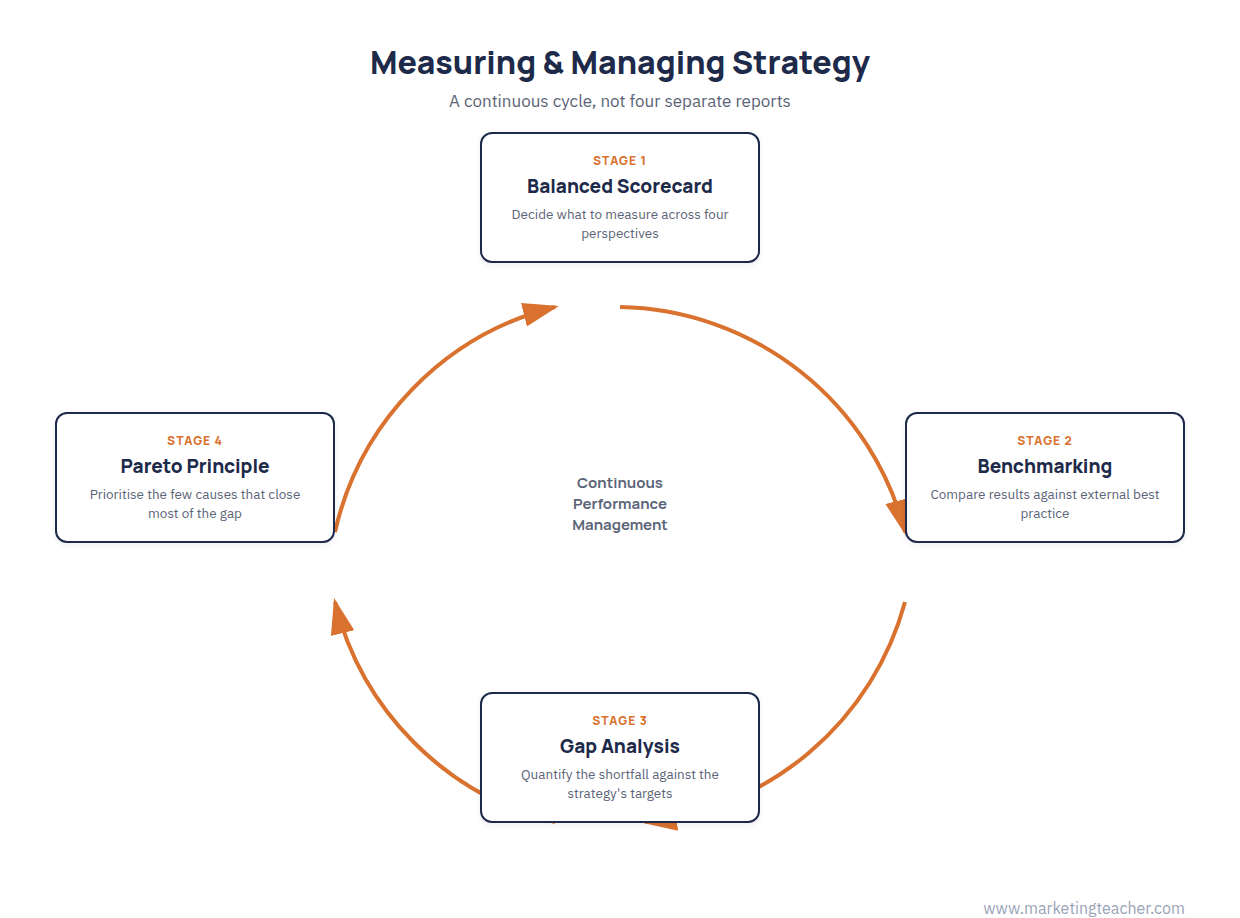
Choosing a strategy – through tools such as Five Forces Analysis, Generic Strategies, or the Boston Matrix – only answers part of the problem, since a strategy that looks sound on paper still has to be delivered, and delivery has to be checked. A family of measurement tools exists for exactly this purpose: the Balanced Scorecard sets out what to measure across the whole business, benchmarking supplies an external yardstick, gap analysis compares where the business actually is against where the strategy says it should be, and the Pareto principle helps managers prioritise which of many possible problems to fix first. Used together, they turn strategy from a one-off decision into something continuously measured and managed.
The Balanced Scorecard
Kaplan and Norton (1992) introduced the Balanced Scorecard in Harvard Business Review as a response to the way most businesses measured performance almost entirely through financial results, which arrive too late to guide day-to-day decisions. The scorecard tracks four linked perspectives: Financial (how the business looks to shareholders), Customer (how it looks to customers), Internal Process (which processes it must excel at), and Learning and Growth (whether it can keep improving and creating value). Because the four perspectives are linked, a scorecard makes it possible to see problems building in customer satisfaction or internal process quality well before they eventually show up in the financial numbers.
Benchmarking
Camp (1989) defined benchmarking as the continuous process of measuring products, services, and practices against the toughest competitors or the companies recognised as industry leaders. Benchmarking answers a question the Balanced Scorecard cannot answer on its own: a business can hit every internal target it sets itself and still be falling behind rivals who are improving faster. Comparing figures such as delivery times, defect rates, or customer satisfaction scores against named external benchmarks keeps a business’s own targets honest, rather than simply comfortable.
Gap Analysis
Gap analysis compares a business’s current trajectory against the level of performance its strategy requires, making visible what Ansoff (1965) called the planning gap in his foundational work on corporate strategy – the space between where existing activities are heading and where the business’s growth objectives say it needs to be. Plotting current performance and required performance on the same chart over time turns a vague sense that “things need to improve” into a specific, measurable shortfall, which is usually the first step toward deciding whether that gap should be closed through better execution of the current strategy or through a genuinely different one.
The Pareto Principle
The Pareto principle observes that a small proportion of causes is typically responsible for a large proportion of effects – commonly summarised as roughly 80% of results coming from around 20% of causes, though the exact split varies by situation. The underlying pattern was first observed by the economist Vilfredo Pareto in the distribution of wealth, but Juran (1951) is credited with popularising its use in business and quality management, applying it to separate the “vital few” causes of a problem from the “trivial many”. Once gap analysis has identified a shortfall, the Pareto principle helps decide which of the many possible causes to tackle first, so that limited management attention goes toward the handful of fixes likely to close most of the gap.
Comparing the Four Tools
Each tool answers a different question in the same overall task of managing strategy: the Balanced Scorecard asks what to measure, benchmarking asks how that compares to the outside world, gap analysis asks how far current performance is from the target, and the Pareto principle asks which causes to fix first. Used in sequence, they connect back to the tools used earlier in the strategy process – the targets built into a scorecard should reflect the choices made through Five Forces Analysis and Generic Strategies, and a widening gap is often the first sign that a portfolio or growth strategy needs to be revisited.
Using the Tools Together, Not in Isolation
A common mistake is treating these as four separate reporting exercises rather than one connected cycle. A Balanced Scorecard built without any external benchmarking can quietly reward a business for being the best version of an underperforming industry, since every internal target can be hit while competitors pull further ahead. A gap analysis run without the Pareto principle to follow it often produces a long list of contributing causes with no clear starting point, so the gap never actually closes because effort is spread too thinly across all of them at once. Running the cycle in order – decide what the scorecard should track, check it against benchmarks, quantify any resulting gap, then prioritise fixes with Pareto – keeps each tool honest by feeding directly into the next.
Summary
The Balanced Scorecard (Kaplan and Norton, 1992) tracks performance across financial, customer, internal process, and learning and growth perspectives. Benchmarking (Camp, 1989) compares that performance against external best practice. Gap analysis, building on Ansoff’s (1965) planning gap, quantifies the shortfall between current and required performance. The Pareto principle, popularised in business by Juran (1951), then helps prioritise which causes of that shortfall to address first. Together, these four tools turn strategy from a decision into something continuously measured and managed.
The slides, worksheet, lesson plan and poster for this lesson are free to download and free to use in your course — no sign-up, no permission needed. See the teacher resources →
Assign this lesson to your class:
Using Canvas, Blackboard or Moodle? Copy the link and paste it into your course page or assignment. More ways to add lessons to your LMS.

