
What Is the Marketing Research Process?
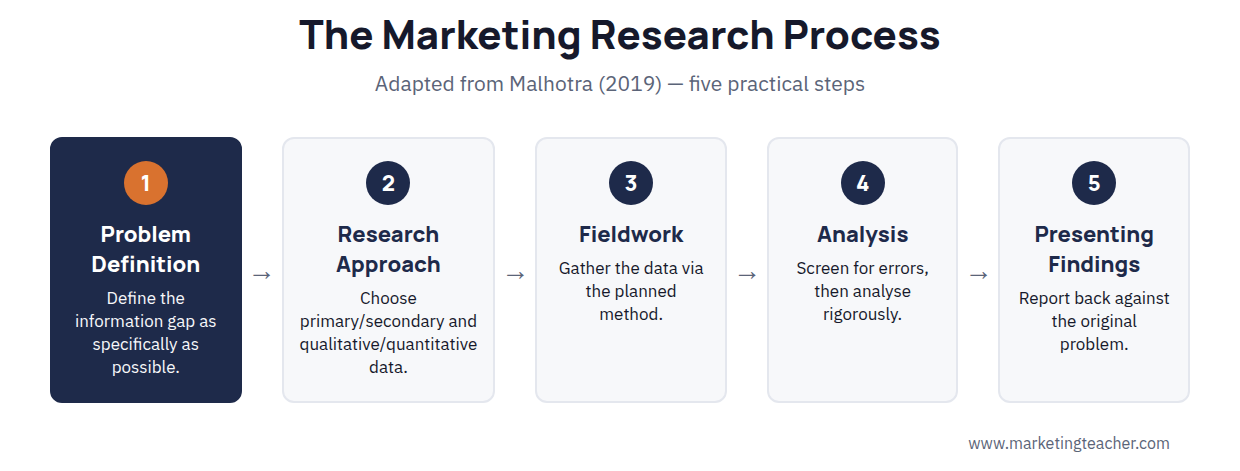
Marketing research rarely succeeds as a single activity; it works best as a structured sequence of steps, each building on the one before it. Malhotra’s (2019) widely used research process, commonly condensed for practical use into five stages, problem definition, developing the research approach, fieldwork, analysis, and presenting findings, gives researchers a reliable structure that keeps a project from drifting away from the original business question it was meant to answer.
Step 1: Problem Definition
The first and arguably most important step involves identifying an information gap and defining a research problem as specifically as possible (Malhotra, 2019). A vague problem, such as “find out why sales are falling,” produces vague, hard-to-act-on research; a well-defined problem, such as “determine whether declining repeat purchase among customers aged 25 to 34 is driven by price, product quality, or a competitor’s new offering,” gives every later step something concrete to work toward. Time spent sharpening the problem definition is rarely wasted, since a poorly defined problem cannot be rescued by good fieldwork or clever analysis later on.
Step 2: Developing the Research Approach
This step involves identifying the types of information needed, where it will come from, and an action plan for gathering it. Information generally falls into two categories: primary data, gathered for the first time for this specific purpose, such as interviews or surveys, and secondary data, already gathered for another purpose, such as government reports, newspaper articles or existing databases. Data sources are further categorised as qualitative, difficult to measure numerically but rich in depth and context, or quantitative, numerical and suited to statistical analysis. Choosing the right mix of primary and secondary, qualitative and quantitative data at this stage shapes everything the research can credibly conclude later.
Step 3: Conducting Fieldwork
Fieldwork is the generic term for the actions taken to gather the data the research approach called for, following a planned approach that results in a body of information suitable for further analysis (Malhotra, 2019). This information is typically stored as written documents, audio-visual recordings, or structured computer databases, depending on the method chosen. Fieldwork quality depends heavily on how carefully the previous step was planned: interviewers need clear guidance, survey questions need to be piloted before wide release, and secondary sources need to be checked for how current and relevant they still are.
Step 4: Analysis
Once the required data is collected, it must be analysed carefully to produce accurate and reliable results. Data is first screened for errors made during collection, ranging from simple recording mistakes to more serious sampling problems, before deeper analysis begins. Qualitative data is typically assessed for its primary themes, requiring the researcher to become genuinely familiar with the material and organise it into meaningful categories, usually presented alongside representative quotes. Quantitative data is analysed using statistical techniques that reveal differences between respondent groups, relationships between variables, and the frequency of particular responses, always with an eye on what the client actually needs to know and the time and budget available to find out.
Step 5: Presenting Findings
The final step involves presenting the findings to the client or management team in a form they can actually use, typically combining a written report with an oral presentation and supporting visual data such as charts and tables. A technically excellent piece of research that is poorly presented, buried in jargon, disorganised, or disconnected from the original business problem defined in step one, can fail to influence a single decision. Bringing the presentation back explicitly to the problem the research was commissioned to answer is what turns analysis into a genuinely useful business recommendation, rather than a report that gets filed away and never actually shapes a decision.
Why the Sequence Matters
It can be tempting to skip ahead, jumping straight to fieldwork before the research approach is properly developed, or rushing analysis to meet a deadline, but each step exists because the one before it is rarely sufficient on its own. A survey launched before the research approach has properly identified whether qualitative or quantitative data is actually needed often collects the wrong kind of information entirely, wasting the fieldwork budget on data that cannot answer the original problem. Following the sequence in order, and being willing to revisit an earlier step when something does not add up, costs less time overall than discovering a fundamental gap only once the findings are already being presented to the client.
Summary
Malhotra’s (2019) marketing research process, commonly used in a condensed five-step form, moves from a carefully defined problem through choosing the right research approach, gathering data in the field, analysing it rigorously, and finally presenting findings in a way the client can act on. Each step depends on the quality of the one before it, which is why experienced researchers invest real time in defining the problem clearly before any data is ever collected.
The slides, worksheet, lesson plan and poster for this lesson are free to download and free to use in your course — no sign-up, no permission needed. See the teacher resources →
Assign this lesson to your class:
Using Canvas, Blackboard or Moodle? Copy the link and paste it into your course page or assignment. More ways to add lessons to your LMS.

