
What Is Customer Information, and How Is It Different from Data?
Businesses succeed by satisfying customer needs and wants, and that starts with finding out what those needs and wants actually are. Data and information aren’t quite the same thing, though the words are often used interchangeably. Data is a raw fact or statistic on its own — the number 7 by itself means nothing in particular. Once that number gains context, it becomes information: 7°C, or seven visits this month, or a satisfaction score of 7 out of 10. Collecting customer data is only the first step; turning it into information that actually says something is what makes it useful.
Internal and External Sources
Internal data relates to the inside of the business itself — the number of employees, which products are in stock, monthly sales figures, or the state of the cash flow. It’s usually the cheapest and quickest place to start, since it already exists somewhere in the company’s own systems (Kotler & Armstrong, 2018). External data comes from outside the business: competitor pricing, the size and demographics of a market segment, or the average age and income of a target group. Working out whether a question can be answered from the company’s own records, or needs a look outside it, is usually the first decision in any customer-information project. A business that skips straight to expensive external research, without first checking what it already knows internally, often ends up paying to rediscover something its own sales records could have shown for free.
Once internal sources are exhausted, external information is gathered through primary research (collected fresh for the problem at hand) or secondary research (data that already exists, collected for another purpose) — both covered in detail elsewhere on this site, since the same primary/secondary distinction applies to customer information as to marketing research generally.
From Data to Action
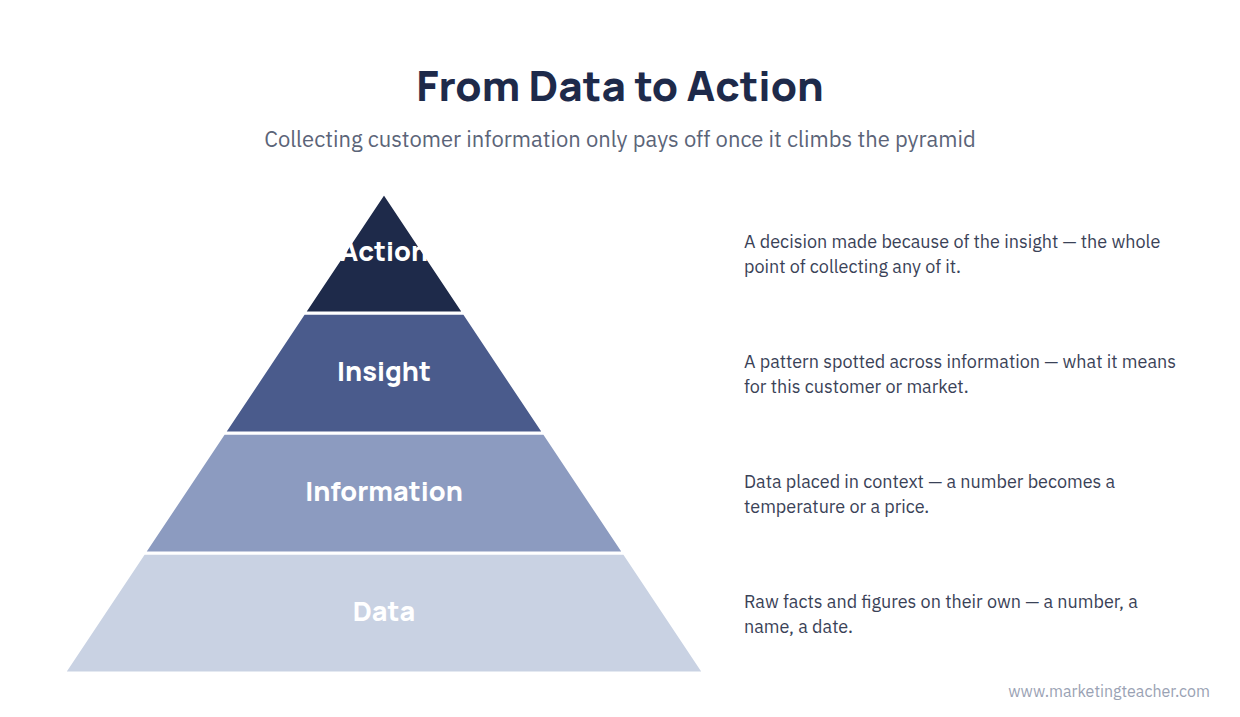
Collecting customer information is never the end goal — it’s a means to a decision. Raw data on its own sits at the bottom of the pyramid: a name, a purchase date, a number. Once it’s placed in context, it becomes information. Once several pieces of information reveal a pattern, that’s an insight — something the business didn’t know before about how a customer or a market segment behaves. And an insight is only worth having if it leads to action: a new product, a different price, a changed message. A business that collects mountains of customer data but never climbs the pyramid to actually decide anything has wasted the entire effort. It’s a useful check to run on any data-collection project before it starts: if the answer to “what decision would this actually change?” is nothing, the data probably isn’t worth collecting in the first place.
Collecting Customer Information Responsibly
Marketing research and customer data collection benefit both the business and its customers when they’re done well — better products, more relevant offers, stronger relationships (Kotler & Armstrong, 2018). But the same data that makes marketing more useful can also make customers uneasy if it’s collected or used carelessly. Many people worry that companies are quietly building detailed profiles of their habits, tracking their browsing, or drawing conclusions about their lives from purchase patterns alone (Kotler & Armstrong, 2018). A business that infers something a customer hasn’t chosen to share — and then acts on it visibly, such as through an oddly specific advert or a mistimed offer — risks turning a useful insight into a genuine trust problem, however accurate the underlying data was.
There’s rarely a single clean rule for where the line sits, but a few habits help keep data collection on the right side of it: being transparent with customers about what’s collected and why, using information to serve the customer better rather than simply to extract more from them, and being cautious about acting on inferences the customer never actually stated. Getting this balance right protects the long-term customer relationship that the data was meant to strengthen in the first place. Data collected once for a specific, disclosed purpose and then reused for something entirely different is one of the fastest ways to erode that trust, even when nothing about the individual pieces of data was ever technically inaccurate.
Summary
Customer information starts as raw data and only becomes useful once it’s placed in context. Internal sources are usually the cheapest place to start, with external primary and secondary research filling the gaps (Kotler & Armstrong, 2018). Turning data into information, insight, and action is what makes the whole exercise worthwhile — and doing it in a way customers are comfortable with is what keeps the relationship, and the data supply, alive.
The slides, worksheet, lesson plan and poster for this lesson are free to download and free to use in your course — no sign-up, no permission needed. See the teacher resources →
Assign this lesson to your class:
Using Canvas, Blackboard or Moodle? Copy the link and paste it into your course page or assignment. More ways to add lessons to your LMS.

