
What Does “ChatGPT Analytics” Actually Mean?
ChatGPT analytics doesn’t mean the tool crunches numbers on its own — it means using a generative AI tool as an assistant inside the analytics process: summarising survey comments, drafting a first-pass interpretation of a dataset, or turning a spreadsheet of results into a readable report faster than writing one from scratch. Davenport et al. (2020) describe this as the “thinking” side of AI in marketing — automating data-heavy analytical tasks — working alongside, not replacing, human marketing judgement.
What Generative AI Actually Speeds Up
The clearest wins show up in tasks that are language-heavy and repetitive: reading through hundreds of open-ended survey responses and grouping them into themes, turning a table of campaign metrics into a plain-English summary a non-analyst can act on, or drafting the first version of a quarterly report that a marketer then edits rather than writes from a blank page. Grewal et al. (2024) frame generative AI’s growing role in marketing this way — augmenting a marketer’s output on tasks like this, rather than taking over the underlying analytical decisions.
The Workflow That Actually Works
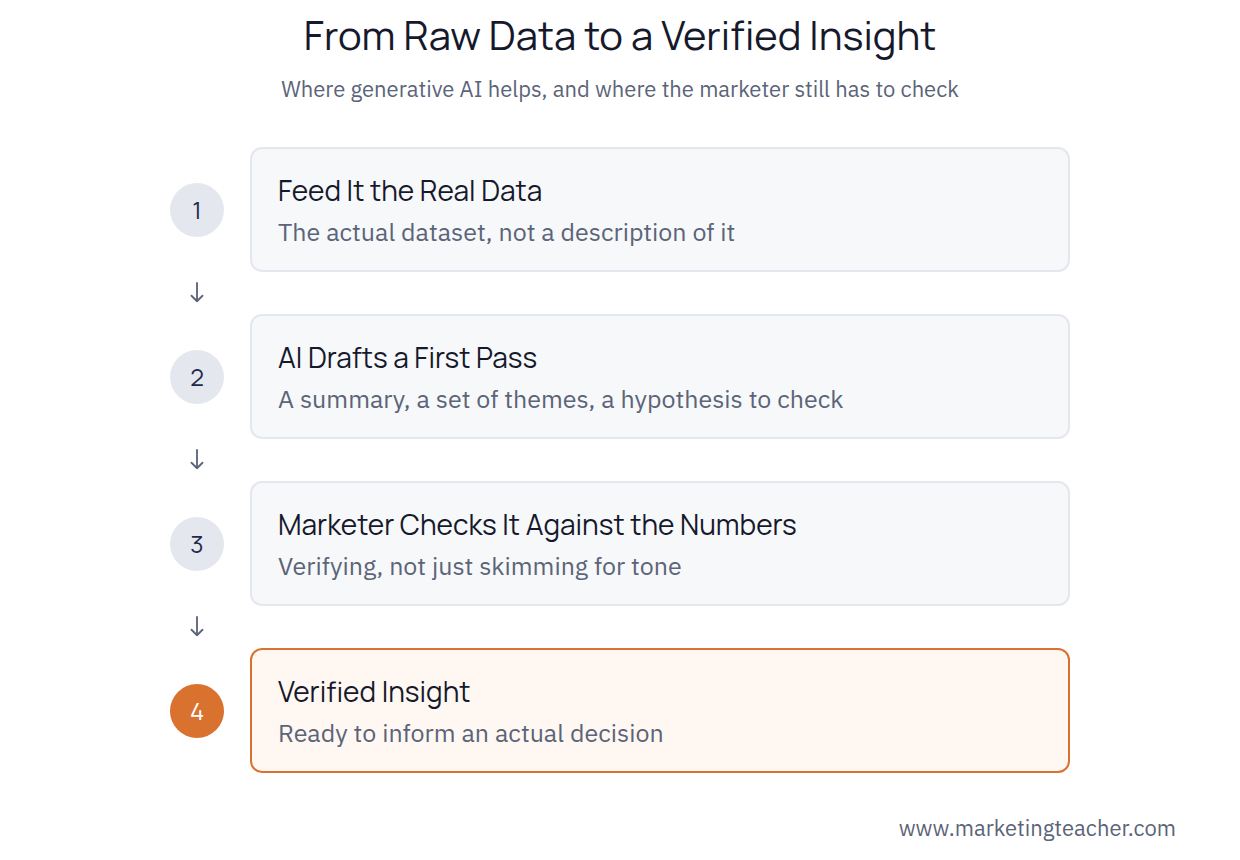
The diagram above sets out the pattern that keeps generative AI useful rather than risky: feed it the real data (not a vague description of it), let it draft a first-pass summary or set of hypotheses, and then have a marketer check that draft against the actual numbers before it goes anywhere near a real decision. Skipping that last step is where things go wrong — a generative AI tool will confidently produce a fluent, plausible-sounding summary even when it has misread or invented a detail, and a marketer who doesn’t check it against the source data has no way to catch that before it reaches a client or a boardroom.
Where the Judgement Still Has to Be Human
A generative AI tool has no way to know whether a pattern in the data is meaningful or coincidental, no accountability for a decision made on a summary it wrote, and no context for facts that live outside the dataset it was given — a sudden dip in engagement might be a real problem, or it might be a public holiday the tool has no way to know about. Choosing which questions are worth asking of the data in the first place, deciding what a finding actually means for strategy, and taking responsibility for the recommendation that follows all remain squarely the marketer’s job.
A Few Practical Guardrails
Treat anything a generative AI tool produces as a draft, not a finished answer — verify specific numbers against the source data before repeating them anywhere. Give it the actual data rather than a paraphrased description of it, since a tool working from a vague summary of a dataset will produce a vague and unreliable analysis of it. And keep a record of which reported figures came from a human calculation versus an AI-drafted summary, so that if a number is later questioned, its origin can be traced and rechecked.
The Risk of “Confident but Wrong”
The specific failure mode worth watching for is fluent confidence, not obvious error. A generative AI tool rarely responds with a hedge or a shrug — it produces a complete, well-formatted answer whether or not the underlying data actually supports it, which makes a wrong summary look exactly as trustworthy as a correct one at first glance. This is a different risk from the errors marketers are used to catching, like a broken formula in a spreadsheet that throws an obviously wrong number. A fabricated or misread detail buried inside otherwise-accurate prose is much easier to miss, which is precisely why the verification step in the workflow above isn’t optional.
Summary
“ChatGPT analytics” is less about the tool doing analysis on its own and more about using generative AI to speed up the language-heavy work inside the analytics process — summarising feedback, drafting reports, sorting responses into themes. Davenport et al. (2020) and Grewal et al. (2024) both frame this as augmenting a marketer’s analytical work rather than replacing it. The workflow that keeps this safe is straightforward: feed the tool real data, treat its output as a first draft, and have a marketer verify it against the numbers before it informs any real decision — because the judgement calls about what a finding means, and who’s accountable for acting on it, remain a human responsibility.
The slides, worksheet, lesson plan and poster for this lesson are free to download and free to use in your course — no sign-up, no permission needed. See the teacher resources →
Assign this lesson to your class:
Using Canvas, Blackboard or Moodle? Copy the link and paste it into your course page or assignment. More ways to add lessons to your LMS.

