
Learning Outcome: By the end of this lesson, you will be able to explain how marketing on X (formerly Twitter) differs from other social platforms, describe the mix of content that drives engagement there, and apply the platform’s strengths to a realistic brand scenario.
This lesson is part of our Foundations of Social Media Marketing course. Study the full course and earn a certificate →
What Is X (Twitter) Marketing?
X, the platform long known as Twitter before its 2023 rebrand, is a real-time, text-first network built around short public posts, replies, and reposts. Where other platforms reward polished visuals, X rewards timeliness and voice: brands use it to share news, join live conversations, handle customer service in public view, and respond to culture as it happens. Santini et al. (2020), in a meta-analysis of 97 studies on social media customer engagement published in the Journal of the Academy of Marketing Science, found that satisfaction is a substantially stronger driver of engagement on Twitter/X than on Facebook or blogs – roughly twice as likely to translate into positive emotion and engagement. That makes the platform unusually well suited to a brand that gets its tone and responsiveness right, and unusually risky for one that doesn’t.
Why Customer Service Matters More Here Than Elsewhere
Read et al. (2019), writing in the European Journal of Marketing, developed and tested a framework of consumer engagement specifically on Twitter and found that brand customer service and brand intimacy were the two strongest drivers of engagement, and that engagement in turn predicted a consumer’s willingness to co-promote the brand to others. In practice, this means a brand’s replies – not just its original posts – are doing real marketing work. A quick, genuinely helpful public reply to a complaint is visible to everyone who sees the thread, not just the original poster, which is why many brands treat their X account as a frontline support channel as much as a broadcast one.
Building a Content Mix That Actually Gets Engagement
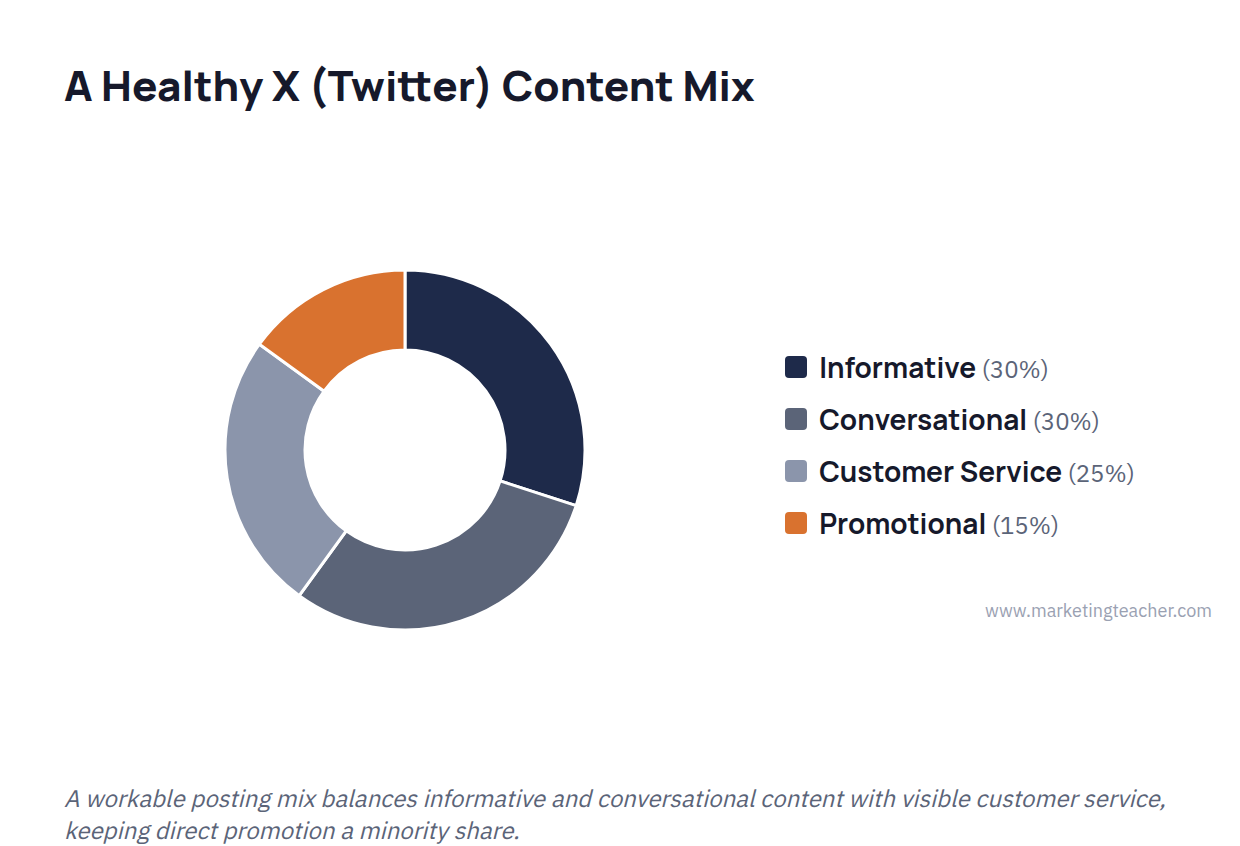
Not every type of post performs the same way. Diwanji et al. (2024), in the Journal of Current Issues & Research in Advertising, compared consumer-generated content against brand-generated advertising on X and found that richer, more authentic formats consistently outperformed straightforward promotional posts in shaping consumer decisions. A workable content mix typically blends four roles: informative posts (product updates, useful facts), conversational posts (questions, polls, replies to trends), customer-service replies, and a small share of direct promotion – kept deliberately light, since an account that only sells rarely earns the following it needs to be heard when it does.
Example: Harrowgate Coffee Roasters Turns a Complaint Into a Following
The fictional independent roaster Harrowgate Coffee Roasters had just 1,400 followers on X when a customer publicly posted that a delivery had arrived with a broken bag seal. Rather than moving the conversation to a private message immediately, Harrowgate replied openly within twenty minutes, apologised, and confirmed a replacement was on its way – then followed up publicly once the customer confirmed it had arrived. The exchange was reposted by three unrelated accounts as an example of good service, and Harrowgate’s follower count grew by around 9% over the following month, well above its usual pace. No advertising spend was involved; the entire gain came from a single well-handled public reply.
What Doesn’t Travel Well on X
Long-form storytelling and heavily produced video generally underperform here relative to Instagram or TikTok – the platform’s character limits and fast-scrolling feed favour a single sharp idea over an elaborate one. Overtly promotional posts with no conversational hook also tend to get buried by the algorithm’s preference for reply-driving content. Brands new to the platform often make the mistake of treating it as a one-way broadcast channel, posting announcements and little else; the research above suggests that engagement, not reach alone, is what X’s algorithm and audience actually reward.
Choosing a Realistic Posting Cadence
Because X rewards timeliness, brands often assume more frequent posting is always better, but the research above points to a more nuanced picture: engagement quality, not raw post volume, is what predicts real outcomes such as follower growth and co-promotion intent. A small business without a dedicated social media team is usually better served by posting less often but replying more consistently, since Read et al. (2019) found engagement driven through replies and customer service carries real downstream value, while a high-volume but low-response account rarely builds the same intimacy. Setting a realistic cadence – even a handful of well-considered posts and prompt replies each week – tends to outperform sporadic bursts of high-volume posting followed by silence.
A Note on the Rebrand
The platform’s name change from Twitter to X in 2023 was a significant enough shift that some of the terminology in older marketing guides is now dated – “tweets” are officially called “posts,” and the bird logo has been retired. The underlying mechanics of what makes content succeed there, however, have stayed remarkably stable across the rebrand: real-time relevance, a distinct voice, and genuine responsiveness to the audience.
Summary
Marketing on X depends on timeliness, voice, and visible responsiveness rather than production value. Customer service replies are themselves a form of marketing, since they’re public and can shape how an entire audience perceives a brand, not just the person being replied to. A healthy content mix balances informative, conversational, service, and promotional posts, with promotion kept to a minority share. The platform rewards brands that show up as a real, responsive presence rather than a broadcast feed.
Key Idea: On X, a brand’s replies are marketing too – a fast, genuine public response to a customer can do more for engagement and reputation than a week of scheduled promotional posts.
More in this series: Marketing on the social platforms
Facebook Marketing · Instagram Marketing · Twitter Marketing · TikTok Marketing · Snapchat Marketing · Influencer Marketing · Social Networks
Teaching this topic?
The slides, worksheet, lesson plan and poster for this lesson are free to download and free to use in your course — no sign-up, no permission needed. See the teacher resources →
Assign this lesson to your class:
Using Canvas, Blackboard or Moodle? Copy the link and paste it into your course page or assignment. More ways to add lessons to your LMS.
Written by Marketing Teacher.
Online course · certificate on completion
Study the full Social Media Marketing course — and earn a certificate
Eleven modules on strategy, content, community, advertising and measurement, written at Level 4, with a short quiz after each.

