
What Is Secondary Marketing Research?
Secondary data is information that already exists somewhere, having been collected for another purpose (Kotler & Armstrong, 2018). It’s sometimes called desk research, because it can often be gathered without leaving the office. Compared with primary research, which is collected fresh for the specific problem at hand, secondary research is usually quicker and cheaper — which is why researchers almost always start there before commissioning anything new. A gap in the existing data, once secondary sources have been checked properly, is usually the clearest signal that a new piece of primary research is actually worth the time and cost.
Where Secondary Data Comes From
The company’s own internal database is usually the best starting point. Kotler and Armstrong (2018) describe how a business can build a rich internal database from its own marketing department (customer characteristics, sales transactions, website visits), its customer service records, its accounting department, and even its sales force’s reports on competitor activity. This internal data can be accessed quickly and cheaply, though it’s often collected for some other purpose and can be incomplete or in the wrong form for a new marketing question. Keeping an internal database current also takes real ongoing effort, since data collected for one campaign or one financial year can go stale quickly once circumstances change.
Beyond the company’s own records, a wide range of external sources exists:
- Trade associations and professional institutes
- National and local press, and industry magazines
- National and international government statistics and census data
- Company websites and published company accounts
- Business libraries and trade directories
- Commercial data suppliers and general online databases
- Informal contacts within an industry
Companies can also buy secondary data outright. Kotler and Armstrong (2018) point to firms that specialise in exactly this: consumer panel data on purchasing habits and brand loyalty, retail audit data on market shares and shelf prices, and syndicated studies covering social and lifestyle trends. Commercial online databases and general internet search engines can also turn up useful secondary sources quickly, though a broad search can return millions of results that take real effort to sift through. Government and industry-association sources are usually worth checking first, since they’re normally free and tend to be more consistently reliable than an unfiltered general search.
Four Tests Before You Trust It
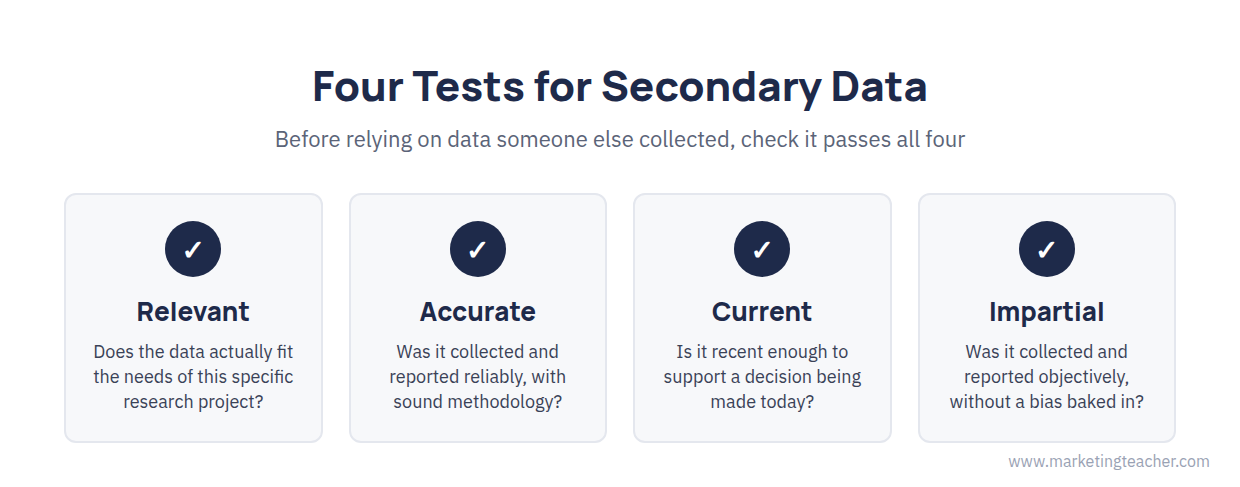
Secondary data is rarely a perfect fit for a new problem, since it was collected with a different question in mind — so before relying on it, Kotler and Armstrong (2018) suggest checking it against four tests. Is it relevant — does it actually fit the needs of this project, not just a similar-sounding one? Is it accurate — was it collected and reported reliably? Is it current — recent enough to support a decision being made today, rather than describing a market that’s since moved on? And is it impartial — collected and reported objectively, without an agenda shaping the numbers? Data that already exists comparing pension savings across two different countries, for instance, might fail the relevance test outright if the two systems aren’t really comparable, however accurate each country’s own figures are. All four tests matter together: data that’s accurate and current but irrelevant to the actual decision is no more useful than data that’s perfectly relevant but hopelessly out of date.
Secondary Data’s Real Advantage — and Its Limit
The appeal of secondary data is straightforward: it’s usually available faster and at a lower cost than commissioning new research, and some information — detailed national statistics, for example — would be far too expensive for any single company to collect on its own (Kotler & Armstrong, 2018). Its limit is just as straightforward: a business can rarely get everything it needs from data someone else already collected. When the four tests above turn up gaps, or the fit still isn’t close enough, that’s the signal to move on to primary research designed specifically around the problem at hand.
Summary
Secondary marketing research uses data that already exists, collected for another purpose, drawn from a company’s own internal records or from a wide range of external sources (Kotler & Armstrong, 2018). It’s cheaper and quicker than primary research, but it needs checking against four tests — relevant, accurate, current, and impartial — before it’s trusted, and any real gaps it leaves are exactly what primary research is for.
The slides, worksheet, lesson plan and poster for this lesson are free to download and free to use in your course — no sign-up, no permission needed. See the teacher resources →
Assign this lesson to your class:
Using Canvas, Blackboard or Moodle? Copy the link and paste it into your course page or assignment. More ways to add lessons to your LMS.

