
What Is Primary Marketing Research?
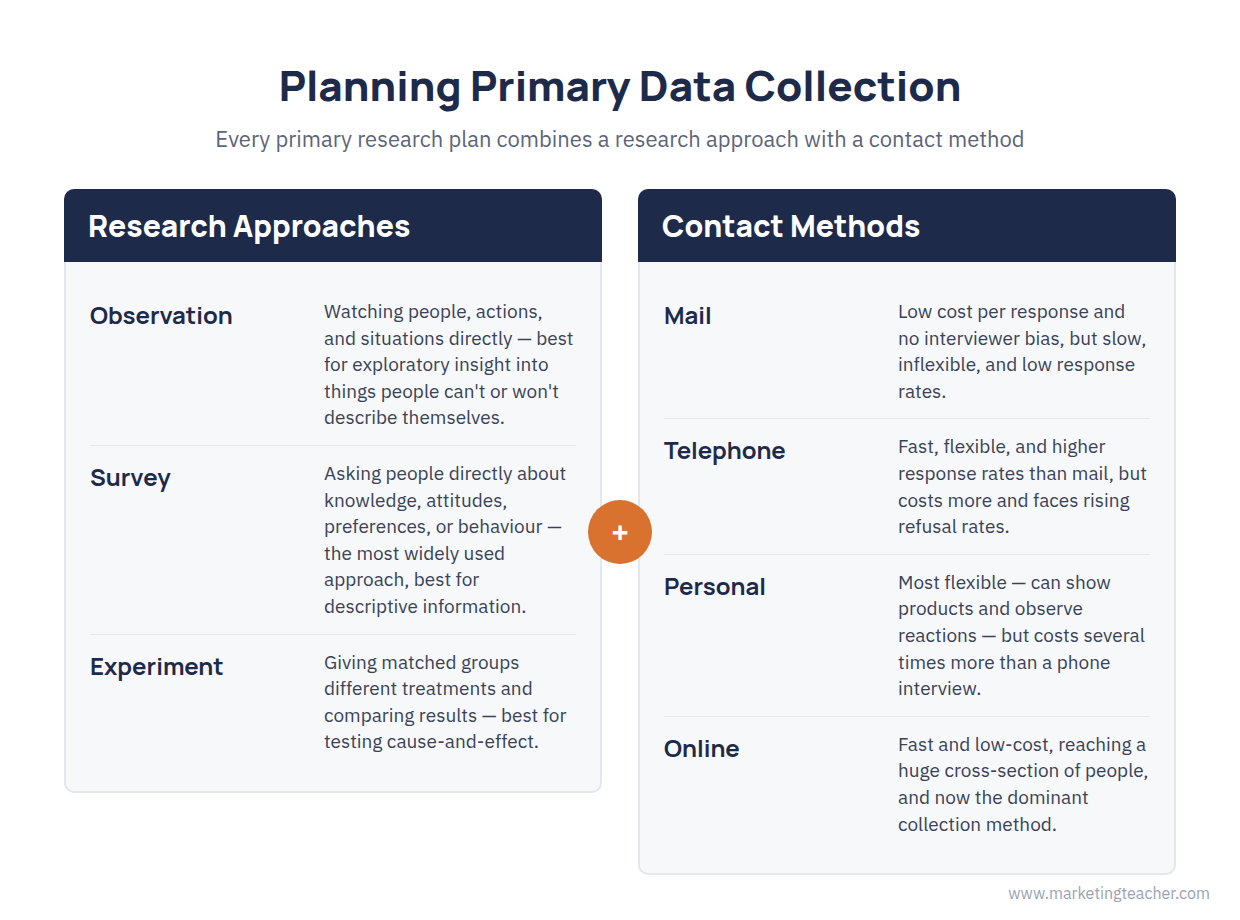
Primary data is information collected fresh, specifically to solve the problem at hand, as opposed to secondary data, which already exists somewhere because it was collected for another purpose (Kotler & Armstrong, 2018). Most researchers check secondary sources first, since they’re cheaper and faster to gather. Primary marketing research only gets commissioned once those existing sources leave a real gap — a question specific enough to this business, this product, or these customers that nobody else has already answered it. Collecting primary data well means making two separate decisions: which research approach will generate the right kind of information, and which contact method will actually reach the people being studied.
Three Research Approaches
Kotler and Armstrong (2018) set out three broad approaches to primary data collection, each suited to a different kind of question. Observational research means watching people, actions, and situations directly, rather than asking about them. It’s best suited to exploratory research, and it can surface details that people are unwilling or unable to put into words themselves — unconscious habits, for instance, or a reaction nobody thought to mention in a survey. Its limits are real, though: attitudes, motives, and private behaviour generally can’t be observed at all, and long or infrequent behaviours are hard to capture.
Survey research is the most widely used approach, and the one best suited to descriptive information — what people know, prefer, or intend to buy. Its main strength is flexibility: a survey can be run by phone, by mail, online, or in person, and can ask about almost any marketing question. Its weakness is that people don’t always give reliable answers: some can’t remember what they actually did, some won’t discuss things they consider private, and some just want to sound informed or helpful rather than accurate.
Experimental research is best suited to testing cause and effect. It involves giving matched groups of subjects different treatments, controlling for other factors, and comparing the results (Kotler & Armstrong, 2018). A regional restaurant chain trialling two different prices for a new menu item in two similar towns, then comparing sales, is running a simple experiment: if everything else about the two towns and the marketing is the same, any difference in sales can be attributed to the price.
Four Contact Methods
Once the approach is chosen, the plan still needs a way to actually reach respondents. Kotler and Armstrong (2018) group these into four contact methods. Mail questionnaires are cheap per response and free of interviewer bias, since there’s no interviewer present to influence the answer, but they’re slow, rigid (the question order can’t adapt), and suffer from low response rates. Telephone interviewing is faster and more flexible — an interviewer can explain a confusing question or probe an interesting answer — and gets better response rates than mail, but it costs more per response, introduces interviewer bias, and is running into rising refusal rates as fewer people answer calls from unknown numbers.
Personal interviewing is the most flexible method of all: an interviewer can show a product, a package, or an advert and watch the reaction directly, not just record an answer. Personal interviews can be one-to-one, or run as focus groups, where a trained moderator guides a small group through a discussion while researchers observe. Focus groups are especially good at surfacing the feelings and motivations behind an answer, not just the answer itself, but a handful of participants can never be assumed to represent a wider market, and people in a group setting sometimes shade their answers toward what sounds acceptable to say out loud. Personal interviewing overall costs several times more than a phone interview.
Online research is now the dominant contact method, covering internet and mobile surveys, online focus groups, and tracking how visitors actually move through a website (Kotler & Armstrong, 2018). It shares survey research’s flexibility while adding real advantages of its own: a questionnaire can reach thousands of people at once by email or social media, responses arrive almost instantly, and there’s no postage, phone, or interviewer cost to pay. As response rates for traditional phone and mail approaches have declined, online research has become the natural first choice for most quantitative studies.
Choosing an Approach and a Contact Method
There’s no single “best” combination — each approach and each contact method trades cost against depth, speed against flexibility. A quick, low-cost read on a large number of people points toward a survey delivered online; a rich, qualitative understanding of why customers feel a certain way points toward personal interviews or a focus group, even though both cost more per respondent and can’t be generalised to the whole market with much confidence. Many real research plans, like Northfield’s, blend more than one approach and more than one contact method in a single project, using each to cover the other’s weak points.
Summary
Primary data is collected fresh to answer a specific problem, once secondary sources have been checked and a real gap remains (Kotler & Armstrong, 2018). Three research approaches — observation, survey, and experiment — suit different kinds of question, and four contact methods — mail, telephone, personal, and online — suit different budgets and levels of detail. A strong marketing research process picks the combination that fits the problem, rather than defaulting to whichever method is most familiar.
The slides, worksheet, lesson plan and poster for this lesson are free to download and free to use in your course — no sign-up, no permission needed. See the teacher resources →
Assign this lesson to your class:
Using Canvas, Blackboard or Moodle? Copy the link and paste it into your course page or assignment. More ways to add lessons to your LMS.

