
What Are Core Competences?
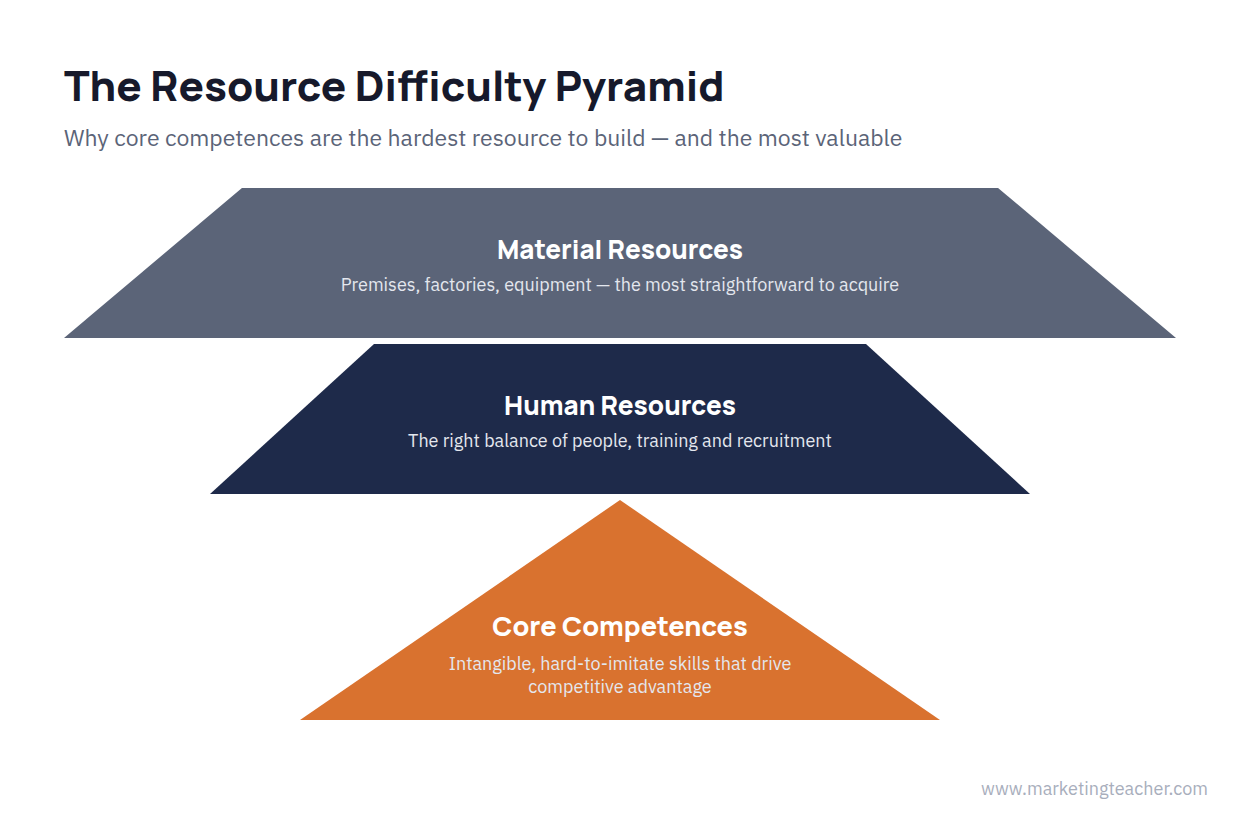
A core competence is a specific, hard-to-copy combination of skills and production knowledge that lets an organisation deliver a distinctive benefit to customers across more than one market. Prahalad and Hamel (1990) introduced the concept using companies such as NEC, Honda and Canon, arguing that a company’s long-term competitiveness comes less from any single product and more from the underlying competences that let it keep generating new products. Honda’s expertise in small engines, for example, let it move from motorcycles into cars, lawnmowers and generators, because the same underlying skill kept unlocking new markets rather than being tied to one product line.
Core Competences Versus Resources
It is easy to mistake a scarce resource, such as a prime retail location or a long-term supply contract, for a core competence. The resource-based view of the firm, formalised by Barney (1991), helps separate the two: a resource or capability only becomes a true source of sustained advantage if it is valuable, rare, hard to imitate and hard to substitute. A resource that fails one of those conditions might still help a business reach a basic competitive threshold, but it will not be a core competence. Threshold resources and competences keep an organisation in the game; core competences are what let it win.
The Three Tests of a Core Competence
Prahalad and Hamel (1990) set out three tests that a skill or technology must pass to count as a genuine core competence. First, it should provide potential access to a wide variety of markets, rather than being useful in only one narrow product line. Second, it should make a significant contribution to the customer benefits that end users actually perceive and value, not just an internal efficiency the customer never notices. Third, it should be difficult for competitors to imitate, whether because it rests on tacit knowledge, years of accumulated learning, or a particular combination of technologies that is hard to replicate as a whole.
Core Competences and Competitive Advantage
Stalk, Evans and Shulman (1992) offered a related but distinct view, arguing that competitive advantage increasingly comes from a company’s broader organisational capabilities, such as speed and responsiveness across its whole value chain, rather than from competence in any single product technology. The two ideas are complementary rather than competing: core competences tend to focus on deep technical or production skill behind a product, while capabilities describe how well an organisation’s processes and people convert that skill into results in the market. A business can have a strong core competence and still lose ground if its organisational capabilities, such as how quickly it turns that competence into new products, are weak.
Building a Core Competence Deliberately
Because a core competence rests on harmonising several streams of technology and organisational learning rather than on a single skill, it is rarely built by one department alone. Prahalad and Hamel (1990) described this as integration across business units: a competence in miniaturisation, for instance, only becomes a genuine core competence once research, manufacturing and product design teams across several divisions are all contributing to and drawing on the same underlying knowledge, rather than each division developing its own separate version. Organisations that structure themselves around rigid, siloed product divisions often struggle to build core competences for exactly this reason, since the investment and learning needed span far more than any one division’s own budget or roadmap.
The Risk of Focusing Too Narrowly
Because core competences take years to build, organisations can become over-attached to them even after the market shifts in a direction the competence no longer serves well. A manufacturer whose core competence is built around one specific material or process can find that same competence becomes a liability once customers move toward a different underlying technology, since the skills, equipment and organisational habits built around the old approach all resist the change. Recognising this risk does not mean abandoning a hard-won competence at the first sign of change; it means periodically testing whether the competence still passes all three of Prahalad and Hamel’s (1990) tests, rather than assuming past success guarantees future relevance.
Summary
Core competences are the specific combinations of skill and production knowledge that pass Prahalad and Hamel’s (1990) three tests: access to multiple markets, a real contribution to customer benefit, and difficulty of imitation. The resource-based view (Barney, 1991) helps separate a true core competence from an ordinary scarce resource, while Stalk, Evans and Shulman (1992) show that broader organisational capabilities matter alongside any single competence. Because core competences sit at the top of a difficulty curve, above material and human resources, they are also usually where an organisation’s most durable competitive advantage comes from.
The slides, worksheet, lesson plan and poster for this lesson are free to download and free to use in your course — no sign-up, no permission needed.

