
What Is the Business Strategy Perspective on CRM?
So far, other lessons in this series have looked at CRM as software and as a set of life-cycle stages. The business strategy perspective takes a step back from both and asks a bigger question: what is the company actually trying to achieve with its customers, over time, and how does it organise itself to get there? Seen this way, CRM is not a department or a piece of software at all — it is a strategic choice about which customers to win, which to keep, and how to grow the value of each relationship.
Three Phases: Acquisition, Retention, Extension
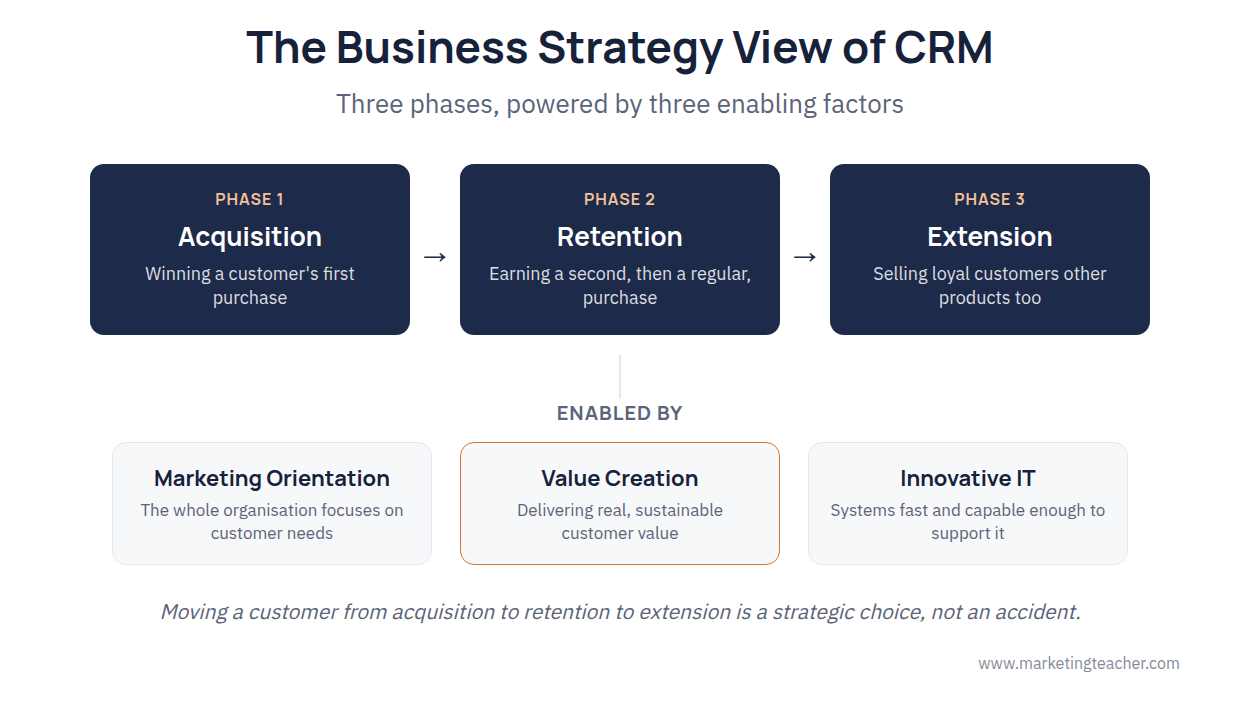
A useful way to describe this strategy, close to the customer-lifecycle model used by Buttle (2004) in his work on CRM, is as three phases. Customer acquisition is the process of winning a customer’s first purchase — historically, this is the phase most businesses focused on almost exclusively. Customer retention follows: once a customer has bought once, the aim shifts to earning a second purchase, then a regular one, so the customer is kept rather than won and lost. Customer extension is the third phase, where a company that has already earned a customer’s trust introduces them to other products or services, sometimes well outside the original purchase category.
Why the Order Matters
These three phases are not interchangeable — each one depends on the last. A company cannot sensibly extend a relationship with a customer it has not yet retained, and it cannot retain a customer it has not yet acquired. Historically, many businesses put almost all of their marketing effort into acquisition and treated retention as something that would simply happen if the product was good enough. Modern CRM strategy treats retention and extension as just as deliberate and just as resource-intensive as acquisition — arguably more so, since an existing customer is usually far cheaper to keep than a new one is to win.
Three Factors That Make It Possible
Moving a customer through these three phases does not happen automatically — Kotler and Armstrong (2018) point to the kind of organisation-wide thinking that has to sit underneath it. The first factor is marketing orientation: the whole organisation, not just the marketing department, has to focus on customer needs, addressing not just the core product a customer buys but the actual product experience and any augmented extras such as service and support. The second factor is value creation: a company has to generate real, sustainable value for the customer, not just a short-term discount, or the relationship will not survive the first sign of a cheaper competitor. The third factor is innovative IT: the systems covered in CRM and Information Technology have to be fast and capable enough to actually support acquisition, retention and extension at scale — a strategy that isn’t backed by working systems stays a strategy on paper.
The Model in Full
The diagram above sets out the whole model together: three phases moving a customer forward, resting on three factors that make that movement possible. Take any one of the three enabling factors away, and the phases above it become much harder to achieve — a company with poor IT, for example, might have a genuine marketing orientation and real value to offer, but simply lack the systems to recognise which customers are worth retaining or extending to.
How This Connects to the Other CRM Perspectives
None of these three phases can be managed by strategy alone. Acquisition, retention and extension all rely on knowing, in practical terms, which stage a given customer is actually at — which is exactly the question addressed by The Customer Life Cycle (CLC) and CRM. A business strategy that says “retain more customers” is only useful once the organisation can actually identify who its existing customers are, how long they have been buying, and where they might be at risk of leaving — information that has to come from somewhere, which is exactly the gap that CRM technology is built to close.
Summary
The business strategy perspective on CRM treats customer relationships as something to be managed deliberately across three phases: acquisition, retention and extension. None of these phases happens by accident — they depend on an organisation-wide marketing orientation, a genuine commitment to creating customer value, and IT systems capable of supporting the strategy at scale. Together with the information technology and customer life cycle perspectives covered elsewhere in this series, this completes the full picture of what CRM means in practice.
The slides, worksheet, lesson plan and poster for this lesson are free to download and free to use in your course — no sign-up, no permission needed. See the teacher resources →
Assign this lesson to your class:
Using Canvas, Blackboard or Moodle? Copy the link and paste it into your course page or assignment. More ways to add lessons to your LMS.

