
What Is Customer Relationship Management (CRM)?
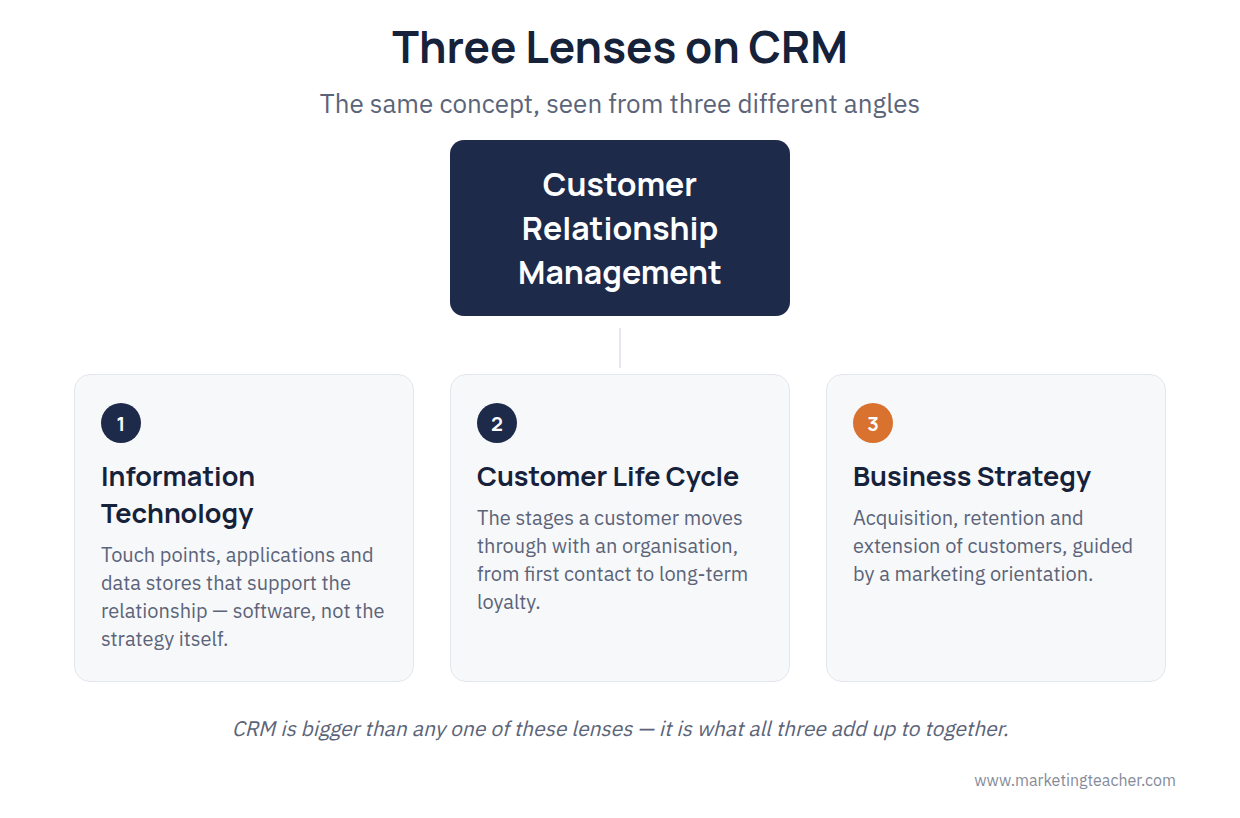
Customer relationship management, or CRM, is one of the most widely used terms in modern marketing — and one of the most widely misunderstood. Kotler and Armstrong (2018) define it, in the broadest sense, as the overall process of building and maintaining profitable customer relationships by delivering superior customer value and satisfaction. That single definition covers everything from acquiring a first-time customer, to engaging an existing one more deeply, to growing the value of a long-term account.
Why CRM Means Different Things to Different People
Part of the confusion around CRM comes from the fact that it is genuinely used in three distinct, valid ways, depending on who is talking about it. A software vendor tends to mean the technology platform. A customer service manager tends to mean the stages a customer moves through with the company. A chief executive tends to mean the overall strategy for acquiring, keeping and growing customers profitably. None of these people is wrong — they are each describing a real and important part of CRM, just from a different vantage point. The confusion usually only becomes a problem when one perspective is mistaken for the whole picture — for example, when a company buys an expensive CRM system and assumes the technology alone will fix weak customer relationships, without also getting the strategy and the life-cycle thinking right.
Perspective One: Information Technology
The narrowest, and most commonly marketed, view of CRM treats it as software: a system for capturing customer touch points, running the applications that support sales, marketing and service, and storing everything in a shared customer database. This is the perspective explored in detail in CRM and Information Technology, where the technology exists to support the relationship, not to replace the strategic thinking behind it.
Perspective Two: The Customer Life Cycle
A second perspective looks at CRM through the stages an individual customer passes through over time — from a first-time prospect, through early purchases, to a loyal, high-value long-term customer, and potentially through decline or loss. This is covered fully in The Customer Life Cycle (CLC) and CRM. Seen this way, CRM is less about any one piece of software and more about recognising which stage a customer is at, and adapting how the company treats them accordingly.
Perspective Three: Business Strategy
The broadest perspective treats CRM as a strategic priority for the whole organisation, not a department or a piece of software. This is the view developed in Business Strategy and CRM: decisions about which customers to acquire, which to retain, and which relationships to grow or let go of are strategic choices with real financial consequences, guided by the kind of marketing orientation a company chooses to adopt.
Why CRM Matters: Customer Equity
Whichever perspective a company emphasises, Kotler and Armstrong (2018) argue that the ultimate aim of CRM is to build high customer equity — the total combined customer lifetime value of all of a company’s current and potential customers. Customer equity is a forward-looking measure: while sales and market share describe how a company has performed in the past, customer equity describes how loyal and valuable its customer base is likely to be in future. A brand can be selling well today while its customer equity is quietly falling, if the customers behind those sales are ageing out of the market or drifting toward competitors. This is why CRM strategy is so closely linked to both customer lifetime value and customer equity: managing relationships well, across all three perspectives, is what protects and grows that future value.
Three Lenses on the Same Idea
The diagram above sets out all three perspectives side by side. None of them is “the” definition of CRM on its own — each is a genuine part of a bigger picture, and a company that only ever thinks about CRM through one lens is missing the other two. A CRM system with no strategy behind it is just an expensive database. A strategy with no system to support it cannot be executed consistently at scale.
Summary
Customer relationship management is the overall process of building and maintaining profitable customer relationships by delivering superior value and satisfaction. That single idea is approached from three different, complementary directions: the information technology that supports it, the customer life cycle it is applied across, and the business strategy that gives it direction. Understanding all three is what separates a company that merely owns CRM software from one that genuinely manages its customer relationships well.
The slides, worksheet, lesson plan and poster for this lesson are free to download and free to use in your course — no sign-up, no permission needed. See the teacher resources →
Assign this lesson to your class:
Using Canvas, Blackboard or Moodle? Copy the link and paste it into your course page or assignment. More ways to add lessons to your LMS.

