
Learning Outcome: By the end of this lesson, you will be able to explain what the Customer Life Cycle (CLC) is, describe how it relates to Customer Relationship Management (CRM), and apply the concept to a real sequence of products a business might offer one customer over time.
Want to go further? Study a full online course and earn a certificate →
What Is the Customer Life Cycle?
The Customer Life Cycle (CLC) has an obvious relative in the Product Life Cycle (PLC), but it asks a different question. Rather than tracking how a single product performs from launch to decline, the CLC focuses on the products and services a customer needs at different points across their whole relationship with a business – and, more broadly, across their life. Kotler and Armstrong (2018) frame this as the final, and most valuable, stage of customer relationship management: once a business has attracted a customer, the real payoff comes from deliberately building and retaining that relationship over time, rather than treating each purchase as an unconnected, one-off transaction.
How CLC Connects to CRM
Customer Relationship Management (CRM) is closely tied to the CLC, though the term itself has no single agreed definition, because it can genuinely be approached from more than one direction. Payne and Frow (2005) identify three perspectives that are commonly used: an information-technology perspective, which treats CRM primarily as the database and software that stores customer information; a Customer Life Cycle perspective, which treats CRM as the ongoing process of matching the right product to a customer at the right stage of their relationship with the business; and a business-strategy perspective, which treats CRM as a company-wide commitment to customer-centred decision-making, not just a system in the marketing department. None of the three is wrong; they simply describe different layers of the same underlying idea, and a business often needs elements of all three working together.
Applying CLC: A Retail Banking Example
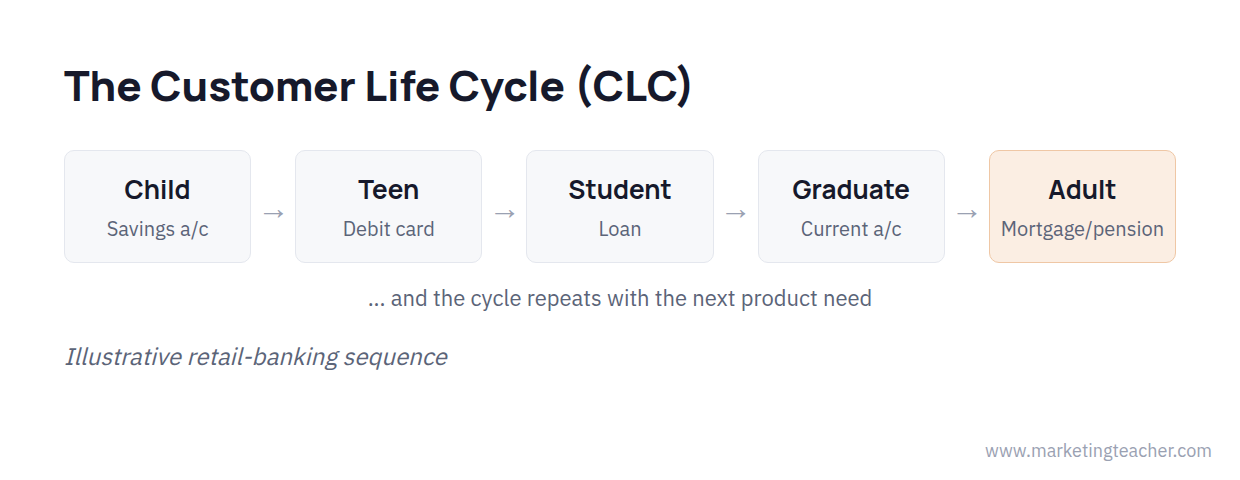
A useful way to see the CLC in action is through a retail banking relationship, since banks typically offer a wide age-based product range aimed at retaining one customer across an entire lifetime. A young saver might open a basic children’s savings account, then move to a teen account with its own debit card as they reach secondary-school age. Entering higher education often brings a student account and, for some, a student loan; graduating brings a graduate current account aimed specifically at new earners. From there the same customer may take out a mortgage to buy property, a car loan, and a pension, before eventually returning to the bank for retirement planning and, in some cases, funeral-cost provision. Every one of these products is different, but the bank is deliberately using the CLC to keep the same customer relationship going across each stage, rather than treating every product sale as the start of a fresh, unconnected relationship.
Example: Ashgrove Motors and a Family’s Growing Needs
The fictional car retailer Ashgrove Motors sells a compact hatchback to a customer in her twenties. Three years later she returns, trades in the hatchback, and buys a larger family estate car after starting a family – the dealership had kept a simple record of her original purchase date and had proactively contacted her ahead of her likely trade-in window, rather than waiting for her to initiate contact herself. Each individual purchase – browsing models, test-driving, arranging finance, taking delivery, returning for annual servicing – is itself a short customer life cycle in miniature, and Ashgrove treats the sequence of these shorter cycles, one after another over many years, as a single longer CLC it is actively managing rather than leaving to chance.
Why No Single CLC Model Fits Every Business
Because every organisation’s product range is different, it is not possible to draw one universal Customer Life Cycle diagram that applies equally to a bank, a car retailer, and a subscription software business. What stays constant is the underlying principle: a CLC is a summary of the key stages in a customer’s relationship with a specific organisation, built around that organisation’s actual products, not a generic template borrowed wholesale from another industry. A business building its own CLC model should start from its own product range and the genuine sequence of needs its customers move through, rather than forcing its business into a life-cycle diagram designed for a different kind of company. Where a model draws on several commonly cited academic sources, that hybrid origin should be stated plainly, since a student or practitioner doing more advanced work should always confirm with their own tutor or manager which specific model their organisation prefers.
Key Idea: The Customer Life Cycle is a sequence of shorter life cycles viewed consecutively – each individual purchase is its own mini life cycle, and a business practising real CRM plans deliberately across the whole sequence, rather than treating each transaction as an isolated event.
A Note on Customer Touch Points
A longer CLC is made up of many shorter cycles, and each of those shorter cycles is itself made up of individual customer touch points – a website visit, a phone call, an in-branch conversation, a service reminder email. Tracking these touch points matters because a customer’s needs can shift mid-cycle: a family that outgrows its current car, or a saver whose income changes, may re-enter part of the CLC earlier than the standard sequence would predict. A CRM system that only records the big milestones, such as “took out a mortgage,” and misses the smaller touch points in between, will struggle to notice this kind of early signal – which is exactly where the IT and CLC perspectives on CRM need to work together rather than separately.
Summary
The Customer Life Cycle describes the products and services a customer needs across their relationship with a business, and it connects closely to CRM, which can be understood from an IT, a CLC, or a business-strategy perspective depending on which layer of the idea is being discussed. Because every organisation’s product range differs, no single CLC diagram applies universally; the constant is the underlying discipline of planning deliberately for a customer’s changing needs over time, and recognising that a lifetime relationship is really a long sequence of shorter cycles managed as one connected whole.
More in this series: Customer relationship management
Customer Relationship Management (CRM) · CRM and Information Technology · Business Strategy and CRM · Mobile CRM: Best Practices for Getting It Right · Social CRM: Turning Social Media Into Customer Insight · e-CRM: How Electronic Channels Change Customer Relationships · Customer Relationship Management (CRM) and Big Data. · Customer Life Cycle (CLC) and CRM
Teaching this topic?
The slides, worksheet, lesson plan and poster for this lesson are free to download and free to use in your course — no sign-up, no permission needed. See the teacher resources →
Assign this lesson to your class:
Using Canvas, Blackboard or Moodle? Copy the link and paste it into your course page or assignment. More ways to add lessons to your LMS.
Written by Marketing Teacher.
Online course · certificate on completion
Study a full online course — and earn a certificate
Three courses that turn the free lessons into ordered modules, written at university Levels 4 to 6, with a short quiz after each.

