
What Does “Place” Mean in Digital Marketing?
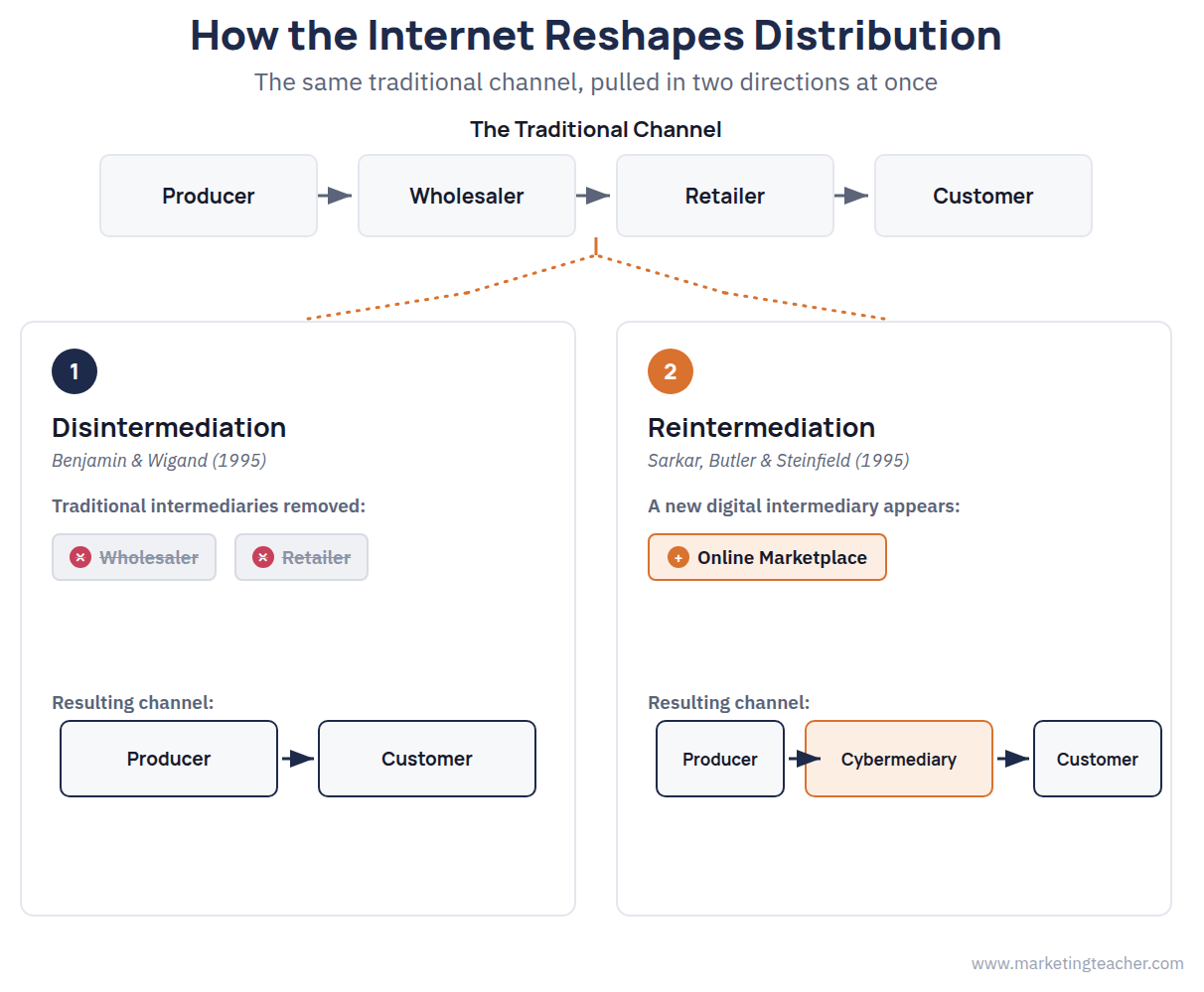
Place, as discussed in the digital marketing mix, covers how a product or service actually reaches a customer, and this is the element the internet has disrupted most visibly. Chaffey and Ellis-Chadwick (2019) note that digital channels do not simply add one more route to market alongside physical distribution, they can bypass, replace, or rearrange the whole chain of businesses that traditionally sat between a producer and a customer. A distribution channel that once needed a wholesaler, a regional distributor, and a retailer to move a product from factory to shopper can, online, sometimes be shortened to a single website. Understanding place in a digital context therefore means understanding two related but opposite forces: businesses being cut out of the channel, and new businesses appearing to take their place.
Disintermediation: Cutting Out the Middleman
Benjamin and Wigand (1995) were among the first to describe disintermediation in electronic markets: the removal of the intermediaries, such as wholesalers, distributors, or retailers, that traditionally stood between a producer and its end customer. Once a producer can build its own website, take payment, and arrange delivery directly, each intermediary it removes from the chain is a cost it no longer has to share its margin with. This is why online-native manufacturer brands often price aggressively against traditional retail equivalents, since they are not paying a wholesaler’s markup or a retailer’s shelf space. Disintermediation also changes the relationship a business has with its customer: instead of a retailer holding the customer data and the ongoing relationship, the producer now holds both directly, which is a significant strategic prize but also a significant new responsibility, since customer service, returns, and delivery all become the producer’s job rather than a retailer’s.
Reintermediation: New Middlemen Take Their Place
Disintermediation is only half the story. Sarkar, Butler, and Steinfield (1995) observed that as some traditional intermediaries were being removed, entirely new kinds of intermediary, which they called cybermediaries, were appearing to take their place: comparison-shopping sites, online marketplaces, review platforms, and auction sites, none of which existed in a purely physical distribution channel. A person selling handmade goods today might still use an intermediary, just a digital one, listing products on an online marketplace rather than approaching physical shops. This process, reintermediation, means the internet has not simply shortened every distribution channel, it has replaced some intermediaries with others that perform a genuinely different function: helping a customer discover and compare products across many sellers rather than physically stocking and displaying them.
Established Businesses vs Online-Native Businesses
An established business moving online, sometimes called a “bricks and clicks” business, usually keeps its physical channel running alongside a new digital one, letting a customer choose between them, and can often use existing operations, such as a physical store network, for tasks like returns or collection that a purely online business has to solve from scratch. An online-native, or “pure-play,” business has no physical channel to fall back on, which forces a cleaner focus on the website and delivery experience but leaves no in-person fallback if something goes wrong for a customer. Many established retailers use tools such as customer relationship management software to unify what they learn about a customer across both their physical and digital channels, so that a purchase made in-store still informs the online experience the same customer receives later, and vice versa. Whichever structure a business starts with, the pricing decisions that follow are directly shaped by how many intermediaries, old or new, still sit between the business and its customer.
Summary
Place in the digital marketing mix is about how a product or service reaches a customer, and the internet has reshaped this more than any other element. Benjamin and Wigand’s concept of disintermediation explains how businesses can remove traditional intermediaries and sell directly, while Sarkar, Butler, and Steinfield’s concept of reintermediation explains how new digital intermediaries, from marketplaces to comparison sites, take their place. An established “bricks and clicks” business and an online-native “pure-play” business each face this differently, but both need a clear view of who, if anyone, still sits between them and their customer.

The slides, worksheet, lesson plan and poster for this lesson are free to download and free to use in your course — no sign-up, no permission needed.

