
What Makes Pricing Different in Digital Marketing?
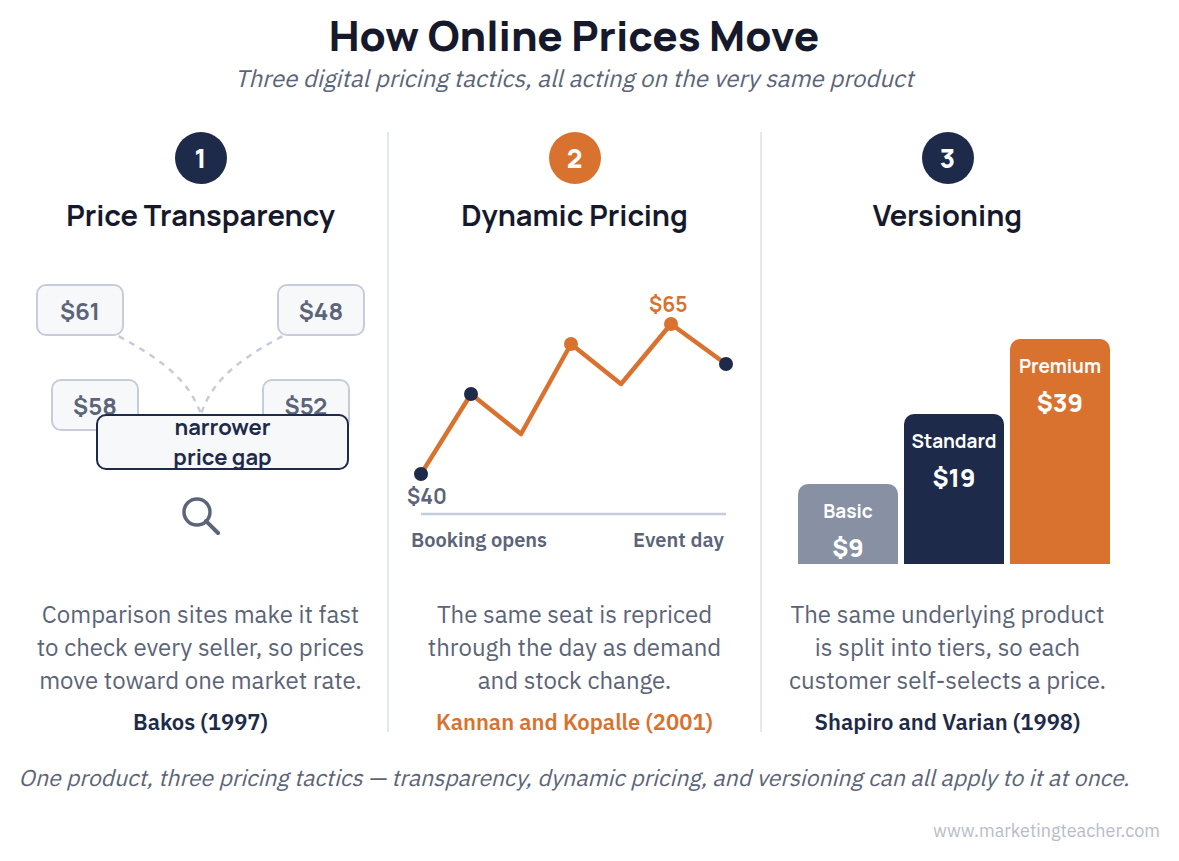
Price, one of the four elements of the digital marketing mix, is reshaped online more by the behaviour of customers than by any single technology. Chaffey and Ellis-Chadwick (2019) note that the internet gives customers far greater visibility of what other sellers are charging for the same or a similar product, and this visibility, more than anything else, is what forces digital pricing to behave differently from pricing in a traditional shop. A retailer that once competed mainly with the two or three other shops on the same high street now competes with every seller a customer can find in a few seconds of searching, and price has to be set with that wider, more visible market in mind. None of this replaces the traditional pricing strategies a business already uses, such as skimming or penetration pricing, it simply adds three digital-specific forces on top of them.
Price Transparency: Why Comparison Shopping Puts Pressure on Price
Bakos (1997) showed that electronic marketplaces sharply reduce the cost, in time and effort, of comparing prices across sellers, and that this reduction in “search costs” has a direct effect on price itself. When a customer can compare ten sellers in the time it once took to visit two shops, sellers who price noticeably above the market are quickly found out, and prices across a category tend to move closer together as a result. This is why comparison-shopping sites and browser price-comparison tools have become such a normal part of online shopping: they make the search cost Bakos described even lower, and they put continuous, visible pressure on any seller who tries to charge more than the going rate without offering something genuinely different in return.
Dynamic Pricing: Prices That Change With Demand
Where price transparency pushes prices together, dynamic pricing does the opposite: it lets a business change its price frequently, sometimes many times a day, in response to demand, timing, or how much stock remains. Kannan and Kopalle (2001) described dynamic pricing on the internet as a direct consequence of how cheap and fast it has become for an online seller to update a price, compared with reprinting a physical price tag or a paper catalogue. An airline seat, a hotel room, or a ride-hailing fare can all be priced differently within the same hour depending on how much demand the seller is seeing right now, and the customer booking early at a lower price and the customer booking late at a higher price are often looking at the exact same product.
Versioning: Selling the Same Product at Different Price Points
A third digital pricing tactic works in the opposite direction from both transparency and dynamic pricing: instead of one product at a moving price, versioning offers several deliberately different versions of the same underlying product at different fixed prices. Shapiro and Varian (1998) described versioning as one of the most effective pricing tools available for digital goods, since a piece of software, a media subscription, or an online course can be split into a Basic, Standard, and Premium tier at almost no extra production cost, letting each customer self-select into the price point that matches how much they value the product. A customer who only needs the core features chooses the cheaper tier, while a customer who wants extra storage, features, or support willingly pays more for the same underlying product, and the business captures more total revenue than a single price could ever achieve on its own.
Summary
Pricing online is not simply the traditional marketing mix‘s price element moved onto a website: it behaves differently because customers can compare offers instantly, because sellers can change a price the moment demand changes, and because a single digital product can be split into several versions sold at several different prices. Understanding price transparency, dynamic pricing, and versioning together, rather than any one in isolation, is what makes it possible to set a digital price strategically instead of just guessing at a number and hoping it holds.

The slides, worksheet, lesson plan and poster for this lesson are free to download and free to use in your course — no sign-up, no permission needed. See the teacher resources →
Assign this lesson to your class:
Using Canvas, Blackboard or Moodle? Copy the link and paste it into your course page or assignment. More ways to add lessons to your LMS.

