
What Is the Digital Marketing Mix?
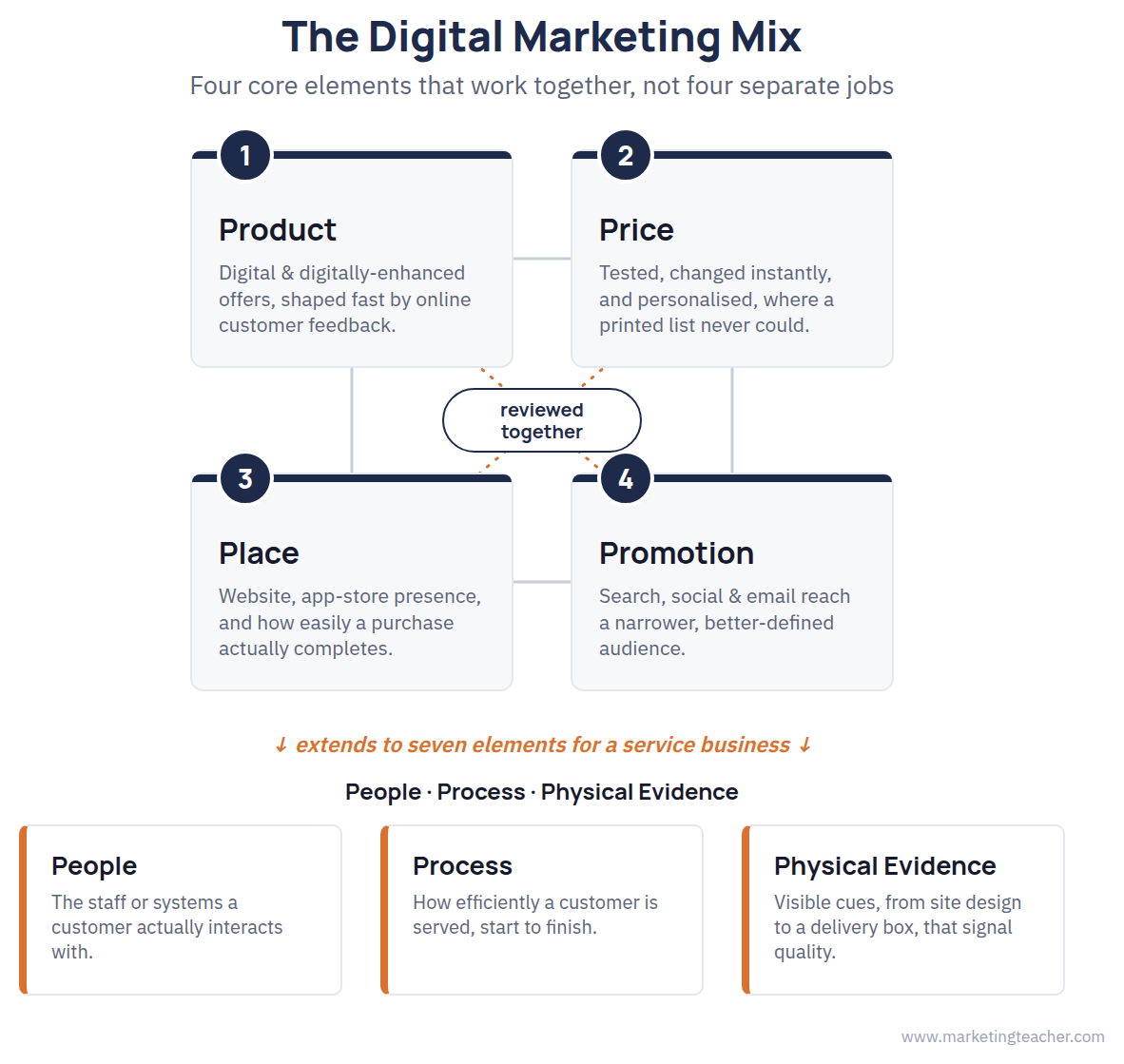
McCarthy (1960) first organised marketing decisions into four elements, product, price, place, and promotion, a framework still taught today because it gives a simple checklist for reviewing a complete marketing offer. The digital marketing mix is not a separate framework so much as the same four elements reconsidered for an online and digital context, since a business selling through a website, an app, or a social channel still has to decide what it is offering, what it charges, how it gets to the customer, and how it lets people know about it. Chaffey and Ellis-Chadwick (2019) note that digital channels do not replace this thinking so much as add new options and new pressures to each element: a price can now be tested and changed instantly rather than printed and fixed, and a promotion can be targeted to an individual browsing history rather than broadcast to everyone at once. Treating the digital mix as an extension of a well-established framework, rather than an entirely new one, keeps a business’s digital planning connected to its wider marketing strategy instead of running as a separate, disconnected effort. It also means a business does not need to learn a new planning language for its digital activity; the same four questions it already asks about a physical offer still apply, only with digital-specific answers.
How Each Element Changes Online
Product decisions online often involve digital or digitally-enhanced versions of a physical offer, from a downloadable extra to an entirely digital service, alongside faster ways to gather customer feedback and adapt the offer in response. A product page itself becomes part of the product experience, since photography, video, and customer reviews now do the persuading a shop assistant might once have done in person. Price becomes far more flexible, since online tools make it easy to test different price points, offer time-limited discounts, or personalise pricing for different customer segments in a way a printed price list never could. This flexibility is also a responsibility: a customer who spots two different prices for the same item on the same day, perhaps through a browser that clears cookies differently, can lose trust quickly. Place shifts from physical distribution and shelf space to website availability, app-store presence, and how easily a customer can actually complete a purchase once they arrive, so a slow-loading checkout page is, in digital terms, the equivalent of a locked shop door. Promotion gains channels a traditional campaign never had: search advertising, social media, and email all let a business reach a narrower, more specifically defined audience than a television or print advert ever could, though this same precision means a poorly targeted campaign can be quietly ignored by exactly the people it was meant to reach.
Keeping the Elements Working Together
A digital marketing mix only works when its elements are reviewed together rather than one at a time, since a change to one element quietly changes what the others need to deliver. The bakery’s midday discount, a price decision, only succeeds because the place decision, the collection-time slot system, is able to handle the shift in demand it creates; a discount without the booking system behind it would simply create a longer queue at a different time of day. Likewise, a promotion that successfully drives a surge of new visitors to a website is only a good outcome if the product pages and checkout process, covered by product and place, can convert that attention into an actual sale rather than a bounce. Reviewing the four elements as a connected set, rather than as four separate departments each optimising its own metric, is what turns a set of individually sensible digital decisions into a marketing mix that genuinely reinforces itself.
From Four Ps to Seven Ps
For a business that is largely selling a service rather than a physical product, three further elements are often added to the original four: people, covering the staff or systems a customer actually interacts with; process, covering how efficiently a customer is served from first contact to completion; and physical evidence, covering the visible cues, from a website’s design to a delivery box, that signal quality even though a service itself cannot be touched. A digital business selling a service, a subscription, or software should generally review all seven elements, not just the original four, since a slick product and a fair price rarely compensate for a confusing checkout process or a site that looks untrustworthy. A subscription software business, for instance, might have an excellent core product and a fair price, yet still lose customers if its cancellation process, a process element, is deliberately difficult to find, since that single friction point can undo the goodwill built by the other six elements combined.
Summary
The digital marketing mix takes McCarthy’s original four elements, product, price, place, and promotion, and reconsiders each for online and digital channels, as Chaffey and Ellis-Chadwick describe. Product, price, place, and promotion each gain new flexibility and new tools online, but those tools only deliver results when the elements are planned together rather than in isolation, and a service-based digital business should extend its review to the further three elements, people, process, and physical evidence, rather than stopping at the original four.

The slides, worksheet, lesson plan and poster for this lesson are free to download and free to use in your course — no sign-up, no permission needed.

