
What Is Direct Marketing?
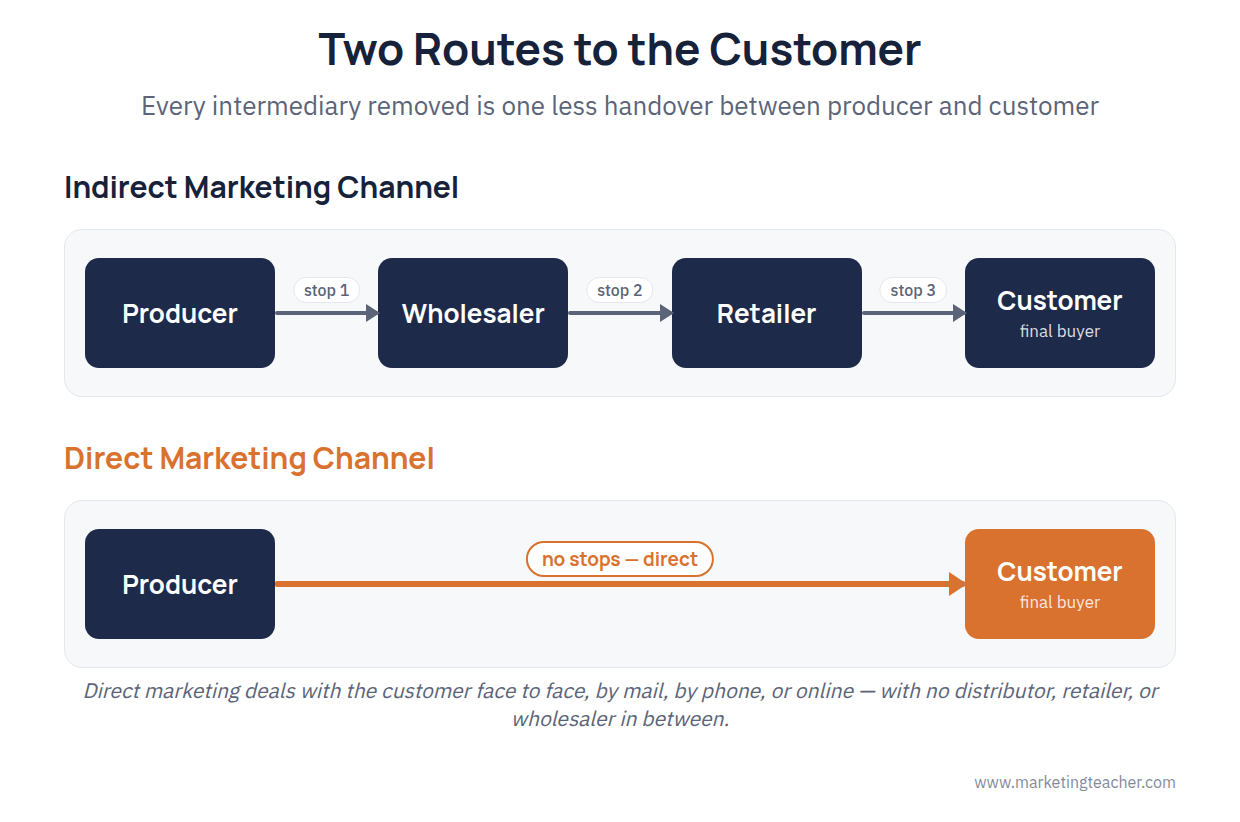
The term “direct marketing” is younger than the practice itself. Wunderman (1967) is generally credited with coining the phrase in a speech at the Massachusetts Institute of Technology, giving a name to a set of techniques, mail order, catalogue selling, telephone selling, that had existed piecemeal for decades. Wunderman went on to be called the father of modern direct marketing, and the definition he helped establish still holds: marketing that deals with the customer directly, without a distributor, retailer, or wholesaler standing in between. Kotler and Armstrong (2018) put it in more contemporary terms, defining direct marketing as engaging directly with carefully targeted individual consumers and customer communities to both obtain an immediate response and build a lasting customer relationship. Whether the tool is a mailed catalogue or a phone call, the underlying idea is the same: the producer, not an intermediary, owns the relationship with the person who eventually buys.
A Channel With No Stops
Most products travel through an indirect marketing channel: a producer sells to a wholesaler, the wholesaler sells to a retailer, and the retailer finally sells to the customer, three separate handovers before the product reaches the person who wanted it. A direct marketing channel skips every one of those stops. The producer deals with the customer face to face, by mail, by telephone, or online, and nobody else touches the sale in between. A bank offering accounts straight to the public, or a specialist food producer taking orders by phone and posting the order out, is trading the wide shelf-space reach of wholesalers and retailers for something a channel with stops can rarely offer: a direct, one-to-one exchange with a named customer, and immediate feedback on whether the offer worked.
The Traditional Toolkit
Long before online marketing existed, direct marketers had already built a working toolkit, and Kotler and Armstrong (2018) note that these traditional forms are still heavily used even now that digital options exist alongside them. Direct-mail marketing sends an offer, catalogue, or sample straight to a named address, using a mailing list built up over time; it costs more per person reached than a mass-media advert, but the people it reaches tend to be far better prospects. Catalogue marketing packages a wide product range into a single printed or digital publication a customer can browse at their own pace, without a retailer’s shelf space limiting what gets shown. Telemarketing uses the telephone to sell or qualify prospects directly, while direct-response television invites an immediate call, click, or order in response to an advert rather than waiting for the viewer to visit a shop. Kiosk marketing places an ordering terminal wherever customers already are, in an airport, a shopping mall, or a college campus, letting them order and pay on the spot. Each tool works differently, but every one of them removes the retailer from the transaction.
Direct Marketing’s Reputation Problem
Direct marketing’s directness is also where its worst abuses come from. Kotler and Armstrong (2018) describe a range of problems running from simple irritation, the overstuffed mailbox, the unwanted spam email, the too-loud direct-response advert, through to genuinely unfair practices aimed at less sophisticated buyers, and at the far end, outright fraud such as phishing emails that impersonate a bank to steal account details. None of this is a reason to dismiss direct marketing itself; it is a reason to practise it carefully. The businesses that get the most out of a direct channel tend to be the ones using permission-based lists, contacting only people who have asked to hear from them, and treating the directness of the relationship as something to protect rather than exploit. Used well, direct marketing sits comfortably alongside the wider marketing mix as one more way of reaching a customer; used carelessly, it damages the very relationship it exists to build.
Summary
The slides, worksheet, lesson plan and poster for this lesson are free to download and free to use in your course — no sign-up, no permission needed. See the teacher resources →
Assign this lesson to your class:
Using Canvas, Blackboard or Moodle? Copy the link and paste it into your course page or assignment. More ways to add lessons to your LMS.

