
How Do You Actually Run an Email Marketing Campaign?
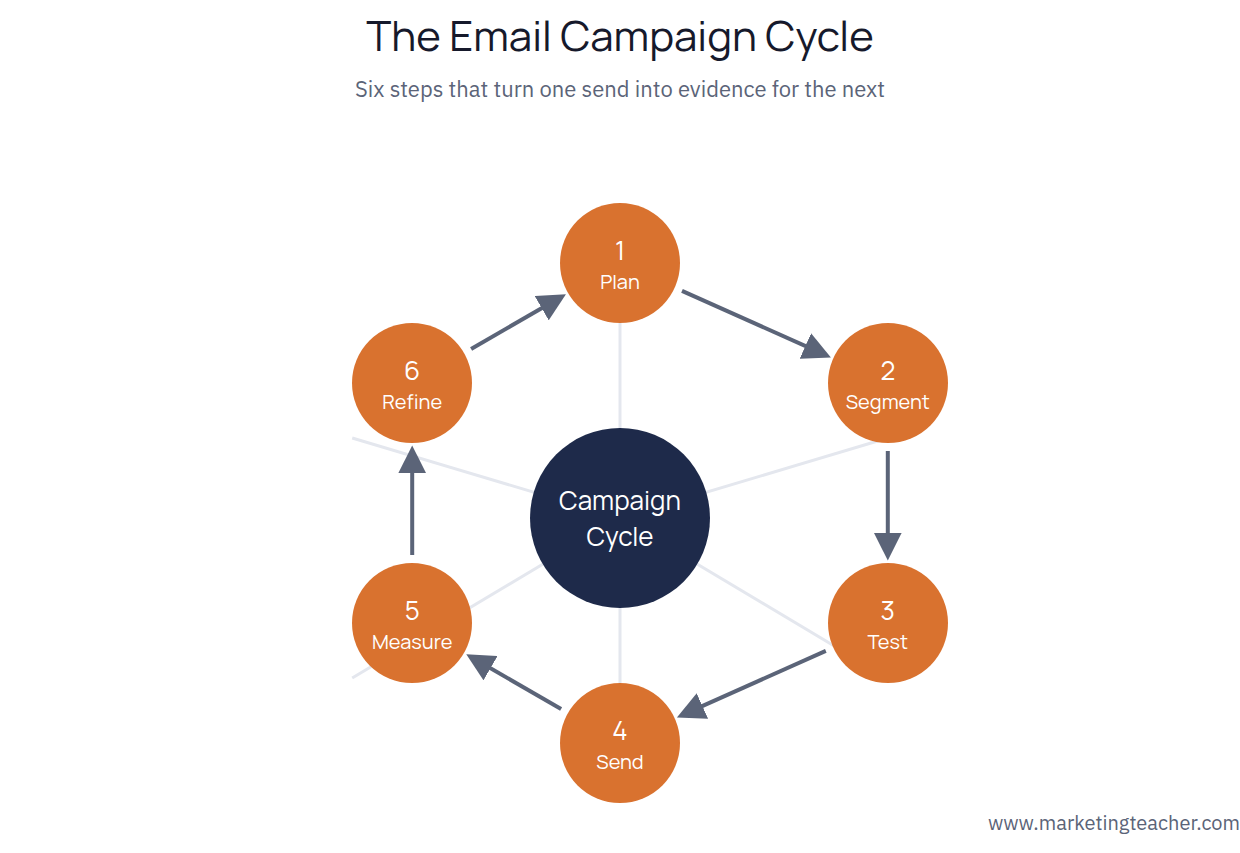
Understanding email marketing as a channel is one thing; running an individual campaign well is another. This lesson is the practical, execution-focused companion — the steps a marketer works through from planning a specific send to measuring whether it worked, and adjusting the next one accordingly.
Start With the Same Planning Discipline as Any Other Campaign
An email campaign deserves the same basic planning structure as any other piece of marketing: a clear objective, a defined target audience, and a specific call to action, decided before a single line of copy is written. Skipping this step is the most common reason campaigns underperform — a beautifully designed email with no clear objective behind it rarely drives the outcome a business actually wanted, however good its open rate looks afterward.
Segment Before You Send
Sending the same message to an entire list is rarely the most effective approach once a list has any size or history to it. Splitting an audience by purchase history, engagement level, or stated interest allows a message to be more directly relevant to each recipient, and relevance is what drives both opens and clicks. A win-back message aimed at customers who haven’t purchased in six months should look nothing like a message to someone who bought yesterday — sending both groups the same generic email wastes the opportunity segmentation exists to solve. Well-targeted segmentation and message personalisation remain among the most consistently effective levers available in email marketing, precisely because they address the relevance problem directly rather than trying to compensate for it with better design alone (Thomas, Chen and Iacobucci, 2022).
Keep the Message Focused and the Landing Page Consistent
An effective marketing email is usually short, built around a single clear message rather than several competing ones, with a recognisable logo and brand treatment placed where a recipient will see it immediately. Just as important, and often overlooked, is where the email actually sends people: the landing page a link leads to should carry the same visual language, tone and offer as the email itself. A mismatch here — an email promising 20% off arriving at a generic homepage with no visible offer — creates a moment of doubt that costs conversions the email had already earned. This handoff from email to landing page is sometimes called funnelling, and treating it as part of the campaign rather than a separate concern is one of the simplest ways to protect a campaign’s results.
Test Before the Full Send
Sending a campaign to a small internal group, or to colleagues, before it reaches the full list catches problems a screen review alone tends to miss: broken links, formatting that collapses on mobile, subject lines that trigger spam filters, or a call to action that isn’t as clear as it looked in the draft. This step takes very little time relative to the cost of sending a flawed campaign to an entire list and only discovering the problem afterward.
Measure What Actually Matters
Once a campaign has gone out, the standard metrics — delivery rate, open rate, click-through rate — tell part of the story, but they’re most useful when tracked over time and compared against a business’s own past campaigns rather than judged against a generic industry benchmark. It’s also worth ranking performance by customer value where possible: a campaign with a modest open rate that converts high-value repeat customers can be more successful than one with an impressive open rate that mostly reaches low-value, one-time buyers. Persuasion in email, in other words, is measured by the decision it produces, not just by whether the message was opened (Thomas, Chen and Iacobucci, 2022).
Keep the List Healthy and Test Small Changes Over Time
A list that isn’t maintained gradually loses effectiveness. Recipients who consistently don’t open emails, addresses that bounce, and people who’ve unsubscribed should be removed or suppressed regularly, both to protect deliverability and to keep engagement metrics meaningful. Beyond list hygiene, small, deliberate changes tested one at a time — a different subject line, a different send time, a different call-to-action wording — build a much clearer picture of what actually moves a specific audience than a single large redesign ever could.
Summary
Running an email marketing campaign well means treating it as a full process rather than a single creative output: plan with a clear objective, segment the audience for relevance, keep the email-to-landing-page experience consistent, test before sending broadly, and measure success by real customer decisions rather than opens alone (Thomas, Chen and Iacobucci, 2022). Maintaining list health and testing small changes over time turns each campaign into useful evidence for the next one.
The slides, worksheet, lesson plan and poster for this lesson are free to download and free to use in your course — no sign-up, no permission needed. See the teacher resources →
Assign this lesson to your class:
Using Canvas, Blackboard or Moodle? Copy the link and paste it into your course page or assignment. More ways to add lessons to your LMS.

