
What Is Display Advertising?
Display advertising is where an advertiser places an advert on somebody else’s website, app, or platform, rather than in the search engine results the way search marketing does. It covers the banner ads, social media adverts, and mobile adverts that most internet users see constantly, usually served through a third-party advertising system such as Google Ads rather than sold directly by the website the advert appears on. Clicking the advert takes the visitor to a landing page or a purpose-built microsite, a small standalone site designed specifically for a promotional campaign, but a display advert’s job does not depend entirely on being clicked: simply being seen builds brand awareness in a way a search advert, which only appears when someone is already looking for something specific, cannot.
How Programmatic Buying Decides Which Advert You See
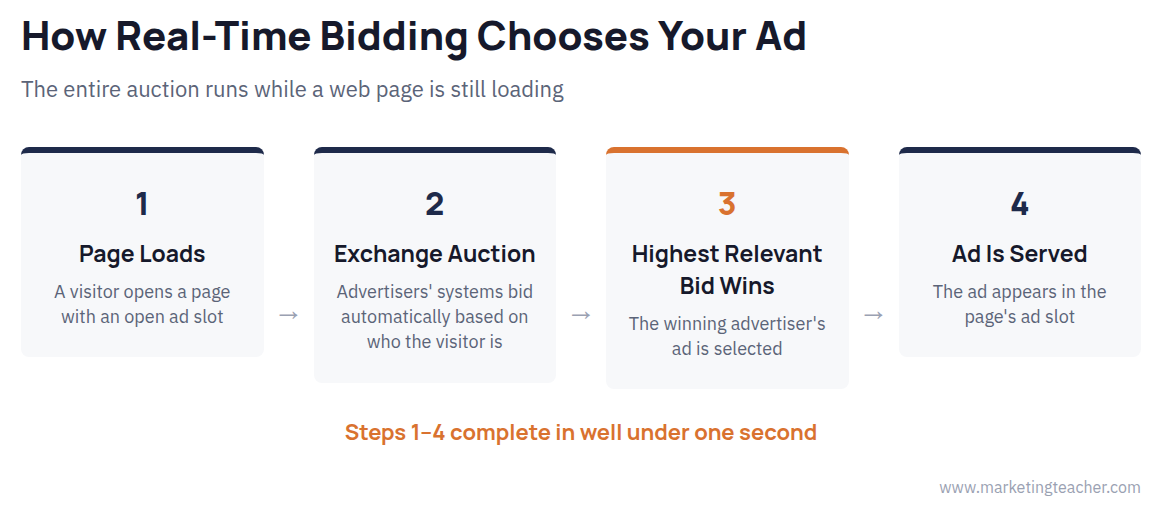
Most display advertising today is bought and placed automatically through programmatic advertising, in which software buys ad space on behalf of an advertiser in real time, often through an auction that completes in the fraction of a second it takes a web page to load. This process, known as real-time bidding, lets an advertiser target a specific audience, for example people who have already visited their website, rather than simply buying space on a particular site and hoping the right people see it. The Interactive Advertising Bureau (2017) maintains the standardized ad sizes and formats that most publishers and ad networks build around, which is why a banner ad looks and fits roughly the same way across most of the websites and apps a person visits. Chaffey and Ellis-Chadwick (2019) note that this combination of automated buying and standardized formats is what makes display advertising so easy to target, adjust, and measure compared with traditional offline advertising.
Common Display Ad Formats
Not all display advertising looks the same. A standard banner is a static image sized to one of the common formats the Interactive Advertising Bureau (2017) sets out, placed in a fixed spot on a page. Rich media ads go further, allowing some interaction, such as expanding when hovered over or letting a visitor flip through a small product carousel without leaving the page they are on. Video display ads, meanwhile, play a short video clip either within the ad space itself or before other video content, and are increasingly common as connection speeds have improved enough that video no longer slows a page down the way it once did. Choosing between these formats is really another version of the same question that applies to any content marketing decision: which format will the target audience actually engage with, and on which device and connection are they likely to encounter it?
Weighing the Benefits and Risks of Display Advertising
Display advertising offers real advantages: it can be highly targeted and precisely costed, campaigns can be adjusted mid-flight based on the data a previous campaign generated, and even an advert that is seen but never clicked still builds brand awareness. It also combines well with other online and offline promotional activity as part of a wider campaign. Against this, a business needs to be careful that its brand does not end up associated with disreputable websites through poorly controlled ad placement, and increasingly wise internet users can suffer from banner blindness, where familiar ad formats are subconsciously ignored altogether, keeping click-through rates comparatively low. Display advertising also is not automatically the right channel for every business: a local plumber, for example, is often better served by a local trade directory or a geographically targeted channel than by a broad display campaign, particularly where the target audience is less likely to be reached through digital devices in the first place.
Summary
Display advertising places an advert on somebody else’s website, app, or platform, most often through a third-party system like Google Ads, using programmatic buying and real-time bidding to target a specific audience automatically. The Interactive Advertising Bureau (2017) standard ad formats keep this consistent across most publishers, while Chaffey and Ellis-Chadwick (2019) point to targetability and measurability as the format’s real strength. Used well, as in a retargeting campaign aimed at visitors who already showed interest, display advertising can be highly cost-effective, but it carries real risks around brand safety and banner blindness, and it is not automatically the best channel for every business.
See also: Social Media Advertising
The slides, worksheet, lesson plan and poster for this lesson are free to download and free to use in your course — no sign-up, no permission needed.

