
What Is the Family Life Cycle?
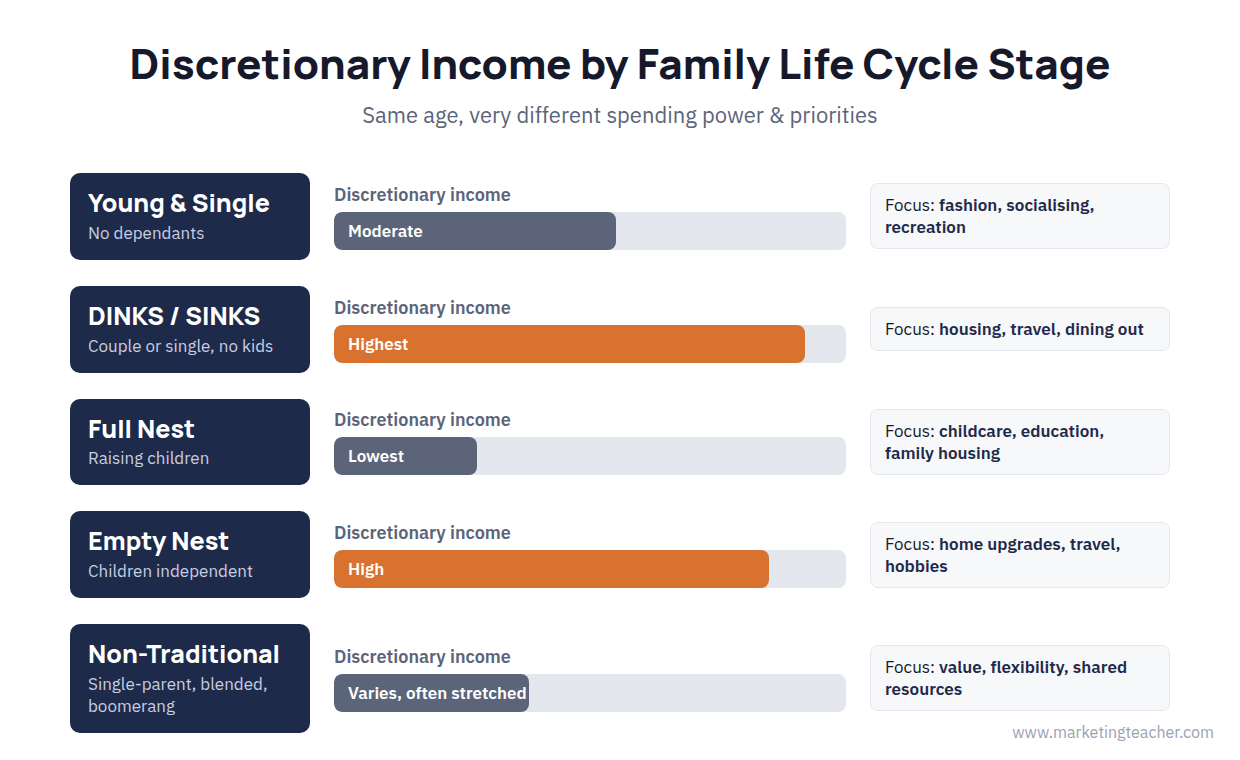
Two 35-year-olds can live completely different consumer lives. One might be a newly married professional with no children and a lot of spare income. The other might be a divorced parent of three, budgeting carefully every month. Age tells a marketer almost nothing useful about either of them. The family life cycle (FLC) concept was developed precisely to solve this problem: rather than segmenting by age, it segments households by their stage in family life, since stage predicts spending behaviour far better than age does (Wells and Gubar, 1966).
The Traditional Stages
The original family life cycle model set out a sequence that most households were expected to move through: young and single, then a newly married couple with no children, then a “full nest” stage as children arrive and grow older, then an “empty nest” stage once children leave home, and finally a solitary survivor stage in later life. Each stage carries a different spending pattern. A young single person spends on fashion, socialising and recreation. A couple with no children, sometimes labelled DINKS (“double income, no kids”) or SINKS (“single income, no kids”), typically has the highest discretionary income of any stage, since there are two incomes (or one comfortable one) and no dependants, and this group spends heavily on housing, holidays, dining out and their own interests. A full nest household redirects spending towards childcare, larger housing, education and family transport, often with much less money left over. An empty nest household, its mortgage paid down and its children independent, frequently rediscovers the discretionary spending power it had before children arrived.
Why the Modern Household Doesn’t Always Fit
The traditional sequence assumes a fairly linear path through marriage and children, and that assumption increasingly does not match how people actually live. Murphy and Staples (1979) updated the original model to account for the rise of divorce, remarriage and households that never fit the “married with children” template at all, and the range of household types marketers now need to consider has only grown since. A single parent household has the spending pressures of a full nest stage without a second income to share them. A blended family brings together stepchildren and, often, two sets of existing consumer habits and loyalties. Boomerang households, where adult children move back in with parents, combine an empty-nest household’s assets with a young adult’s spending needs. Same-sex couples, cohabiting couples who never marry, and multigenerational households with grandparents raising grandchildren all sit outside the original sequence entirely. The practical lesson is the same one Murphy and Staples were making in 1979: the FLC concept still works, but only if the stages used actually reflect the households in the target market, not a single assumed pathway through life.
Using FLC Alongside Other Segmentation Variables
Family life cycle stage is rarely used entirely on its own. It works best combined with income, since two households in the same FLC stage can have very different budgets, and with geographic or lifestyle data, since a full-nest household in a city centre apartment shops differently to one in a suburban house with a garden. Retailers of big-ticket items such as furniture, cars and holidays tend to find FLC stage especially predictive, because these purchases are so closely tied to household size and life stage, while retailers of everyday low-cost goods often find it adds less predictive power than simpler variables like household size alone.
Summary
The family life cycle groups consumers by household stage rather than age, because two people of the same age can have entirely different spending priorities depending on whether they are single, partnered without children, raising a family, or past that stage (Wells and Gubar, 1966). The traditional sequence of young single, couple, full nest and empty nest still describes a great deal of spending behaviour, but Murphy and Staples (1979) showed decades ago that a realistic model also needs room for single parents, blended families, boomerang households and couples who never have children at all. Used well, alongside income and lifestyle data, family life cycle stage remains one of the more practical segmentation tools available to a marketer.

