
What Are the Three Levels of a Product?
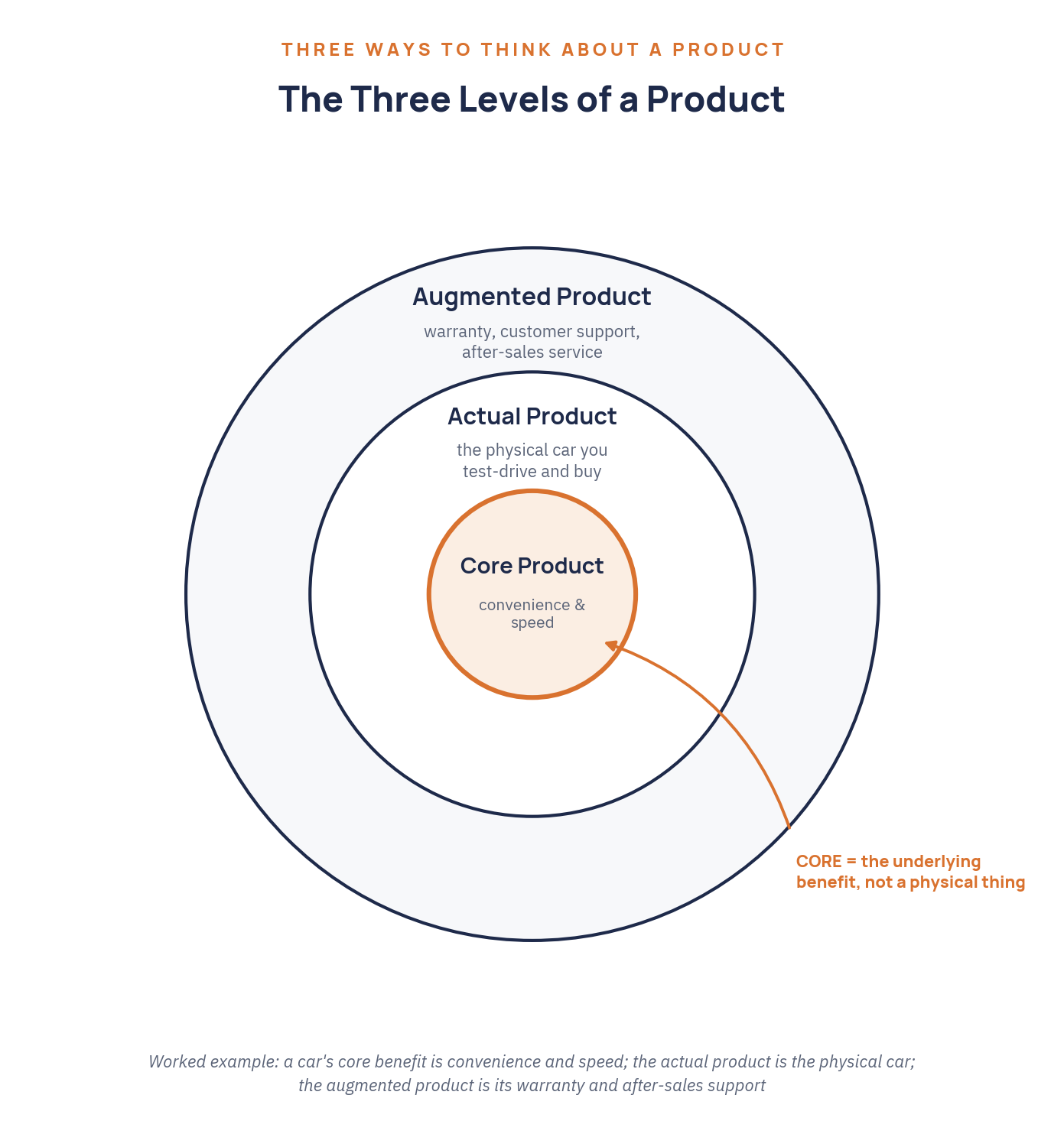
Most people think of a product simply as the physical thing they buy. Marketers look deeper than that. Kotler and Armstrong (2018) describe a product as having three levels: the core product, which is the problem-solving benefit a customer is really buying; the actual product, which is the tangible item itself; and the augmented product, which is everything added around it to make the offer more valuable. A customer rarely buys a product for its own sake — they buy what it does for them, and the physical item is just the vehicle that delivers it.
The Core Product
The core product is not something you can touch. It is the underlying benefit or problem being solved — comfort, convenience, status, speed, reassurance. Someone buying a mattress is not really buying foam and fabric; they are buying a good night’s sleep. Someone buying a fire extinguisher is buying peace of mind, not a metal cylinder. Businesses that only think about the physical product and forget the core benefit often end up competing on price alone, because they have lost sight of the actual reason a customer chose them in the first place.
The Actual Product
The actual product is what most people picture when they hear the word “product” — the tangible version a customer can see, touch and use. Kotler and Armstrong (2018) break the actual product down into five characteristics that a business designs deliberately: a quality level, a specific set of features, a particular design, a brand name, and packaging. Two products can deliver an almost identical core benefit — getting people from A to B, say — while looking completely different at the actual-product level, because one manufacturer has chosen a different combination of quality, features, design, branding and packaging to reach a different part of the market.
The Augmented Product
The augmented product is everything a business adds around the actual product to make it more attractive or easier to buy. Kotler and Armstrong (2018) point to elements such as delivery, installation, credit terms, warranties and after-sales support as classic examples. None of these change what the physical item actually is, but they can be the deciding factor in a purchase, especially once competing products have become hard to tell apart on quality or features alone. A warranty does not change how a washing machine washes clothes, but it changes how confident a buyer feels about choosing it.
Features vs Benefits
Products tend to have many features but only a small number of benefits that actually matter to a given customer. A fitness tracker might have dozens of features — heart-rate monitoring, sleep tracking, water resistance, a dozen exercise modes — but a particular customer might buy it for exactly one benefit: motivation to walk more each day. An inexperienced salesperson lists every feature and hopes something lands; an experienced one asks questions first, works out which benefit the customer actually wants, and then points only to the features that deliver it. This is why product design has to work at all three levels at once — a feature is only valuable if it connects back to a benefit the core product promises.
Why This Matters for New Product Development
New product development rarely starts with a blank sheet at the actual-product level. Kotler and Armstrong (2018) frame it as a search for ways to deliver the core benefit better, not simply a search for new features to bolt on. A business might revisit new product development because customer needs have shifted, because a competitor has raised the bar on quality or design, because new technology has made a better solution possible, or because changes elsewhere in the marketing mix demand it — a move to online-only distribution, for example, often forces a product to become smaller, simpler to ship, or easier to set up without in-person help. Whatever the trigger, the strongest new products tend to improve more than one of the three levels at once, rather than adding features at the actual-product level while leaving the core benefit and the augmented product untouched.
Summary
The three levels of a product give marketers a way to see past the physical item itself. The core product is the benefit being sold, the actual product is the tangible version a customer experiences, and the augmented product is everything added to make the offer easier or more attractive to buy. New product development has to work across all three levels together, and a product’s position at each level tends to shift over its product life cycle as competitors catch up and customer expectations move on.

The slides, worksheet, lesson plan and poster for this lesson are free to download and free to use in your course — no sign-up, no permission needed. See the teacher resources →
Assign this lesson to your class:
Using Canvas, Blackboard or Moodle? Copy the link and paste it into your course page or assignment. More ways to add lessons to your LMS.

