
Why Pricing Is More Complex Across Borders
Setting a single domestic price is already a balancing act between cost, competition and customer willingness to pay; setting prices across several countries multiplies every one of those variables. Cateora, Money, Gilly and Graham (2023) note that a price which works well in one market can be entirely unworkable in another once local costs, currency movements, competitor behaviour and government regulation are all accounted for, which is why international pricing needs its own deliberate strategy rather than a simple export of the domestic price list.
What Influences International Pricing?
Several factors shape what a company can realistically charge in a foreign market. The cost of manufacturing, distributing and marketing the product in that specific market sets a natural floor. Currency fluctuations can make the same nominal price far more or less profitable within months, and can make long-term investment decisions, such as building a factory in a new country, genuinely difficult to plan around. Competitor pricing in that market, the price local customers are actually willing to pay, and a company’s own objectives, sometimes accepting a loss in a smaller market to maintain global brand presence and economies of scale, all play a role. Government policy and taxation add a further layer that a purely domestic pricing decision never has to consider. A related effect, often called price escalation, is worth planning for separately: tariffs, additional shipping and insurance, extra distribution intermediaries, and local taxes can each add their own markup on top of the previous one, so a product that leaves the factory at a modest price can arrive on a foreign shelf costing considerably more than the same markup structure would produce at home.
Grey Markets and Parallel Importing
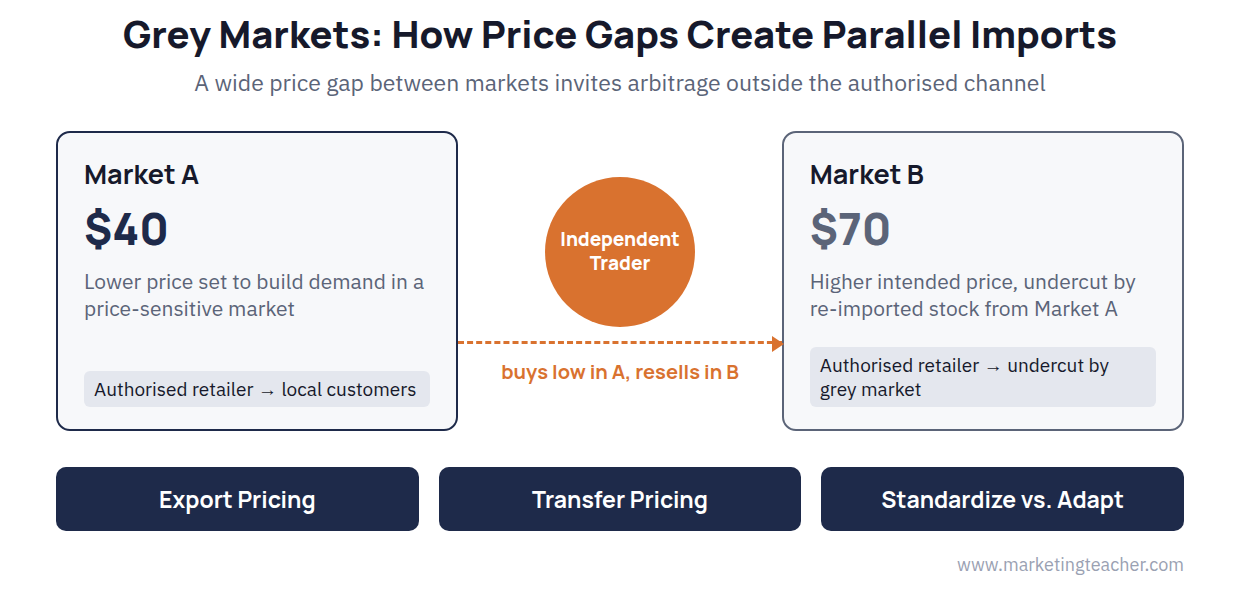
A grey market, or parallel importing, arises when a product is bought legitimately in one country, where the price is lower, and then resold in another country at a price still below what the manufacturer intended to charge there, undercutting the manufacturer’s own authorised channel in that second market. Duhan and Sheffet (1988) describe this as a largely legal but commercially disruptive form of parallel trade: nothing stops an independent trader from buying stock where it is cheap and reselling it where prices are higher, and the practice becomes more likely whenever a company charges very different prices for the same product across neighbouring markets.
International Pricing Approaches
Companies typically choose from a small number of broad approaches when setting international prices. Export pricing sets the price for a foreign market from the home country, based on the influences already discussed, with a standard domestic pricing approach then layered on top. Transfer pricing applies where goods are sold internally from the parent company to a foreign subsidiary; Cravens (1997) explains that multinational firms use transfer pricing strategically, not just as an internal accounting exercise, since the price set between related companies affects where profit is recognised and how competitively the subsidiary can price to local customers. Non-cash arrangements, such as counter-trade where goods are exchanged for goods rather than currency, remain a minor but persistent feature of trade with some markets, particularly where a trading partner’s currency is difficult to convert or in short supply.
Standardization Versus Adaptation in Pricing
As with other elements of the marketing mix, a company must decide whether to charge a broadly consistent price worldwide or adapt its price to local conditions in each market. A standardised approach is simpler to manage and easier for customers who travel or compare prices online to accept as fair, but it ignores real differences in local costs, competition and purchasing power. Adapting price to each market captures more of what each market can genuinely bear, but widens the price gaps between markets that make grey market activity more likely in the first place, so the two decisions, standardization and grey market risk, are closely linked rather than separate problems.
Summary
International pricing decisions are shaped by production costs, currency fluctuations, competitor behaviour, company objectives and government policy, all varying by market (Cateora, Money, Gilly and Graham, 2023). Export pricing and transfer pricing are the two most common approaches multinational companies use to set prices across borders (Cravens, 1997), and any decision to adapt price by market has to be weighed against the grey market and parallel importing risk that large price gaps between markets can create (Duhan and Sheffet, 1988).
The slides, worksheet, lesson plan and poster for this lesson are free to download and free to use in your course — no sign-up, no permission needed. See the teacher resources →
Assign this lesson to your class:
Using Canvas, Blackboard or Moodle? Copy the link and paste it into your course page or assignment. More ways to add lessons to your LMS.

