
How Should a Company Choose Which Market to Enter?
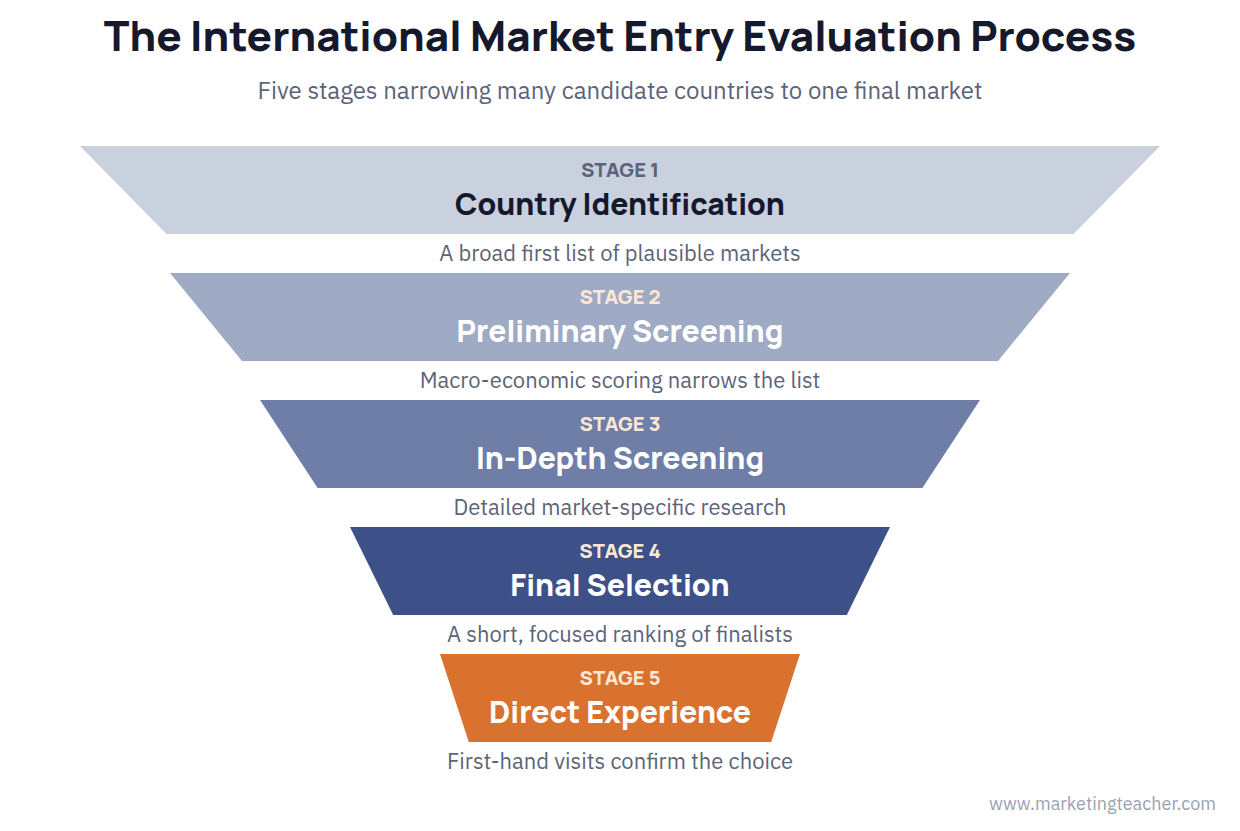
With almost two hundred countries in the world, a company planning to expand internationally cannot realistically evaluate every one of them in equal depth. Papadopoulos and Denis (1988) describe systematic country screening as a way of narrowing a very long list of possible markets down to a manageable, well-justified shortlist, rather than picking a market on instinct or familiarity alone. The international market entry evaluation process does exactly this, moving through five progressively more detailed stages: Country Identification, Preliminary Screening, In-Depth Screening, Final Selection and Direct Experience.
Stage One: Country Identification
At this first stage, almost any country is still in play, so the task is a broad overview rather than detailed analysis. Some countries suggest themselves through an obvious match, a shared language, a similar culture or political outlook, or simple geographic proximity. Others make sense because they belong to the same trading bloc as an existing market, reducing tariff and regulatory barriers to entry. At this early stage countries are included or discarded quickly and for fairly general reasons, the goal is simply to produce a first, wide list of plausible candidates.
Stage Two: Preliminary Screening
The countries that survive stage one now face a more serious look at macro-economic conditions: currency stability, exchange rate risk, the overall level of domestic consumption, and similar broad indicators. This is also the point at which a company starts factoring in structural barriers to entry, some markets require a minimum level of domestic ownership for a foreign business to operate at all, and some carry a political risk premium that has to be weighed against the potential reward. Scoring, weighting and ranking the remaining countries against these macro factors produces a shorter list ready for closer examination. Because this stage relies mainly on published, secondary data, such as government statistics and international agency reports, it can usually be completed quickly and at relatively low cost compared with the stages that follow, which is exactly why it works well as a coarse filter before committing to more expensive, market-specific research.
Stage Three: In-Depth Screening
Every country reaching stage three is already considered broadly feasible, so the focus shifts to the kind of detailed, market-specific research needed to make real decisions: what price the market will bear, how a product or service should be distributed, how best to communicate with local target segments, and how the product itself may need to be adapted. This is also where a company starts building the foundation for segmentation, targeting and positioning in that specific market, alongside harder numbers such as overall market value, applicable tariffs or quotas, and the intensity of competition a new entrant would face.
Stage Four: Final Selection
By stage four, a company is choosing between a small, carefully filtered shortlist rather than screening broadly. Decision-makers weigh each remaining country against the company’s own strategic goals, and often study competitors, or similar domestic firms that have already entered the market, to sharpen their estimate of real entry costs. Experience in other, already-entered markets can also inform this stage, similarities between markets sometimes make it possible to reuse lessons learned elsewhere. A final, more tightly focused round of scoring and ranking narrows the list to the country or countries a company will actually pursue.
Stage Five: Direct Experience
No amount of desk research fully substitutes for first-hand experience. At this final stage, a manager or their representatives travel to the remaining candidate country to experience its culture and business practices directly. This matters because everyone evaluating a foreign market does so from the reference point of their own domestic experience, and it is easy to unconsciously judge an unfamiliar market against expectations that were never going to transfer. Approaching the visit with genuine openness, rather than measuring everything against how things are done at home, is what makes this stage valuable rather than just a formality.
Summary
The international market entry evaluation process gives companies a structured way to move from a near-unlimited set of possible markets to a single, well-justified choice, using country identification, preliminary and in-depth screening, final selection and direct experience as progressively more detailed filters (Papadopoulos and Denis, 1988). Root (1994) similarly frames country screening as a foundational step in choosing an entry strategy, one that has to be completed before a company can sensibly weigh which mode of entry, from exporting through to direct investment, best suits the market it has chosen.
The slides, worksheet, lesson plan and poster for this lesson are free to download and free to use in your course — no sign-up, no permission needed. See the teacher resources →
Assign this lesson to your class:
Using Canvas, Blackboard or Moodle? Copy the link and paste it into your course page or assignment. More ways to add lessons to your LMS.

