
How Does Culture Shape International Marketing?
Culture is, put simply, the way a group of people do things. It might relate to an entire country (national culture), a smaller group within a country (a sub-culture), or even an organization (corporate culture). Nobody is born with a culture, it is learned, and it includes the values and norms, customs and traditions, beliefs and religions, and tangible symbols a group shares. When a company markets a product or service abroad, it inherits every one of these local assumptions, whether it plans for them or not, so understanding a target market’s culture is not an optional extra, it is central to whether the marketing works at all.
A Framework for Analysing Culture
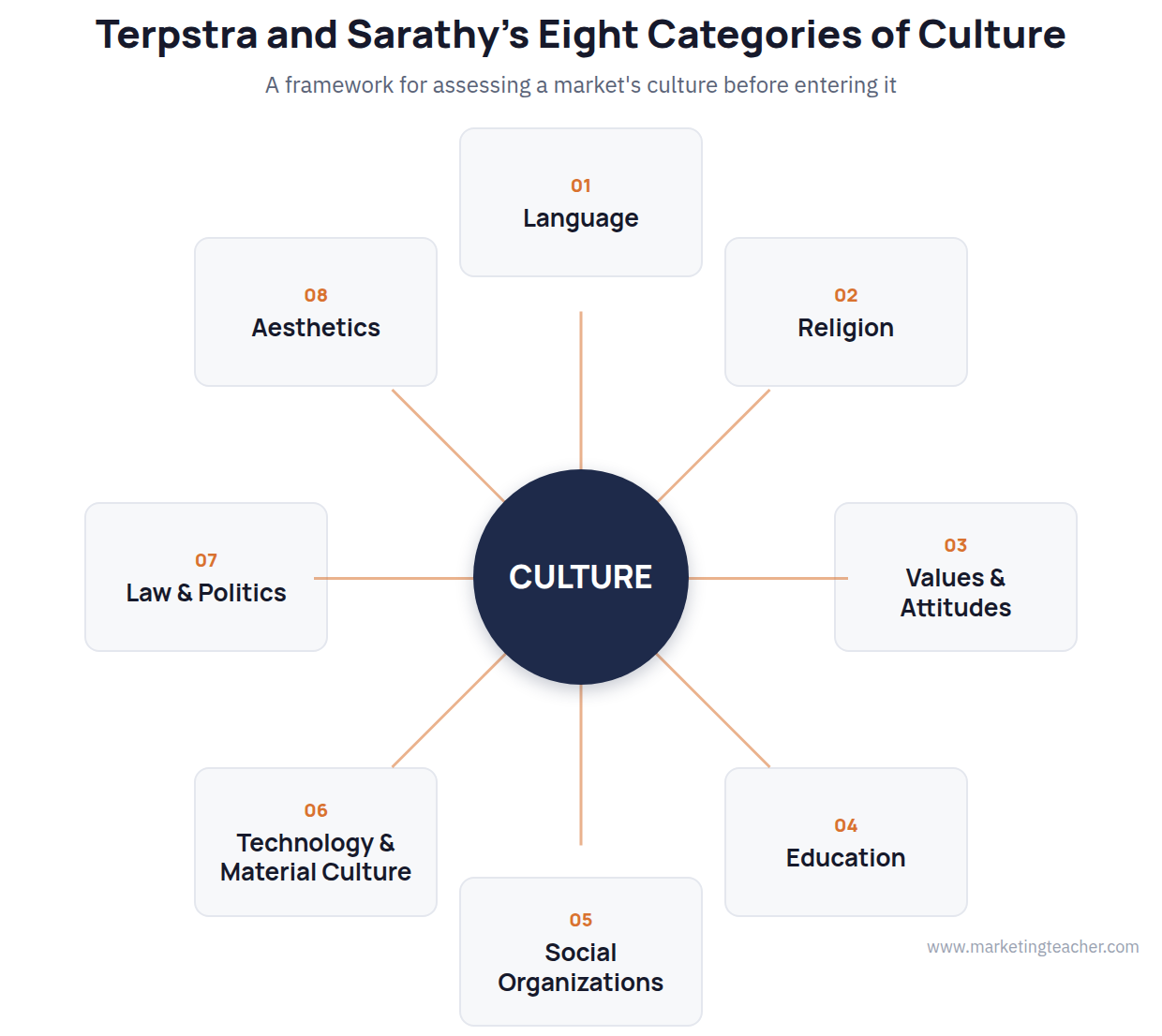
Terpstra and Sarathy (2000) propose eight categories for systematically assessing a market’s culture before entering it: language, religion, values and attitudes, education, social organizations, technology and material culture, law and politics, and aesthetics. Working through each category in turn helps a marketing team spot problems in advance, a promotional message that is perfectly acceptable at home can misfire abroad in ways that are hard to predict without doing the groundwork first.
Language and Communication Style
Language is more than vocabulary and translation. Hall (1976) distinguishes between low-context and high-context cultures based on how much meaning is carried by the words themselves versus the surrounding situation. In a low-context culture, what is said is generally what is meant, and spoken or written language carries most of the communication’s weight. In a high-context culture, the literal words matter less than shared background, tone and body language, so a message that reads as plain and direct in a low-context market can come across as blunt or even rude in a high-context one, while an indirect message calibrated for a high-context audience can seem vague or evasive elsewhere.
Religion, Values and Social Organization
Religious belief shapes what a market considers acceptable in advertising and branding, imagery, humour or symbolism that is harmless in one culture can be seen as disrespectful in another, so campaigns need reviewing against local religious sensitivities before launch rather than after complaints arrive. Values and attitudes also vary, sometimes even within a single country, and can affect everything from how much vacation local employees expect to take to how a target audience responds to individualistic versus group-oriented messaging. Social organization, how a society structures family, work, class and community, shapes who actually makes a purchasing decision within a household or business, and whether marketing should be aimed at an individual or an entire decision-making unit.
Education, Technology and Aesthetics
The nature and level of education in a market affects both literacy and the kind of message that will land. Where literacy is lower, a marketer might favour visual media or spoken formats such as radio over dense written copy. Technology and material culture cover the practical infrastructure a marketing plan depends on, is there reliable power to run a product, a distribution network to move goods, or enough local demand for material goods rather than a more service- or experience-oriented consumer culture? Aesthetics, meanwhile, covers the sensory and artistic side of a market: what colours, designs, sounds or styles a local audience finds appealing, and what they consider tasteless or unattractive, all of which can quietly make or break a campaign’s reception.
When Marketing Gets Culture Wrong
Real cases show what happens when a brand ignores one part of the cultural system. Each of the three below touches a different category.
Values and national pride: Dolce & Gabbana in China. In November 2018 the Italian fashion house posted three short videos ahead of a major show in Shanghai. They showed a Chinese woman trying to eat pizza, spaghetti and a giant cannolo with chopsticks while a male voice told her how. Many Chinese viewers saw the videos as mocking and racist. Models and celebrities pulled out, the show was cancelled, and major Chinese shopping sites removed the brand’s products. The founders then posted a video apology.
History and brand names: “Hitler” ice-cream cones in India. In 2015 news reports showed ice-cream cones on sale in India under the name “Hitler”, with his image on the boxes. German newspaper Bild called it a “macabre publicity stunt”. The name drew little reaction locally but caused outrage abroad. A brand name can mean very different things in different countries.
Body language: the “OK” hand sign. A circle made with the thumb and first finger means “okay” in the USA. In parts of France it can mean “zero” or “worthless”. In Japan it can stand for money. In Turkey, Greece and parts of the Middle East it can be read as vulgar. An advert or packshot that uses this gesture may send a message you never meant.
The lesson is simple. Test your messages, names, images and gestures with people from the local market before launch. See international marketing communications for more on adapting promotion.
Why Treat Culture as a System
These eight categories rarely operate in isolation, a market’s religion often shapes its values and social organization, and its level of education can shape both its media literacy and its aesthetic preferences. Rather than checking each category off independently, the framework works best as a way of building a rounded picture of a market’s culture as an interconnected whole, since a decision made to satisfy one category, adjusting a product’s design for local aesthetics, for example, can have knock-on effects on how it is perceived under another, such as religion or social status.
Summary
Culture influences almost every marketing decision a company makes once it operates across borders, from the tone of an advertisement to the design of a product itself. Terpstra and Sarathy’s (2000) eight-category framework gives marketers a systematic way to assess a target market’s culture in advance, while Hall’s (1976) distinction between high-context and low-context communication styles explains why the same message can land very differently in different cultures. Treating these categories as connected rather than separate helps a company build marketing that respects, rather than clashes with, the culture of the market it is entering.
The slides, worksheet, lesson plan and poster for this lesson are free to download and free to use in your course — no sign-up, no permission needed. See the teacher resources →
Assign this lesson to your class:
Using Canvas, Blackboard or Moodle? Copy the link and paste it into your course page or assignment. More ways to add lessons to your LMS.

