
What Are the Seven Cs of Website Design?
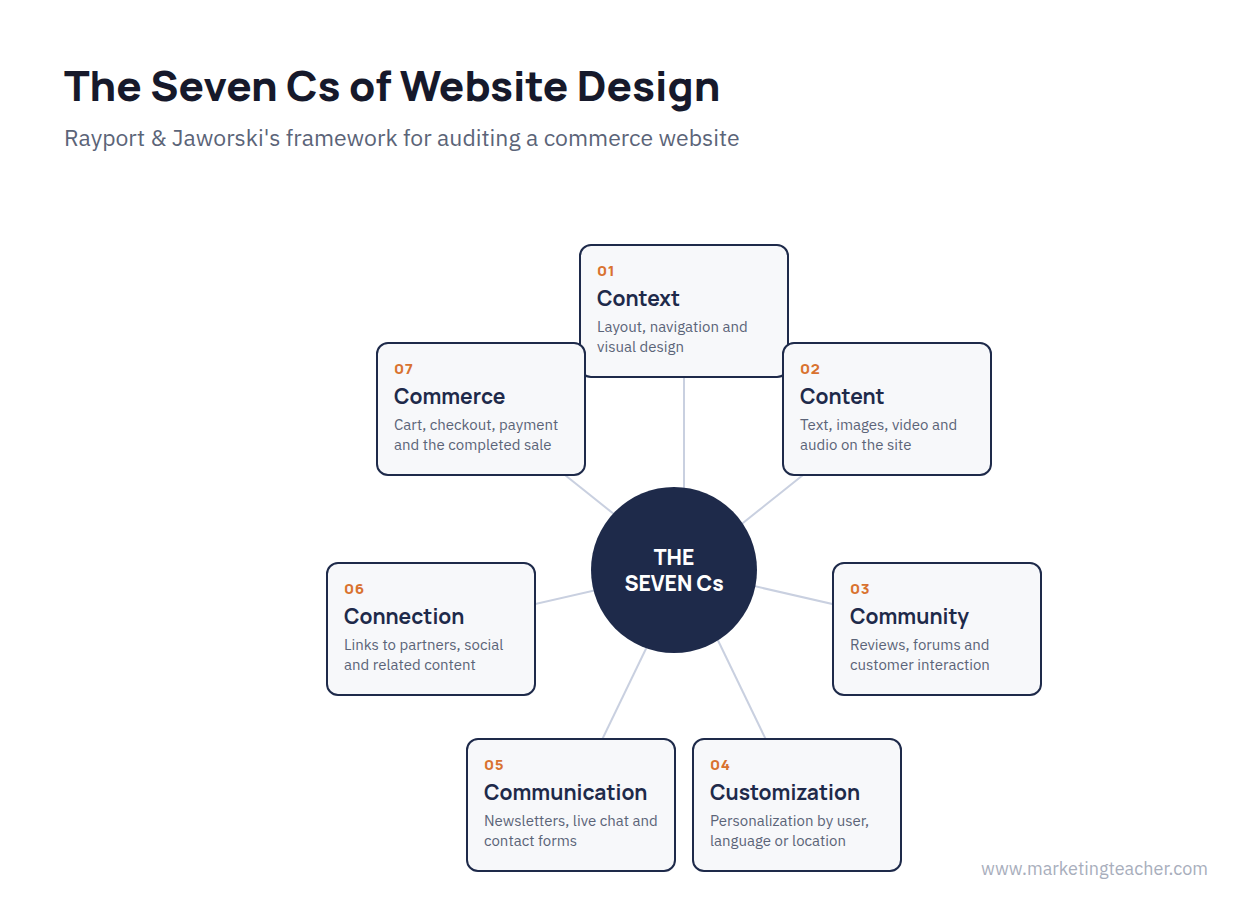
The Seven Cs is a framework for evaluating and designing a commerce website around the experience it gives customers, rather than just the features a business wants to show off. Developed by Rayport and Jaworski (2001), the framework breaks a website into seven design elements: context, content, community, customization, communication, connection and commerce. Instead of treating a website as one big design decision, the Seven Cs invites a marketer to check each element in turn, since a site can look impressive overall while still being weak on one or two of these dimensions in ways that quietly cost it customers.
The Seven Elements Explained
Context covers the site’s layout and visual design: is it easy to find things, and does the aesthetic match what the brand is selling? Content is the substance itself: the text, images, video and audio a visitor actually consumes. Community describes whether the site lets customers interact with each other, through reviews, forums or comment sections, turning shoppers into participants rather than passive readers. Customization is how far the site adapts to an individual visitor, from remembering a returning customer’s preferences to showing different content by language or location. Communication covers how the site talks to visitors and lets them talk back, whether that is a newsletter signup, a live chat widget or a simple contact form. Connection is about the site’s links outward, to partner sites, social platforms or complementary content that extends the customer’s journey beyond the page they landed on. Commerce, finally, covers the actual transactional tools: the cart, the checkout, the payment options and anything else that turns a visitor’s interest into a completed sale.
Why No Single Element Can Carry a Website Alone
A common mistake is to over-invest in one or two of the seven elements while neglecting the rest, such as a beautifully designed site (strong context) that offers no way for customers to ask a question before buying (weak communication), or a content-rich blog that makes actually purchasing the product unnecessarily difficult (weak commerce). The Seven Cs framework is useful precisely because it forces a systematic check across all seven areas rather than letting a strong showing in one area mask a weakness in another. A quick self-audit against each of the seven elements, done honestly, will usually surface at least one gap that a purely visual review of the homepage would miss.
Applying the Framework to a Redesign
When planning a redesign or a new site, working through the Seven Cs in order gives a practical checklist rather than an abstract set of principles. Context and content decisions typically come first, since they shape what the site looks and reads like; community and customization can often be added incrementally once the core site is live; communication and connection should be reviewed for every page, not just a dedicated “contact us” section; and commerce should be tested end-to-end by someone unfamiliar with the site, since the people who built the checkout are usually the worst judges of how confusing it might be to a first-time visitor.
The Seven Cs on Mobile
Most commerce traffic today arrives on a phone rather than a desktop, and each of the seven elements needs a separate check on a small screen. Context that looks clean on a wide monitor can become cluttered navigation on mobile; commerce flows with many form fields are far more likely to be abandoned when a customer is typing with their thumbs; and communication tools such as live chat need to stay reachable without covering the content the customer came for. Reviewing the Seven Cs against an actual customer journey map for a mobile visitor, from first landing on a product page through to completed checkout, tends to surface friction that a desktop-only review misses entirely, since a step that takes one click on a laptop can take several frustrating taps on a phone.
Summary
The Seven Cs framework, developed by Rayport and Jaworski (2001), breaks commerce website design into context, content, community, customization, communication, connection and commerce, giving marketers a systematic way to audit a site rather than relying on a single overall impression. As Thistledown’s experience shows, a website can excel on some elements while quietly losing customers through weaknesses in others, which is why every element deserves its own honest review, particularly commerce, since that is the element most directly responsible for turning interest into a completed sale.
The slides, worksheet, lesson plan and poster for this lesson are free to download and free to use in your course — no sign-up, no permission needed. See the teacher resources →
Assign this lesson to your class:
Using Canvas, Blackboard or Moodle? Copy the link and paste it into your course page or assignment. More ways to add lessons to your LMS.

