
What Is a Generational Cohort, and Why Does It Matter?
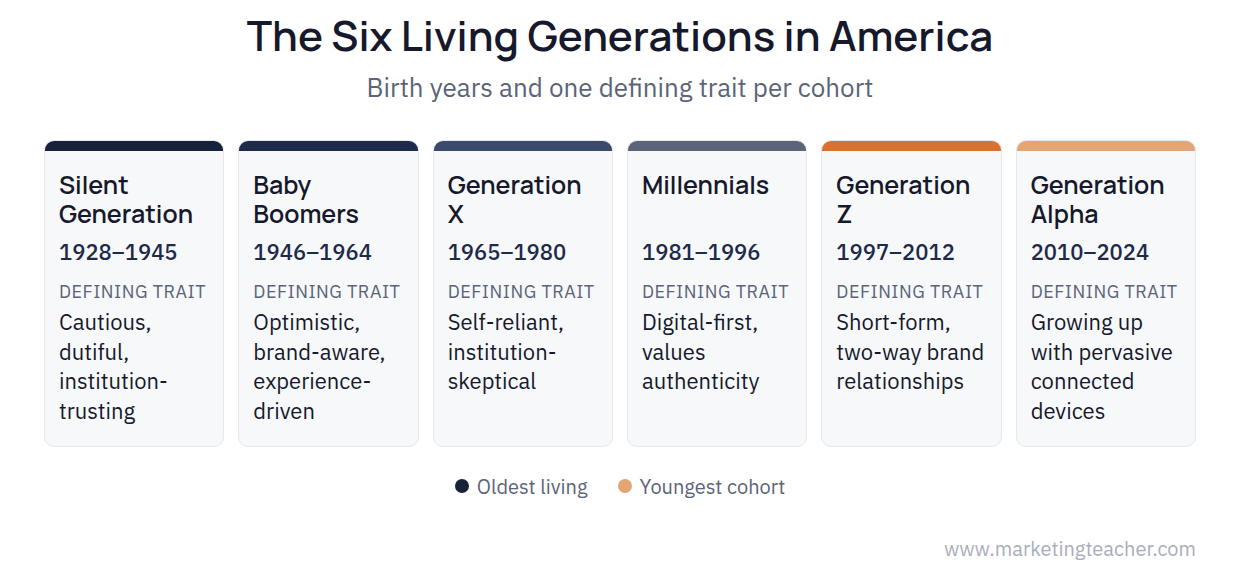
A generational cohort is a group of people born within a similar span of years who share formative experiences, such as major technological shifts, economic conditions, or historical events, during their childhood and early adulthood. Strauss and Howe (1991) argue that these shared formative experiences produce recognisable, recurring patterns in a generation’s values and behaviour as adults, which is why marketers treat generational cohort as a genuinely useful, if imperfect, way to segment an audience alongside age, income and other more familiar variables.
Six Cohorts, One Population
As of the mid-2020s, six generational cohorts make up the living American population: the Silent Generation, Baby Boomers, Generation X, Millennials, Generation Z, and Generation Alpha (Dimock, 2019; McCrindle, 2021). This is a genuinely current list: the generation before the Silent Generation, often called the GI Generation, has effectively aged out of the population entirely, while Generation Alpha, the newest named cohort, has only emerged as its oldest members reach their teenage years.
The Silent Generation and Baby Boomers
The Silent Generation, born between 1928 and 1945, came of age during the Great Depression and the Second World War, producing a cautious, dutiful, institution-trusting outlook that has generally carried through into their approach to spending and saving. The Baby Boomers, born between 1946 and 1964, grew up in a much more prosperous, optimistic period and remain a large, economically significant, brand-aware segment well into what earlier generations would have considered retirement.
Generation X and Millennials
Generation X, born between 1965 and 1980, is a comparatively small cohort raised in the transition from analogue to digital life, generally more skeptical of institutions and more self-reliant than the generations on either side of it. Millennials, born between 1981 and 1996, came of age already immersed in the early internet, and are typically characterised by comfort with digital-first services, a strong preference for authenticity over polish in marketing, and a formative experience of entering the workforce during a period of significant economic disruption.
Generation Z and Generation Alpha
Generation Z, born between 1997 and 2012, is the first cohort to have no meaningful memory of life before smartphones and social media, and generally expects short-form, highly visual content and a genuinely two-way relationship with the brands it follows. Generation Alpha, born from around 2010 onward, is the newest named cohort, coined by researcher Mark McCrindle (2021), and is growing up with even more pervasive access to connected devices and AI-driven tools than any generation before it, though as most of its members are still children, its adult consumer habits remain the least well understood of the six.
Why Marketers Use Generational Segmentation
Knowing which generation a customer belongs to gives a reasonable first guess at their media habits, formative economic conditions, and general attitude toward institutions and brands, which is genuinely useful when deciding where and how to reach a new audience. It is a starting hypothesis rather than a certainty about any individual, since two people born a year apart, right at a cohort boundary, may have more in common with each other than with the average member of their assigned generation.
The Limits of Generational Thinking
Individual variation within any one generation, by income, region, family circumstances and personal history, is typically far larger than the average difference between generations, which is why a responsible marketer treats a generational profile as one input among several rather than a substitute for real customer research. Leaning too heavily on generational stereotypes risks alienating the many people within a cohort who do not match the average profile at all.
Where the Cohort Boundaries Actually Come From
The exact birth years attached to each generation are not fixed by law or a single universal standard; different researchers draw the lines a year or two apart depending on which formative event they treat as the dividing marker. Pew Research Center, one of the most widely cited sources on the subject, has been explicit that its own boundaries are a practical convention rather than a scientific measurement, useful for consistent analysis over time rather than a claim that someone born in the last year of one cohort is meaningfully different from someone born in the first year of the next. A marketer who treats a birth-year cutoff as a hard line, rather than an approximate midpoint in a gradual generational shift, is likely to misread the customer sitting right at the edge of it.
Combining Generational Data With Other Signals
Generational cohort works best when it sits alongside other segmentation variables, such as income, life stage, location and purchase history, rather than standing in for all of them at once. A 35-year-old Millennial who has just become a parent may share more purchasing priorities with an older Gen X parent than with a childless Millennial peer, which is exactly the kind of overlap a purely generation-based segmentation model would miss. Used as one layer among several, generational data adds useful context; used alone, it flattens genuinely different customers into a single, misleading average.
Summary
America’s population today spans six living generations, the Silent Generation, Baby Boomers, Generation X, Millennials, Generation Z, and Generation Alpha, each shaped by the economic and technological conditions of its formative years (Dimock, 2019; McCrindle, 2021). Understanding these broad patterns helps a marketer choose sensible starting points for channel, tone and message, but the real value comes from testing those assumptions against actual customer behaviour rather than treating any single generation as a uniform audience.
The slides, worksheet, lesson plan and poster for this lesson are free to download and free to use in your course — no sign-up, no permission needed. See the teacher resources →
Assign this lesson to your class:
Using Canvas, Blackboard or Moodle? Copy the link and paste it into your course page or assignment. More ways to add lessons to your LMS.

