
What Is a Customer Journey Map?
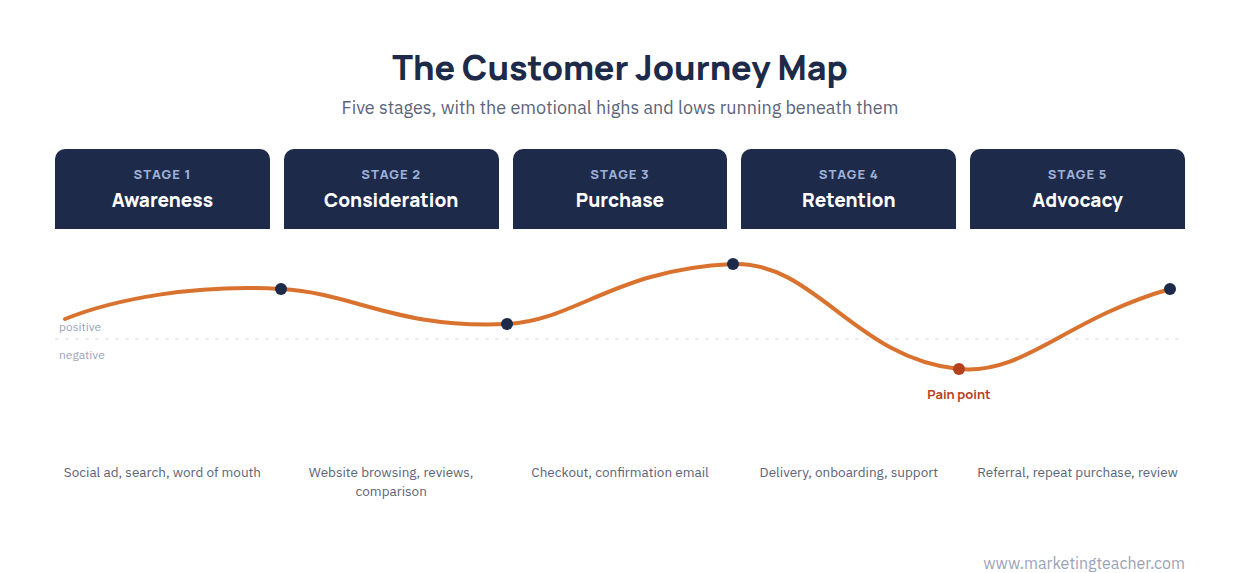
A customer journey map is a visual representation of the stages a customer moves through, and the touchpoints they encounter, as they become aware of a business, consider its offer, buy from it, and (ideally) keep coming back. Lemon and Verhoef (2016) argue that customer experience is genuinely cumulative: it builds up across many touchpoints and stages over time, rather than being decided by any single interaction, which is exactly what makes mapping the full journey more useful than judging isolated moments on their own. A journey map typically lays stages out left to right along a timeline, with the touchpoints, customer questions, and emotional highs and lows recorded underneath each stage.
The Stages of a Customer Journey
Most journey maps use some version of five stages. Awareness is when a potential customer first becomes aware that a need exists, or that a business might meet it. Consideration is when they actively compare options, read reviews, and weigh up alternatives. Purchase is the point of decision and transaction itself – often a much smaller part of the overall journey than businesses assume. Retention covers what happens after the sale: onboarding, support, and whether the experience matches what was promised. Advocacy is when a satisfied customer recommends the business to others, effectively feeding new customers back into someone else’s Awareness stage. The exact stage names vary between businesses, but the underlying idea – that a customer’s relationship with a business has a shape over time, not just a single moment of purchase – stays the same.
Why Whole Journeys Matter More Than Single Touchpoints
Rawson, Duncan and Jones (2013) studied customer experience across multiple industries and found that businesses which optimised individual touchpoints in isolation – a faster checkout, a friendlier call script – often saw little overall improvement in customer satisfaction or loyalty, because a good experience at one touchpoint can still be undone by a poor one elsewhere in the same journey. Their research found that measuring and managing complete journeys, rather than a scorecard of separate touchpoints, correlated far more strongly with customer satisfaction, reduced churn, and increased revenue. This is the central practical case for building a journey map at all: it forces a business to see connections between stages that a touchpoint-by-touchpoint view would miss entirely.
Building a Journey Map in Practice
A useful journey map is built from real evidence, not guesswork. Customer interviews and surveys reveal what people were actually thinking and feeling at each stage, rather than what a business assumes they felt. Website and app analytics show where customers actually drop off or hesitate, which often does not match internal assumptions about where problems occur. Support and complaints logs are a particularly rich source, since they capture the moments a journey has already gone wrong for a real customer. Combining these sources matters because each one is incomplete on its own – analytics show what happened but not why, while interviews explain motivation but cover only a small sample of customers – and a journey map built from only one source risks reflecting its blind spots rather than the customer’s actual experience.
Customer Journey Mapping and Strategic STP
A single journey map rarely fits an entire market equally well, which is why journey mapping works best alongside Segmentation and Targeting: different customer segments often move through very different journeys, with different touchpoints mattering more or less to each. A business that has already decided, through Positioning, what it wants to be known for should expect its journey map to reinforce that positioning at every stage – a business positioned on premium service, for example, should see that promise show up consistently from Awareness through to Retention, not just in its advertising.
Summary
A customer journey map lays out the stages a customer moves through – typically Awareness, Consideration, Purchase, Retention, and Advocacy – along with the touchpoints and emotions at each one. Lemon and Verhoef (2016) frame customer experience as cumulative across this whole journey, and Rawson, Duncan and Jones (2013) found that managing journeys as a whole outperforms optimising individual touchpoints in isolation. Journey mapping works best alongside Segmentation, Targeting, and Positioning, since different segments typically experience meaningfully different journeys.
The slides, worksheet, lesson plan and poster for this lesson are free to download and free to use in your course — no sign-up, no permission needed. See the teacher resources →
Assign this lesson to your class:
Using Canvas, Blackboard or Moodle? Copy the link and paste it into your course page or assignment. More ways to add lessons to your LMS.

