
What Is a Service?
A service is an act of doing something for someone, rather than a physical item handed over in exchange for money. It cannot be touched, seen, tasted, heard or held before it is bought, which creates a distinct set of challenges for a marketer that a manufacturer of physical goods does not face. Where a product’s quality can often be judged by picking it up and examining it, a service has to be sold largely on trust, reputation and imagery, since there is nothing tangible to inspect in advance.
The Four IHIP Characteristics
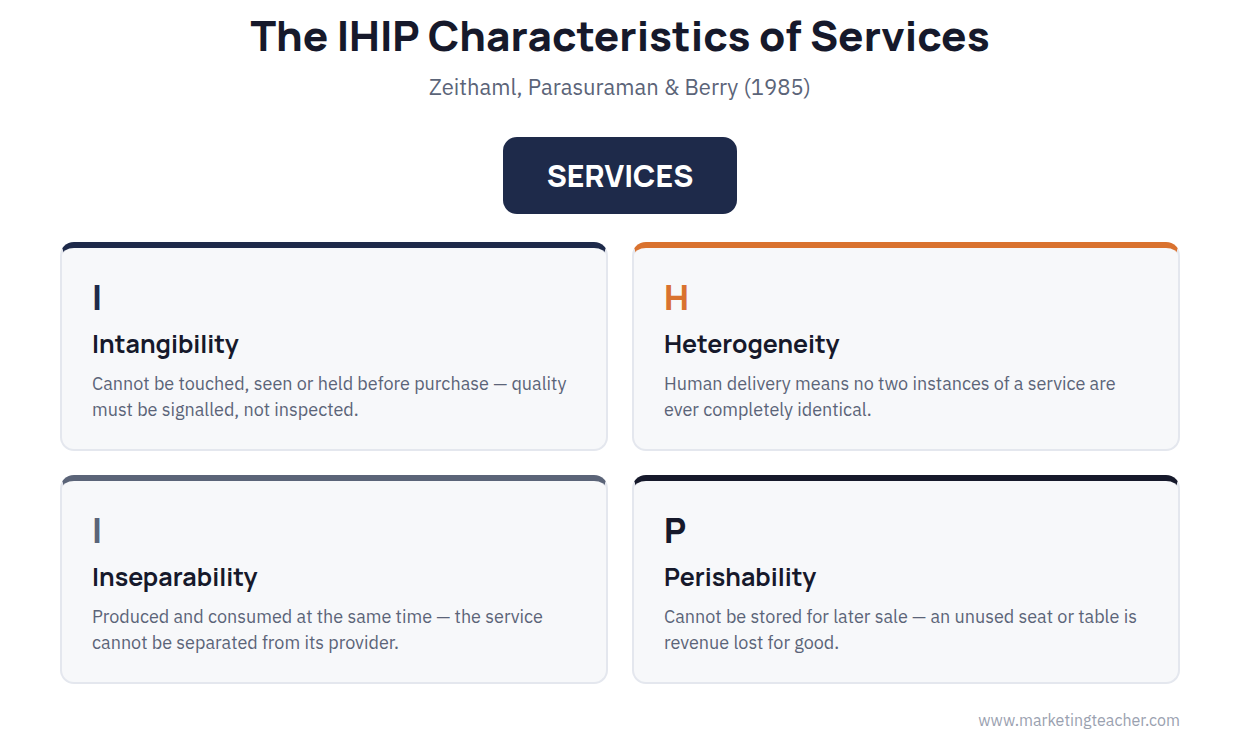
Zeithaml, Parasuraman and Berry (1985) identify four defining characteristics of services, commonly remembered by the acronym IHIP: intangibility, heterogeneity, inseparability and perishability. These four properties explain why services need to be marketed differently from physical products, and why the standard marketing mix eventually had to be extended to cope with them.
Intangibility
Intangibility means a service has no physical form of its own. Motor insurance may come with a certificate, but the protection itself cannot be touched or held. Because a service cannot be physically inspected before purchase, marketers rely instead on physical cues, staff appearance, branding and word of mouth, to signal quality that a customer cannot otherwise verify in advance.
Heterogeneity
Heterogeneity, sometimes called variability, reflects the fact that human involvement in delivering a service means no two instances are ever completely identical. Returning to the same garage for a car service twice might produce two different levels of satisfaction depending on which mechanic is on duty that day. Large standardised brands work hard to minimise this variation through training and process design, but some heterogeneity is almost impossible to eliminate wherever people, not machines, are doing the delivering.
Inseparability
Inseparability describes how a service is produced and consumed at the same time, and cannot be separated from the person or system delivering it. A live theatre performance cannot be taken home the way a recording of it could; a recorded version becomes a different product entirely, a DVD, rather than the live service itself. Because the customer is often present during production, an eye test or a haircut for example, there is an opportunity for real-time feedback that a manufactured product rarely offers: a customer can ask for an adjustment mid-service in a way they cannot with a product already boxed and shipped.
Perishability
Perishability means a service that goes unused cannot be stored and sold later. Once an airline seat takes off empty, that specific seat’s revenue opportunity is gone permanently; it cannot be put into inventory and resold tomorrow. This is why airlines, restaurants and cinemas frequently use pricing and promotions to smooth demand across quiet and busy periods, discount matinees, off-peak train tickets, midweek restaurant vouchers, since selling a perishable service at a lower price is better than not selling it at all.
How Customers Judge Quality Before Buying
Because services cannot be inspected in advance the way products can, Zeithaml (1981) describes three distinct ways customers evaluate quality, depending on when that judgment can actually be made. Search qualities are attributes a customer can assess before purchase, more common in products, such as checking a garment’s size or colour, though a service can carry some search qualities too, such as an advertised price or stated qualification. Experience qualities can only be judged during or after consumption: a customer only knows whether a meal or a vacation was good once they have actually experienced it, and a single excellent or poor meal can define how the whole trip is remembered. Credence qualities are the hardest of all to evaluate, since a customer often cannot judge them even after the service has been delivered. Whether a dentist filled a cavity correctly, or an accountant filed a tax return optimally, depends on specialist knowledge most customers simply do not have, so trust in the provider’s credentials and reputation has to stand in for direct evaluation.
Ownership Is Never Transferred
A further distinction between services and products is that a service never transfers ownership to the customer. An engineer who services an air-conditioning unit does not hand over ownership of the service, the equipment, or their own expertise; the customer has purchased the outcome of an action, not a physical asset they can resell. This is one more reason services rely so heavily on relationship and reputation: since nothing physical changes hands, trust in the provider becomes one of the only tangible things a customer actually retains.
Why the Marketing Mix Had to Extend
As Western economies shifted away from manufacturing toward service-based industries, marketers found that the traditional four Ps, product, price, place and promotion, were not enough to capture what makes a service offering succeed or fail. The extended marketing mix, or 7Ps, adds physical evidence, process and people to the original four, directly addressing the IHIP challenges above: physical evidence compensates for intangibility, process addresses variability, and people acknowledge that service quality is inseparable from the individuals delivering it.
Summary
A service differs from a product in ways that create real marketing challenges: it cannot be touched or inspected in advance, it varies from one delivery to the next, it is produced and consumed simultaneously, and it cannot be stored for later sale. Zeithaml, Parasuraman and Berry’s (1985) IHIP framework captures these four characteristics, while Zeithaml’s (1981) search, experience and credence qualities explain why some aspects of a service can be judged before purchase and others only during or long after. Together, these ideas explain why the marketing mix had to expand beyond the traditional four Ps to include physical evidence, process and people, giving service marketers the tools to manage what a physical product’s marketer never has to think about.
The slides, worksheet, lesson plan and poster for this lesson are free to download and free to use in your course — no sign-up, no permission needed. See the teacher resources →
Assign this lesson to your class:
Using Canvas, Blackboard or Moodle? Copy the link and paste it into your course page or assignment. More ways to add lessons to your LMS.

