
What Is Predictive Analytics?
Predictive analytics is the use of statistical models and machine learning techniques applied to historical data to forecast a future outcome — not to explain why something happened in the past, but to estimate what’s likely to happen next. Wedel and Kannan (2016) frame this as one of the core methods of marketing analytics in data-rich environments: using patterns in past customer behaviour to generate a specific, actionable forecast about future behaviour, rather than a general description of past trends.
What Marketers Actually Forecast With It
The most common marketing applications cluster around a handful of specific predictions: which customers are likely to stop buying (churn prediction), which are likely to respond to a particular offer (purchase propensity), how much a given customer is likely to be worth over time (customer lifetime value), and how much demand a product is likely to see in an upcoming period. Malthouse (2005) worked through the mechanics of predicting customer lifetime value specifically, showing that even a fairly simple model built on recency, frequency, and monetary history can meaningfully separate customers likely to remain valuable from those unlikely to return — a distinction that changes how much a business should reasonably spend trying to retain each group.
What the Model Actually Needs to Be Useful
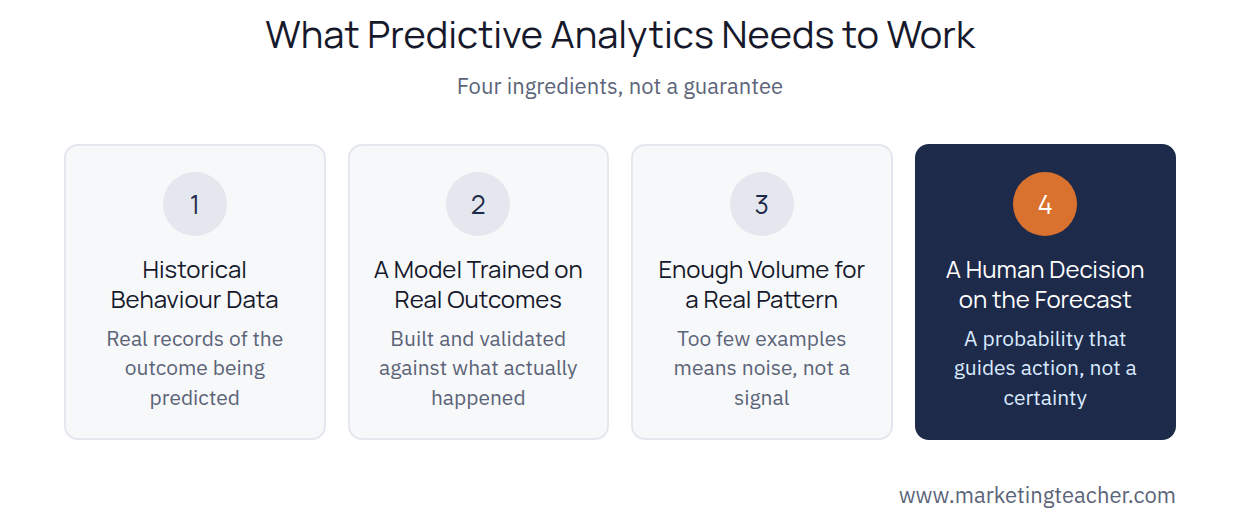
A predictive model is only as good as the data and the outcome it was trained against. It needs a genuine historical record of the behaviour being predicted — a churn model needs real examples of customers who did and didn’t churn, not just a description of who’s currently active — and it needs enough of those examples to find a pattern that will actually hold on new customers rather than one that happens to fit the specific data it was built on. A business with a few hundred customers and a handful of churn cases doesn’t have enough signal for a reliable model; a business with tens of thousands does.
A Forecast Is a Probability, Not a Certainty
The output of a predictive model is a probability or a score, not a guarantee — a customer flagged as “likely to churn” may still stay, and one not flagged may still leave, because the model is estimating a pattern across many customers, not making a promise about any one individual. Treating a predictive score as a certain fact rather than a probable one leads to overconfident decisions, like writing off a flagged customer entirely rather than simply prioritising them for extra attention. The model narrows where to focus effort; it doesn’t replace the judgement of deciding what to actually do about it.
Where It Breaks Down
Predictive analytics struggles in a few predictable ways: when the underlying customer behaviour genuinely changes (a model trained on pre-recession spending patterns won’t reliably predict post-recession behaviour), when the historical data is too thin or too biased toward one type of customer to generalise, and when the business acts on the forecast in a way that changes the very behaviour it was predicting — a customer who receives a retention offer specifically because they were flagged as likely to leave may stay for reasons the original model never accounted for. None of this makes the technique unreliable; it means a predictive model needs periodic retraining on fresh data and a human check on whether its assumptions still hold.
How This Relates to Machine Learning More Broadly
Predictive analytics is best understood as one specific application of the broader machine learning techniques covered in Marketing and Machine Learning — the model-building and pattern-recognition methods are the same, but predictive analytics is narrowly focused on forecasting a defined future outcome (will this customer churn, will they buy) rather than the wider set of tasks machine learning can be applied to, such as classifying content or personalising a page layout in real time. A marketing team doesn’t need to master every machine learning technique to use predictive analytics well; it needs a clear question, a genuine historical record of that specific outcome, and a model built and validated against it.
Summary
Predictive analytics applies statistical and machine learning models to historical customer data to forecast future behaviour — who’s likely to churn, who’s likely to buy, and how much a customer is likely to be worth over time (Wedel and Kannan, 2016; Malthouse, 2005). It works best with a large, genuine historical record of the outcome being predicted, and its output is a probability that narrows where a marketing team should focus, not a certainty about any individual customer. Kept current with fresh data and paired with human judgement about what action each forecast justifies, it lets a marketing team target a small, genuinely at-risk or high-value group instead of treating every customer the same way.
The slides, worksheet, lesson plan and poster for this lesson are free to download and free to use in your course — no sign-up, no permission needed. See the teacher resources →
Assign this lesson to your class:
Using Canvas, Blackboard or Moodle? Copy the link and paste it into your course page or assignment. More ways to add lessons to your LMS.

