
What Does “Marketing and ChatGPT” Actually Cover?
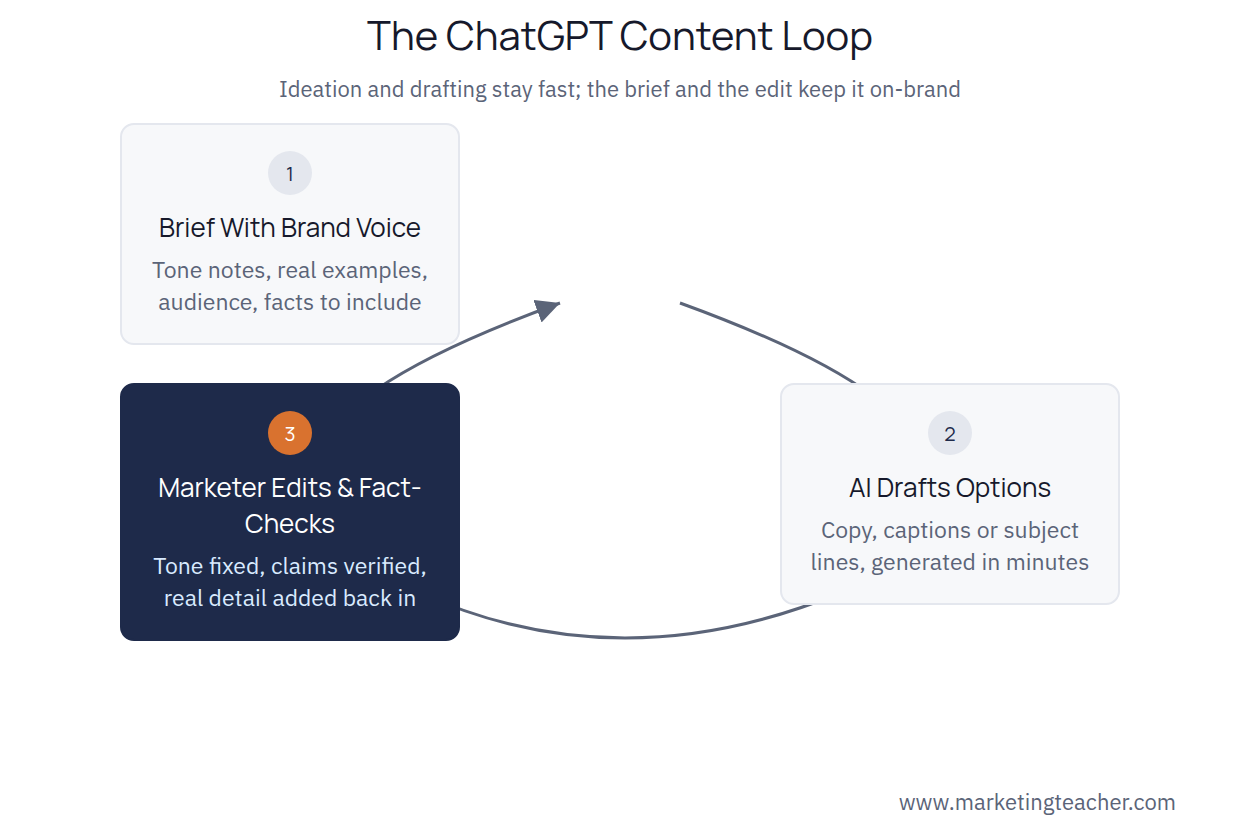
ChatGPT and similar generative AI tools show up in marketing in several distinct ways, and it’s worth being precise about which one this lesson covers. Using AI to power a customer-facing support chatbot is its own topic, covered in AI Chatbots for Marketing. Using AI to help interpret data and write up findings is covered in ChatGPT Analytics. This lesson is about a third, distinct use: ChatGPT as a writing and ideation assistant — drafting ad copy, social captions, email subject lines, and brainstorming campaign concepts, before a human marketer edits and approves the result.
Where It Actually Speeds Up Marketing Content Work
The clearest use case is the first draft: a marketer facing a blank page for twenty product description variants, a week of social captions, or ten subject-line options to A/B test can generate a full set in minutes rather than hours, then spend their time selecting and refining rather than originating from nothing. A recent systematic review of generative AI in digital marketing and customer engagement describes this as AI’s role across the full path “from ideation to execution” — supporting brainstorming, drafting and iteration rather than replacing the creative judgement that picks the winning option (Frontiers in Communication, 2025). Used this way, the tool compresses the time between having a campaign brief and having options worth reviewing.
Feeding It a Brief, Not Just a Topic
The quality gap between a useful draft and a generic one almost always comes down to what the tool was given to work with. A prompt that includes the brand’s actual tone of voice, a real example of past copy the brand is happy with, the specific audience being addressed, and any claims that must be avoided produces drafts a marketer can genuinely use as a starting point. A prompt that just names a topic (“write something about our new product”) produces the same kind of generic, forgettable copy any other brand’s marketer would get from the same tool with the same thin prompt — which is exactly the risk covered next.
The Homogenization Risk
A specific and measurable risk of leaning on the same generative AI tool across many brands is that marketing content starts to converge — different brands’ output becomes more similar to each other than it used to be. A 2025 study using Italy’s temporary nationwide ChatGPT restriction as a natural experiment found that when access to the tool was cut off, the lexical and semantic similarity between different local businesses’ marketing content actually dropped (Liu, Wang and Yang, 2025) — meaning wide AI access had been quietly pulling different brands’ content closer together. For a brand that competes partly on having a distinct voice, this is a genuine cost of using AI content tools without deliberately working to counteract it.
Keeping AI-Assisted Content Distinct and Accurate
Three habits address most of the risk. First, always seed the tool with brand-specific material — past copy, tone notes, real product facts — rather than a bare topic, since a thin prompt is what produces generic, convergent output. Second, treat every factual claim in a draft as unverified until a human checks it against a real source, since a generative AI tool has no way to confirm a product spec or a price is still current. Third, keep a human editing pass as a fixed step in the workflow rather than an optional one, both to fix tone and to introduce the specific details — a real customer quote, a genuinely unusual product detail — that a generic AI draft won’t include on its own.
Summary
Used specifically as a content-creation and ideation assistant — distinct from AI customer-service chatbots or AI-assisted analytics — ChatGPT can turn a marketing brief into a set of draft ad copy, captions, or subject lines in minutes rather than hours (Frontiers in Communication, 2025). The quality of what it produces depends heavily on what it’s given: a prompt seeded with real brand voice and product facts produces usable drafts, while a thin, generic prompt risks the kind of content convergence documented when AI access is measured against otherwise-similar businesses (Liu, Wang and Yang, 2025). A brand-specific brief and a mandatory human edit-and-fact-check pass are what turn a fast first draft into content that’s actually usable and still sounds like the brand that’s publishing it.
The slides, worksheet, lesson plan and poster for this lesson are free to download and free to use in your course — no sign-up, no permission needed. See the teacher resources →
Assign this lesson to your class:
Using Canvas, Blackboard or Moodle? Copy the link and paste it into your course page or assignment. More ways to add lessons to your LMS.

