
Marketing in the Press: Newspaper and Magazine Advertising
Why Do Small Businesses Still Advertise in the Press?
National and local newspapers and magazines are a mature form of advertising, but they remain popular with entrepreneurs, start-ups and small companies because publishers already understand their own readership and can recommend a package of advertising that delivers a known level of exposure. Press advertising also has a longer shelf life than a broadcast advert, since a reader can return to a page, and it slots naturally alongside genuine editorial content the reader has already chosen to read. Media-planning fundamentals such as cost-per-thousand and page position, covered by Belch and Belch (2012) among others, give a small business owner a structured way to judge whether a particular publication is worth the spend.
Working Out What You Actually Need
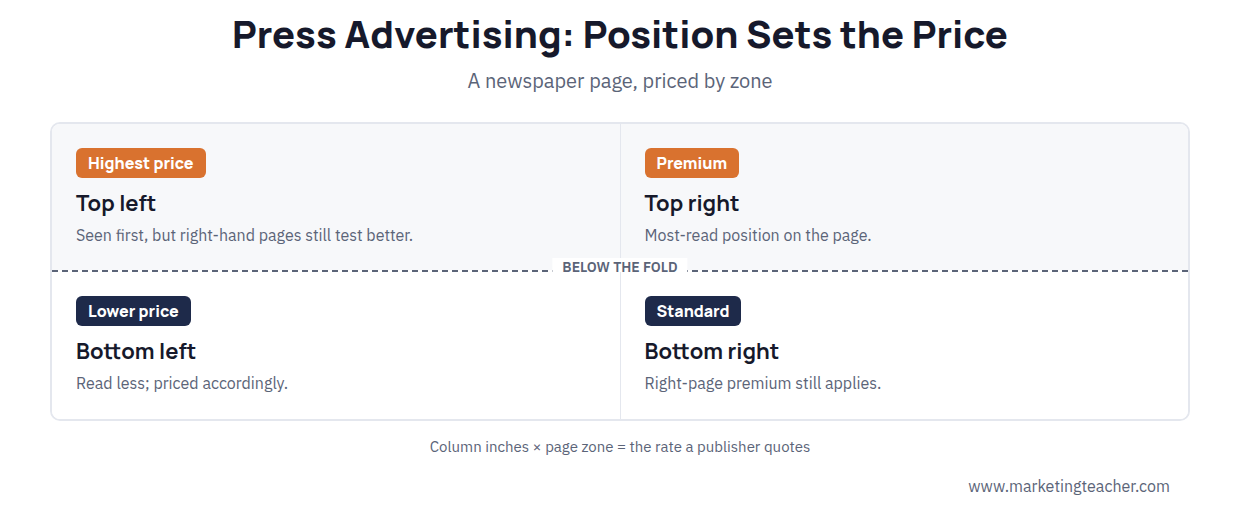
Before contacting a publication, it pays to get back to basics and work out exactly what the advertising needs to achieve, since newspaper sales staff are often paid largely on commission and have every incentive to sell as much space as possible. A clear brief, built from an outline advertising plan, protects a small business from being sold more space or a longer campaign than the objective actually calls for. Advert size is usually quoted in column inches or centimetres, and price varies with position on the page: adverts at the top of a page cost more than those below the fold, and a right-hand page commands a premium over a left-hand one because readers are measurably more likely to see it (Belch and Belch, 2012).
Buying and Timing the Advertising
Press advertising is typically bought either for a specific financial amount, such as a fixed monthly budget, or for a defined length of campaign such as a month or a year, and many small businesses time their spending seasonally, increasing it around Christmas or using it to stimulate sales during a naturally quiet period of the year. Whatever the size of the campaign, the advert itself should always be proof-read and formally signed off before it runs, since a spelling error or an inconsistency with the rest of the business’s marketing is far more visible, and far harder to withdraw, once it is in print. Including a voucher or a unique code the customer can use when purchasing is a simple, low-cost way to give a broad measure of how well a specific advert actually performed.
Local Versus National Titles
Local press advertising is generally priced using a rate per thousand readers, so a local newspaper reaching 10,000 households, of whom perhaps 60% are estimated to be relevant to a specific business such as a small car dealership, gives an advertiser a ballpark figure for whether the audience justifies the cost, and a benchmark against which to compare other media (Belch and Belch, 2012). National advertising becomes the more sensible choice when a business sells a niche product with a geographically scattered customer base: a small manufacturer of fishing flies is unlikely to benefit much from local advertising at all, and instead reaches a much higher concentration of its actual target audience by advertising in a national angling magazine, particularly if it also sells through wholesalers and wants to demonstrate that it is actively promoting its brand nationally.
Judging Whether It Worked
Because press advertising rarely produces an immediate, fully traceable sale in the way a digital advert can, a small business needs to build measurement into the advert itself rather than relying on guesswork afterward. A dedicated voucher code, a specific landing page mentioned only in that advert, or simply asking new customers how they heard about the business are all low-cost ways of connecting a press campaign to real results. Comparing the resulting cost-per-thousand and response rate against other channels the business has tried, such as radio or outdoor advertising, over time builds a genuinely useful picture of which media actually earn their keep for that particular business and audience.
Summary
Newspaper and magazine advertising remains a viable channel for small businesses precisely because publishers understand their own readership and can quote a predictable cost-per-thousand. Getting a clear brief before speaking to a sales team, understanding how page position affects price, and choosing between local and national titles based on how concentrated the target audience actually is, are the fundamentals covered by media-planning texts such as Belch and Belch (2012). Building simple measurement into every advert, rather than hoping it worked, is what turns press advertising from a guess into a channel a small business can genuinely evaluate.
The slides, worksheet, lesson plan and poster for this lesson are free to download and free to use in your course — no sign-up, no permission needed.

