
Why Doesn’t One Marketing Mix Fit Every Business?
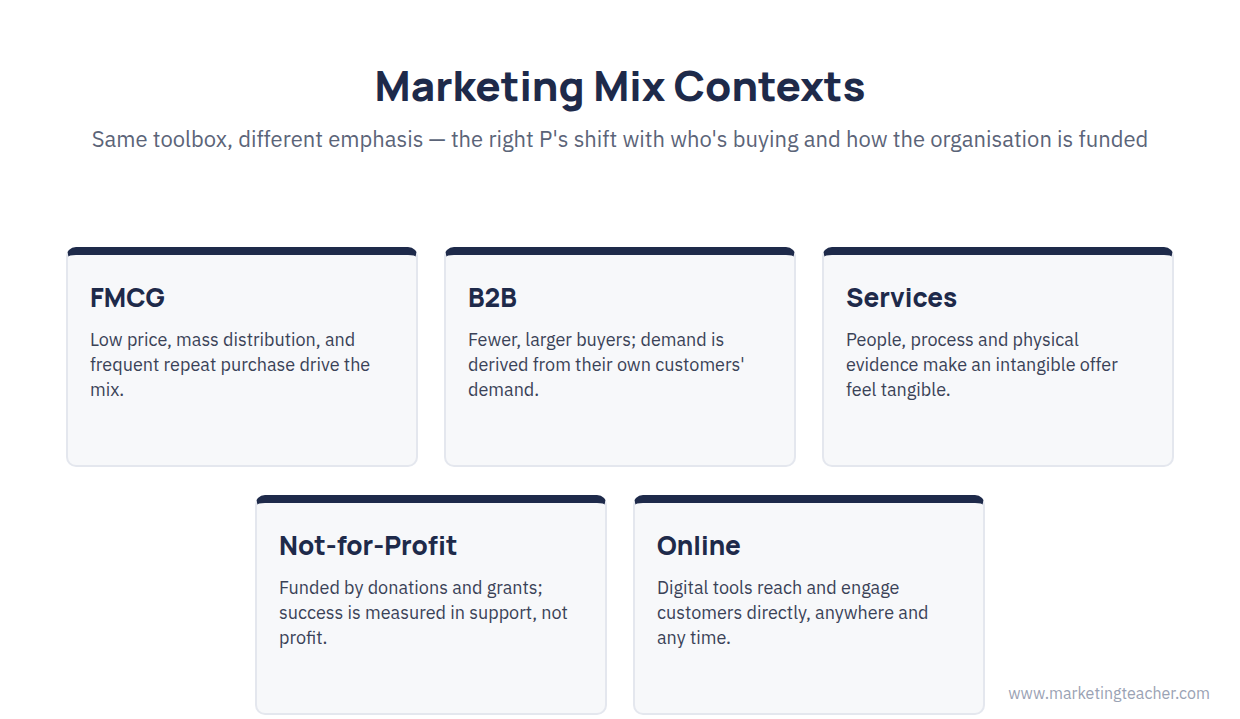
The marketing mix and the services marketing mix give every business the same basic toolbox of decisions to make. But the right combination of those decisions looks very different depending on what’s being sold, who’s buying it, and how the organization is funded. A supermarket chain selling toothpaste, a manufacturer selling components to another manufacturer, a hospital, a charity, and an online retailer are all “marketing” — but each one leans on a different part of the mix to win.
Fast-Moving Consumer Goods (FMCG)
FMCG products are what Kotler and Armstrong (2018) call convenience products: items customers buy frequently, immediately, and with minimal comparison, such as toothpaste, snacks, or laundry detergent. Because customers spend so little time deciding, FMCG marketing leans hard on low pricing, wide and convenient distribution, and constant brand visibility through advertising and in-store promotion — the goal is to be the easy, familiar choice sitting right where the customer already is. Compare that with a shopping product like a sofa or a laptop, where buyers happily spend days comparing brands, price, and quality before committing — an FMCG brand rarely gets that luxury of a customer’s attention, so it has to win the decision before the customer has really started thinking about it.
Business-to-Business (B2B)
B2B marketing deals with a fundamentally different buyer. Kotler and Armstrong (2018) note that business markets normally involve far fewer, much larger buyers than consumer markets, and that business demand is derived demand — it ultimately comes from the demand for whatever the buyer’s own customers want. A dip in consumer demand for laptops, for example, quickly reduces a components supplier’s demand for the parts that go inside them. That makes B2B buying more rational and relationship-driven: fewer but deeper customer relationships, and marketing communication that speaks to specification, reliability, and long-term partnership rather than impulse. Losing a single large B2B account can matter as much as losing thousands of individual consumers at once, which is exactly why B2B marketers usually invest so much more time in each relationship than an FMCG marketer ever could.
Service Organizations
Services bring a different problem entirely. Kotler and Armstrong (2018) identify four characteristics that set services apart from physical products: intangibility (they can’t be seen or tried before purchase), inseparability (they’re produced and consumed at the same time, often by the same person delivering them), variability (quality depends on who provides the service and when), and perishability (an empty seat or missed appointment can’t be stored and sold later). Because a service can’t be inspected in advance, marketers have to make the invisible feel trustworthy — which is exactly why the services marketing mix adds people, process, and physical evidence to the original four Ps.
Voluntary and Not-for-Profit Organizations
Not-for-profit organizations — charities, museums, foundations, community groups — aren’t chasing profit at all; Kotler and Armstrong (2018) note they compete hard for funding and support instead, since most rely on donations, grants, or membership fees rather than product sales to cover their costs. That changes what marketing success even means: a not-for-profit’s “sale” is a donation, a volunteer sign-up, or a piece of media coverage that builds public trust. Willowbrook Wildlife Trust (fictional), for example, doesn’t measure a campaign by units sold but by how many new members it recruits and how much it raises toward its running costs for the year.
Online Businesses
Online businesses cut across every context above rather than replacing them — a B2B supplier, an FMCG brand, and a charity can all trade mainly online. Kotler and Armstrong (2018) describe how digital and social media marketing lets a business reach and engage customers directly, anywhere and at any time, through company websites, apps, email, and branded community spaces where customers gather around shared interests. Northfield Outfitters (fictional), an online-only clothing retailer, relies on this directly: no physical shop window at all, so its product photography, checkout speed, and customer reviews have to do the work a real till and a shop assistant would otherwise do.
Summary
The same marketing mix framework covers FMCG, B2B, services, not-for-profit, and online organizations, but each context pulls different levers: FMCG leans on price and distribution, B2B on relationships and derived demand, services on people and physical evidence, not-for-profit on funding and support rather than sales, and online businesses on digital tools that reach customers directly (Kotler & Armstrong, 2018). Recognizing which context you’re in is the first step to building a mix that actually fits it.
The slides, worksheet, lesson plan and poster for this lesson are free to download and free to use in your course — no sign-up, no permission needed. See the teacher resources →
Assign this lesson to your class:
Using Canvas, Blackboard or Moodle? Copy the link and paste it into your course page or assignment. More ways to add lessons to your LMS.

