
What Are Modes of Entry?
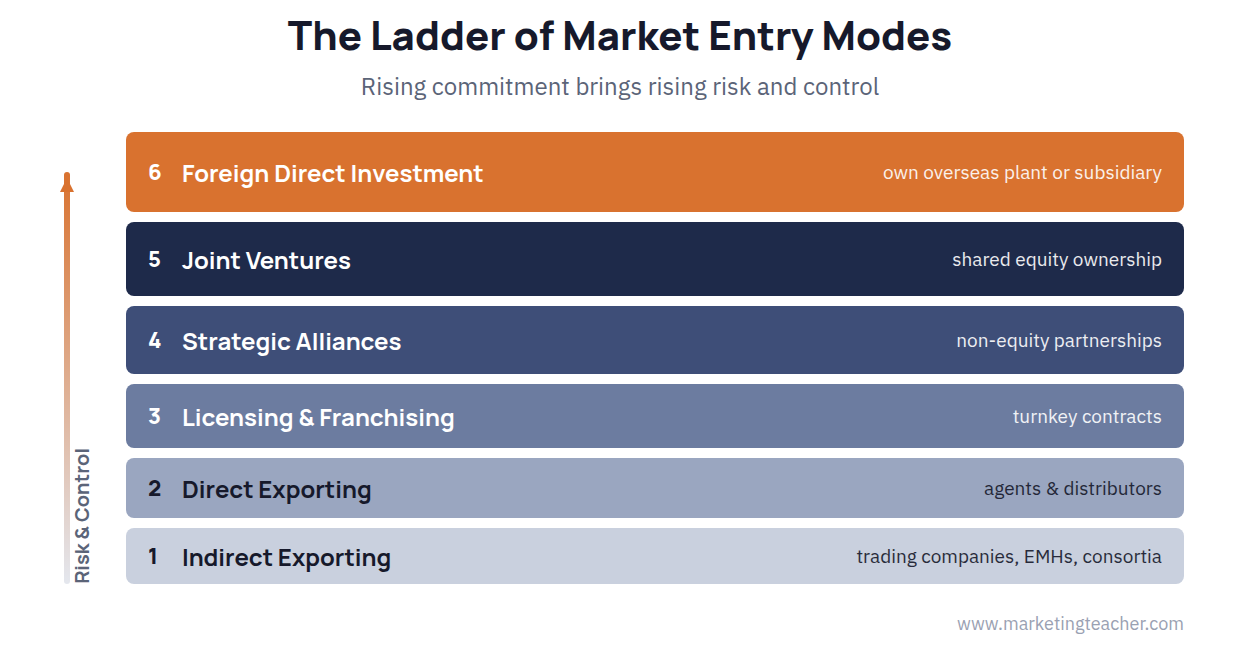
A mode of entry is the channel a company chooses to gain access to a new international market. Paul and Mas (2020) describe the choice of entry mode as one of the key “Path” decisions a firm makes when internationalizing, alongside decisions about timing (Pace) and sequencing (Pattern). No single mode suits every company or every market; the right choice depends on how much control, risk and long-term commitment a company is prepared to take on, and each mode trades these off differently.
Exporting: Direct and Indirect
Exporting is usually the lowest-commitment way to enter a foreign market. With indirect exporting, a company sells through an intermediary in its home country rather than dealing with the foreign market itself, for example piggybacking on another company’s existing distribution, using an export management house that handles exporting on the company’s behalf, joining a consortium of smaller businesses exporting together, or working through an established trading company. Direct exporting, by contrast, means the company markets overseas on its own behalf, giving it more control over its brand and pricing but requiring more investment in market knowledge and relationships.
Licensing, Franchising and Turnkey Contracts
Licensing allows a company to charge a fee or royalty for the use of its technology, brand or expertise, without directly operating in the foreign market itself. Franchising is a specific form of licensing where the franchiser supplies branding, operating concepts and expertise to a local franchisee, while keeping tight control over how the business is run. Turnkey contracts involve building a complete operation, such as a factory, training the local workforce to run it, and then handing the finished plant over to the client, without retaining ownership once the handover is complete.
Agents, Distributors and Strategic Alliances
International agents represent a company in a foreign market on a commission basis without taking ownership of the goods, making them a relatively low-cost but low-control option; international distributors work similarly but take ownership of the goods themselves, giving them a stronger incentive to sell. Strategic alliances are non-equity agreements between independent companies, covering shared manufacturing, joint research and development, or distribution partnerships, that let a company access local capability without merging ownership.
Joint Ventures and Foreign Direct Investment
Joint ventures are equity-based, meaning a new company is set up with each partner owning a share of it, often used to gain access to technology, local management skills, or distribution channels a company could not easily build alone, and sometimes required by local law before a foreign business can operate in a market at all. Foreign direct investment goes a step further: a company invests directly in its own overseas manufacturing plant, machinery and labor, either by building new facilities or acquiring an existing business. This gives a company the strongest local presence and the greatest control, but also exposes it to the full commercial risk of the local market. An international sales subsidiary offers similar local presence with somewhat lower risk, operating more like a company-owned distributor than a full manufacturing operation. Because foreign direct investment locks up capital in a specific country for the long term, companies typically only commit to it once earlier, lower-risk modes have confirmed there is genuine, durable demand in that market.
The Stages of Internationalization
Johanson and Vahlne (1977) describe internationalization as a gradual, incremental process rather than a single decision, an idea now widely known as the Uppsala model. A company typically starts with low-commitment modes such as indirect exporting, and only moves toward direct exporting, its own foreign sales presence, and eventually foreign manufacture as it accumulates market knowledge and confidence. Not every company passes through every stage in order; some skip stages entirely or enter at a later point, particularly where a market opportunity or competitive pressure demands faster action. Authorities on international marketing do not always agree on exactly where a given mode sits within this progression, some treat franchising as a stage of its own rather than a form of licensing, for instance, so the more useful habit is weighing every available mode on its own merits rather than worrying about which category it technically belongs to.
Summary
Companies can enter international markets through exporting, licensing and franchising, agents and distributors, strategic alliances, joint ventures, or foreign direct investment, each offering a different balance of control, risk and commitment (Hollensen, 2020). The stages of internationalization concept explains why many companies build up to higher-commitment modes gradually rather than starting with the biggest possible investment (Johanson and Vahlne, 1977; Paul and Mas, 2020), accumulating market knowledge at each stage before taking on greater risk.
The slides, worksheet, lesson plan and poster for this lesson are free to download and free to use in your course — no sign-up, no permission needed. See the teacher resources →
Assign this lesson to your class:
Using Canvas, Blackboard or Moodle? Copy the link and paste it into your course page or assignment. More ways to add lessons to your LMS.

