
What Is Internet Advertising?
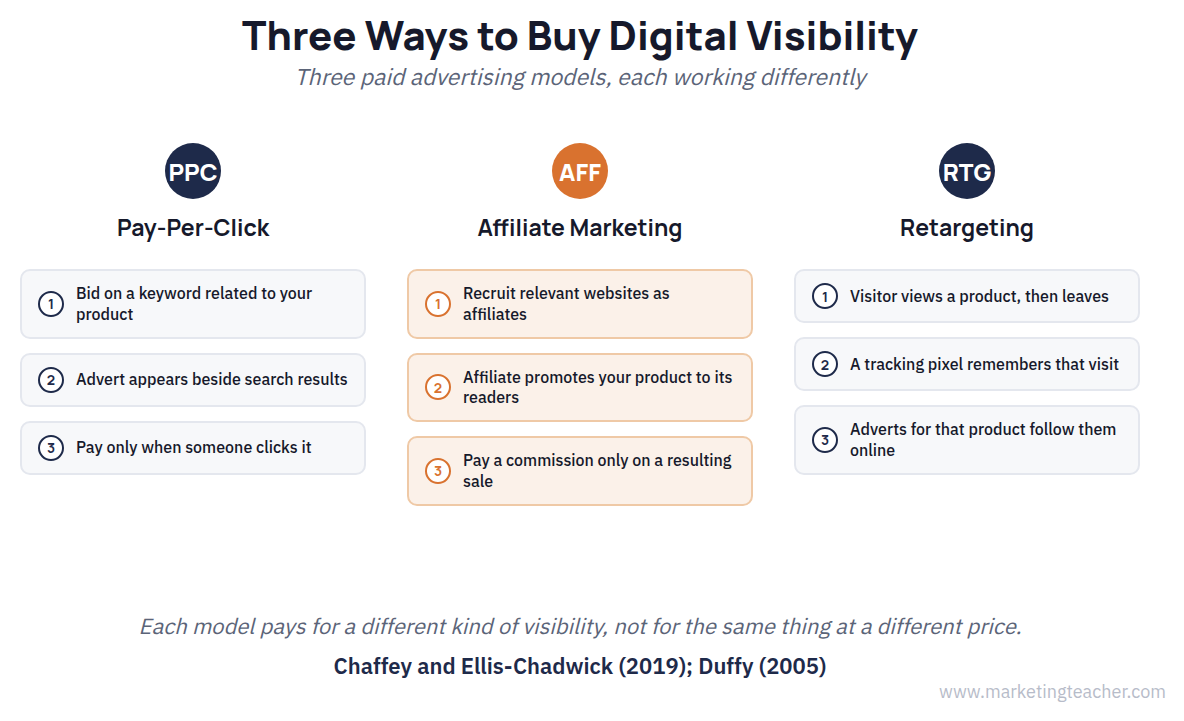
Once a website exists, the next challenge is making sure the right people find it. Internet advertising covers the paid, external ways a business increases its visibility and traffic, distinct from the unpaid, organic content and search engine optimisation work covered elsewhere in this Lessonstore. Chaffey and Ellis-Chadwick (2019) group most paid digital advertising into a small number of recurring formats: pay-per-click search advertising, affiliate marketing, and display or retargeted advertising, each paying for a different kind of visibility rather than competing directly with one another.
Pay-Per-Click Search Advertising
Pay-per-click, or PPC, advertising is a cost-per-click model in which a business bids on a keyword closely related to its product or service, and pays only when a potential customer actually clicks the resulting advert. Google Ads is the dominant platform for this, running text adverts alongside a search engine’s organic results, but Microsoft Advertising runs an equivalent programme on Bing, so a search advertising strategy is rarely built around a single platform alone. The advertiser sets a maximum bid per click and a total budget, and a popular, competitive keyword such as “marketing” typically costs far more per click than a longer, more specific keyword such as “marketing lessons for beginners,” since fewer advertisers are bidding on it. A campaign can run for a fixed period or simply until its budget is spent, and many businesses use a specialist PPC management agency, or a certified platform professional, to set up and continually adjust bids and keywords rather than managing the campaign entirely in-house. Because the advertiser only pays when someone actually clicks, rather than simply for an advert being displayed, PPC is often described as a highly measurable and controllable form of advertising: a business can see exactly what each click cost and, if its website tracks conversions, exactly what each resulting sale or lead cost too.
Affiliate Marketing: Paying for Performance
Affiliate marketing is a commission-based partnership in which a business, the advertiser, pays other websites, its affiliates, a commission for traffic or sales they generate on its behalf (Duffy, 2005). A company selling surfboards, for example, might recruit travel and lifestyle websites covering surfing destinations as affiliates, since their existing readers are already a good match for the product. Duffy (2005) frames the model as depending on a genuine win-win relationship: the advertiser only pays when a result actually happens, usually a completed sale or a qualifying lead, while the affiliate earns a share of revenue it would not otherwise have generated on its own. Affiliate networks act as an intermediary between many advertisers and many affiliate websites, handling tracking, payment, and reporting so neither side has to manage those relationships one at a time. This arrangement is sometimes described as a basic agency relationship: the affiliate promotes on behalf of the advertiser rather than owning the product itself, and is rewarded only for the results it actually delivers.
Offline Promotion Still Matters
Digital advertising works alongside, not instead of, offline promotion. This Lessonstore’s own lessons on Promotion, as part of the Marketing Mix, and on Introduction to Marketing Communications cover the wider promotional toolkit a business can draw on beyond the internet, from press coverage and sponsorship to competitions and word of mouth. A coherent promotional plan usually treats digital advertising as one channel within that wider mix rather than a replacement for it, since offline awareness often drives the searches and direct visits that digital advertising then converts.
Summary
Internet advertising covers the paid, external ways a business drives traffic to its website. Pay-per-click search advertising, led by platforms such as Google Ads and Microsoft Advertising, charges per click against a chosen keyword. Affiliate marketing pays other websites a commission for traffic or sales they generate on a business’s behalf, a genuine performance-based partnership rather than a flat advertising fee. Retargeting keeps a business visible to people who have already shown interest in a specific product, typically converting far better than advertising to a cold audience. All three sit alongside, rather than replace, the offline promotion covered elsewhere in the marketing mix.
The slides, worksheet, lesson plan and poster for this lesson are free to download and free to use in your course — no sign-up, no permission needed. See the teacher resources →
Assign this lesson to your class:
Using Canvas, Blackboard or Moodle? Copy the link and paste it into your course page or assignment. More ways to add lessons to your LMS.

