
What Is International Marketing?
International marketing is the process of planning and carrying out the pricing, promotion and distribution of goods and services to customers in more than one country, in a way that recognises the differences between those markets rather than simply repeating the domestic approach abroad (Cateora and Ghauri, 1999). It applies the same core marketing principles used in a single domestic market, understanding customers, building a suitable offering, pricing it appropriately and reaching the right audience, but does so across borders where customer needs, competition, culture, law and infrastructure can all vary considerably from one country to the next.
How International Marketing Differs From Domestic Marketing
Doole and Lowe (2001) argue that the fundamentals of marketing do not change once a company crosses a border, but the environment those fundamentals are applied in changes a great deal. A pricing strategy that works well at home may be undermined abroad by different consumer purchasing power, import tariffs or currency fluctuation. A promotional campaign that resonates in one culture can misfire, or even cause offence, in another. Distribution channels that a company can rely on domestically may not exist in the same form in a new market, requiring different partners, logistics and regulatory approvals. International marketing, in short, is domestic marketing carried out under a much wider and more variable set of constraints.
Three Levels of International Involvement
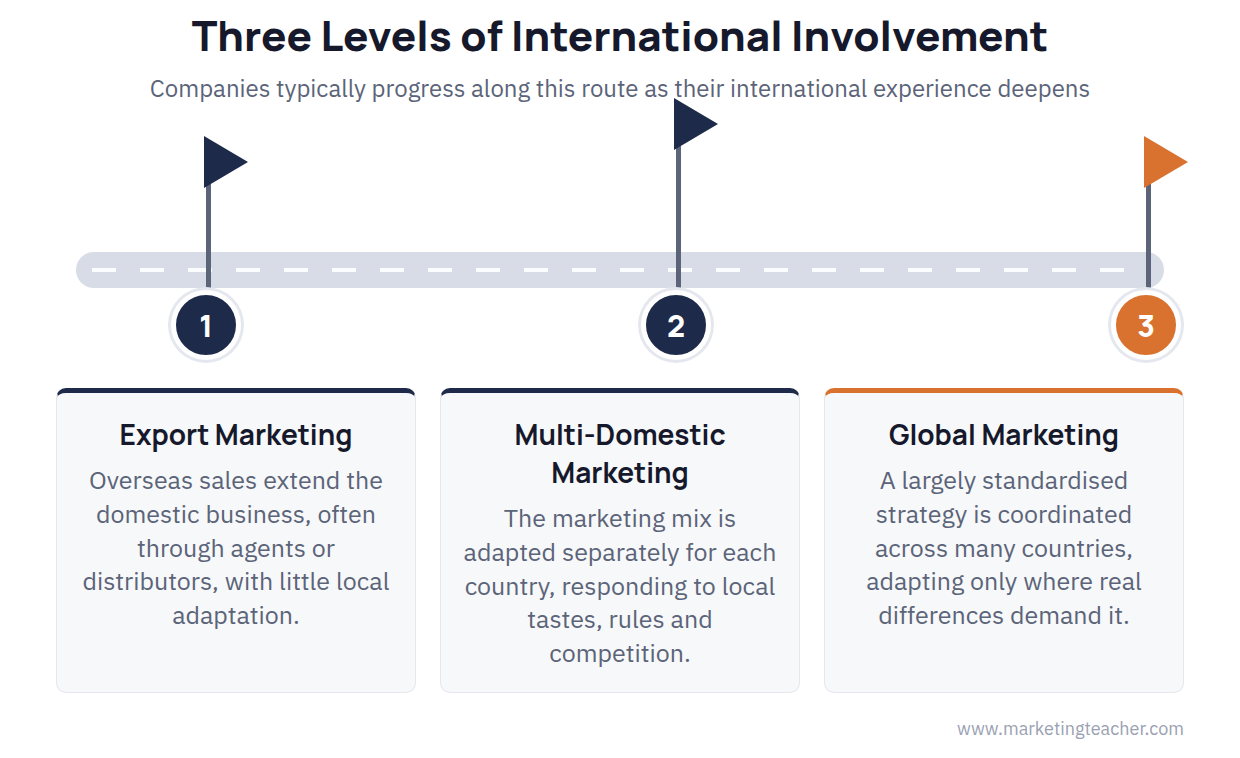
Companies rarely move from a purely domestic focus to a fully global strategy in one step. Mühlbacher, Leihs and Dahringer (2006) describe three broad levels a company typically passes through. At the export marketing level, a company treats overseas sales as an extension of its domestic business, often selling through agents, distributors or trading companies with little adaptation to individual markets. At the international, or multi-domestic, marketing level, the company adapts its marketing mix separately for each country it operates in, responding to local tastes, regulations and competition on a market-by-market basis. At the global marketing level, the company coordinates a largely standardised strategy across many countries at once, treating the world, or large regions of it, as a single market while still allowing for necessary local adjustments.
Why Companies Go International
Johansson (2000) points to several recurring forces that push companies beyond their home market. A saturated or slow-growing domestic market limits how much further a company can expand at home, making new geographic markets an obvious source of additional growth. Spreading sales across several countries also spreads risk, since a downturn in one market can be offset by stronger performance elsewhere. Larger overall sales volumes can bring economies of scale in production and purchasing that a purely domestic operation could not achieve on its own. Companies also sometimes follow their existing customers abroad, particularly business customers who have themselves expanded internationally, or respond to competitors who are already established in attractive foreign markets. Doole, Lowe and Kenyon (2019) add that improvements in digital communication and logistics have lowered the practical cost of entering a foreign market considerably compared to earlier decades, which is one reason even smaller companies now consider international expansion far earlier in their growth than they once did.
Thinking Globally While Acting Locally
Keegan (2002) draws a useful distinction between a multinational marketing approach, which adapts almost everything to each local market, and a genuinely global marketing mindset, which starts by identifying what is similar across markets before deciding what still needs to be adapted. Neither extreme works well on its own: treating every market as entirely unique wastes the efficiency gains available from a more coordinated approach, while assuming every market is the same risks the kind of costly missteps a truly local strategy would have avoided. Most successful international marketers sit somewhere between the two, standardising where genuine similarities exist and adapting where real differences demand it, a balance explored further in the lesson on the international marketing environment.
Summary
International marketing is the planning and delivery of a company’s pricing, promotion and distribution activities to customers in more than one country, recognising rather than ignoring the differences between those markets (Cateora and Ghauri, 1999; Doole and Lowe, 2001). Companies typically progress through export, multi-domestic and global levels of international involvement (Mühlbacher, Leihs and Dahringer, 2006), driven by forces such as market saturation at home, risk-spreading and economies of scale (Johansson, 2000), and the most effective international marketers learn to think globally while still acting locally where real market differences demand it (Keegan, 2002).
The slides, worksheet, lesson plan and poster for this lesson are free to download and free to use in your course — no sign-up, no permission needed. See the teacher resources →
Assign this lesson to your class:
Using Canvas, Blackboard or Moodle? Copy the link and paste it into your course page or assignment. More ways to add lessons to your LMS.

