
Outdoor Marketing: Posters, Billboards and Street Furniture
What Is Outdoor Advertising?
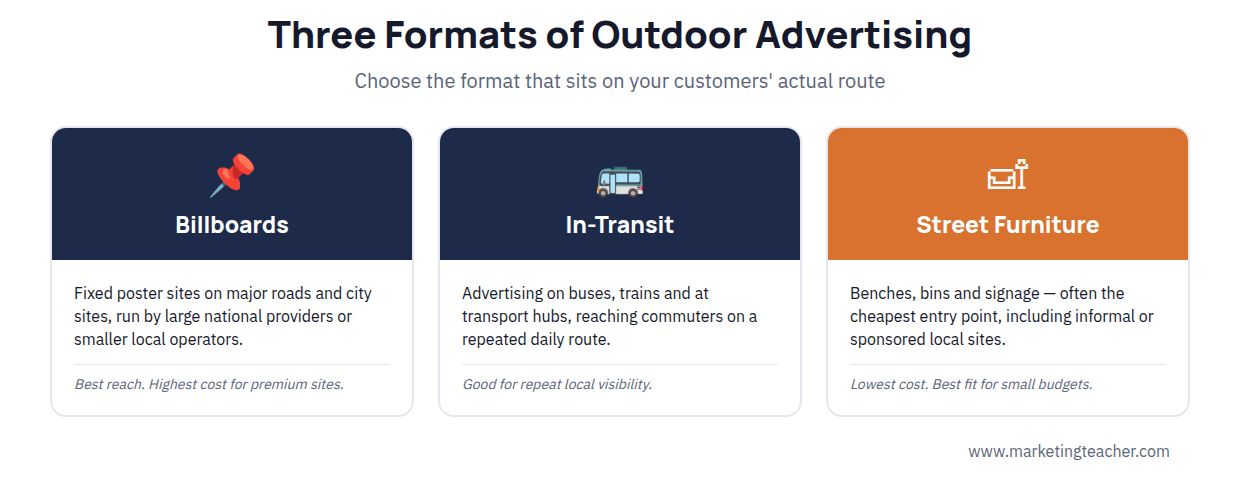
Outdoor advertising, also known as out-of-home advertising (OOH), covers all the advertising a customer is exposed to while outdoors: on billboards while walking, on posters at a bus stop, or on the side of a bus itself. Fill’s (2009) survey of marketing communications channels places OOH alongside press and broadcast media as a distinct format family, and once a business starts looking for it, it becomes clear how prolific outdoor advertising actually is. The three broad categories are posters and billboards on fixed sites, in-transit advertising on vehicles and at transport hubs, and street furniture, which covers fixed public objects such as benches, bins and signage that carry advertising as a secondary function.
Large Providers and Local Alternatives
Large, established outdoor advertising companies such as JCDecaux operate a significant share of premium billboard and transit sites, particularly in major cities, and a business with a substantial budget may choose to work with one of these national providers for reach and consistency. Most small businesses do not have that budget, and the more realistic route is to work with a smaller, local outdoor advertising company that controls a handful of prime sites in the areas a business’s actual customers pass through. A local provider is also usually far more willing to negotiate on price and contract length than a large national operator with fixed rate cards.
Finding Outdoor Advertising on a Tight Budget
When even a local outdoor advertising company’s rates feel out of reach, Carson, Cromie, McGowan and Hill’s (1995) work on entrepreneurial marketing points to the kind of resourceful, informally negotiated arrangements that smaller firms often rely on instead of a formal media contract. A café near a railway station, for example, might approach a homeowner whose garden backs onto the railway line and offer a small monthly fee for a sign fixed to the rear fence facing the trains, a mutually useful arrangement since the homeowner cannot even see the sign themselves but benefits from the extra income. The underlying principle is the same as with any outdoor advertising: find a site that is reliably seen by the actual target audience, whatever form that site takes.
Street Furniture as an Advertising Format
Street furniture, in Fill’s (2009) sense of the term, refers to any fixed object the public uses or encounters in a shared space, from a simple public bench to recycling bins and pedestrian signage. A small business can sometimes access this format very cheaply by sponsoring something the local council already maintains, such as a set of gardens at a road junction its customers regularly pass, in exchange for a small sign acknowledging the sponsorship. Beyond the advertising value itself, this kind of sponsorship tends to make a business look more community-minded to the people who see it, which is a reputational benefit that a conventional billboard rarely offers in the same way.
Choosing a Format That Fits
The right outdoor format for a small business depends less on which type looks most impressive and more on which one sits on a route its actual customers already travel. A large highway billboard reaches enormous numbers of people, but very few of them may ever become customers of a small local business, whereas a modest sign on a fence or a sponsored bench on the correct street can reach a smaller but far more relevant audience for a fraction of the cost. Testing a single, well-chosen site for one season before committing to a longer contract is a low-risk way to find out whether a particular location genuinely delivers customers. It is also worth walking or driving the route a target customer actually takes before choosing a site, rather than judging a location purely from a rate card or a photograph, since a site that looks prominent in isolation can be far less visible once real traffic, signage clutter and viewing angle are taken into account.
Summary
Outdoor or out-of-home advertising covers billboards, transit advertising and street furniture, and while large national providers such as JCDecaux operate a significant share of premium sites, most small businesses are better served by a local operator, or even an informally negotiated site such as a fence or a sponsored public bench. Fill (2009) frames these as a distinct format family within the wider marketing communications mix, while Carson, Cromie, McGowan and Hill’s (1995) work on entrepreneurial marketing is a reminder that the most cost-effective outdoor advertising for a small business is often the most resourceful, not the most expensive.
The slides, worksheet, lesson plan and poster for this lesson are free to download and free to use in your course — no sign-up, no permission needed.

