
What Are the Bases of Market Segmentation?
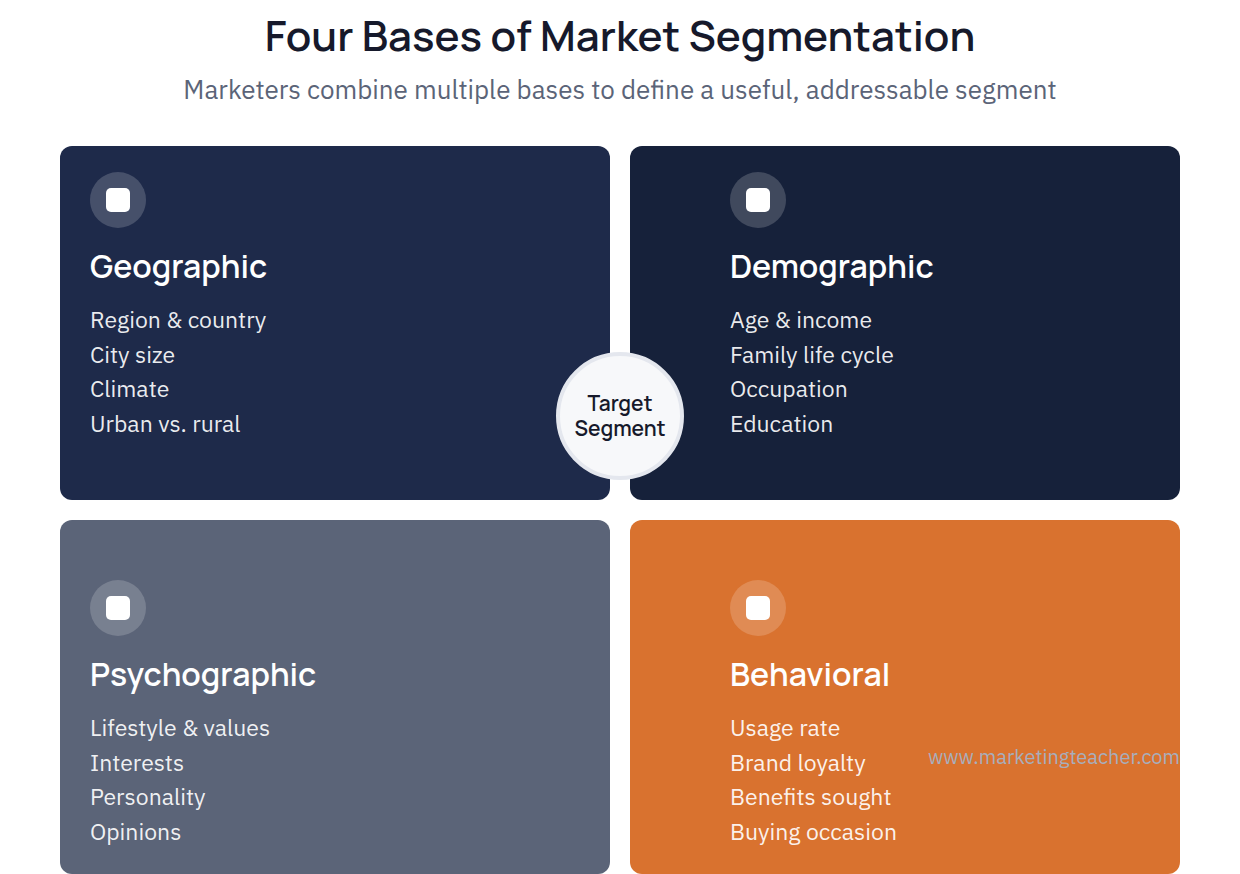
Segmentation is the process of dividing a broad target market into smaller, more manageable groups of customers who share similar needs or characteristics, so that a business can tailor its product, message and channel to each group rather than treating the whole market as one audience. Kotler and Armstrong (2018) group the variables marketers use to do this into four broad bases: geographic, demographic, psychographic and behavioral. No single base tells the whole story on its own, which is why most real segmentation strategies combine several of them.
Geographic Segmentation
Geographic segmentation divides a market by location: region or country, city size, climate, or urban versus rural setting. A business selling snow-clearing equipment has an obvious reason to weight its marketing toward colder regions, while a business selling patio furniture benefits from focusing on warmer climates and suburban households with outdoor space. Geography is often the simplest base to act on, since it maps directly onto where advertising budget and distribution effort get spent.
Demographic Segmentation
Demographic segmentation groups customers by measurable, factual characteristics: age, income, gender, family size, occupation, education, and stage in the family life cycle (for example, a young single person, a couple with young children, or an empty-nester whose children have left home). Demographic data is popular with marketers because it is relatively easy to collect and correlates reasonably well with what people buy and how much they spend, even though it says little about why they buy it.
Psychographic Segmentation
Psychographic segmentation groups customers by lifestyle, values, interests, opinions and personality traits, such as whether someone identifies as adventurous, cautious, status-conscious or environmentally minded. The best-known psychographic framework, VALS, groups American consumers into eight types based on their primary motivation and available resources. Because two customers with identical demographics can have very different attitudes and buying motivations, psychographic segmentation often explains behaviour that demographic data alone cannot, though it is harder and more expensive to measure since it usually depends on surveys or inferred behaviour rather than easily observed facts.
Behavioral Segmentation
Behavioral segmentation groups customers by their actual relationship with a product: usage rate, brand loyalty, the benefits they seek, their readiness to buy, or the occasion prompting the purchase. A customer buying flowers for a weekly household display behaves very differently from one buying flowers once a year for a specific occasion, even if the two look identical on every demographic measure, which is why many marketers treat behavioral data as the most directly actionable base once it is available.
Why Marketers Combine Multiple Bases
Relying on a single base rarely produces a useful segment. Knowing only that a customer is 35 to 44 years old (demographic) says little on its own, but combining that with a suburban location (geographic), an active and outdoor-oriented lifestyle (psychographic), and frequent repeat purchases of hiking gear (behavioral) describes a specific, addressable group a marketer can actually design a campaign around. Modern segmentation, particularly online, increasingly blends these bases automatically through purchase history and browsing behaviour, but the same four underlying categories still describe what is being measured.
Segmentation Requires Trade-offs
No segmentation scheme is free: dividing a market into narrower groups increases the relevance of a message but also increases the cost and complexity of producing and delivering distinct versions of it. A small business with a limited marketing budget generally benefits from picking the one or two bases most predictive of purchase behaviour for its specific product, rather than attempting to segment on every variable available, since an overly fragmented approach can spread a limited budget too thin to be effective in any single segment.
From Segments to a Target Market
Segmentation on its own only describes the groups that exist within a market; a business still has to evaluate which of those segments are large enough, reachable enough, and profitable enough to actually pursue, a step generally referred to as targeting. A segment that is theoretically distinct but too small, too expensive to reach, or already dominated by an established competitor is rarely worth building a dedicated strategy around, however cleanly it can be defined on paper.
Summary
Market segmentation divides a broad market into geographic, demographic, psychographic and behavioral groups so a business can tailor its product, message and channel to each one rather than treating every customer the same way (Kotler and Armstrong, 2018). Combining multiple bases produces genuinely useful, addressable segments, but segmenting too finely carries real costs, so choosing the one or two bases most predictive of actual purchase behaviour is usually a better strategy than segmenting on every variable available.
The slides, worksheet, lesson plan and poster for this lesson are free to download and free to use in your course — no sign-up, no permission needed. See the teacher resources →
Assign this lesson to your class:
Using Canvas, Blackboard or Moodle? Copy the link and paste it into your course page or assignment. More ways to add lessons to your LMS.

