
What Is Marketing Research, and How Is It Different from Market Research?
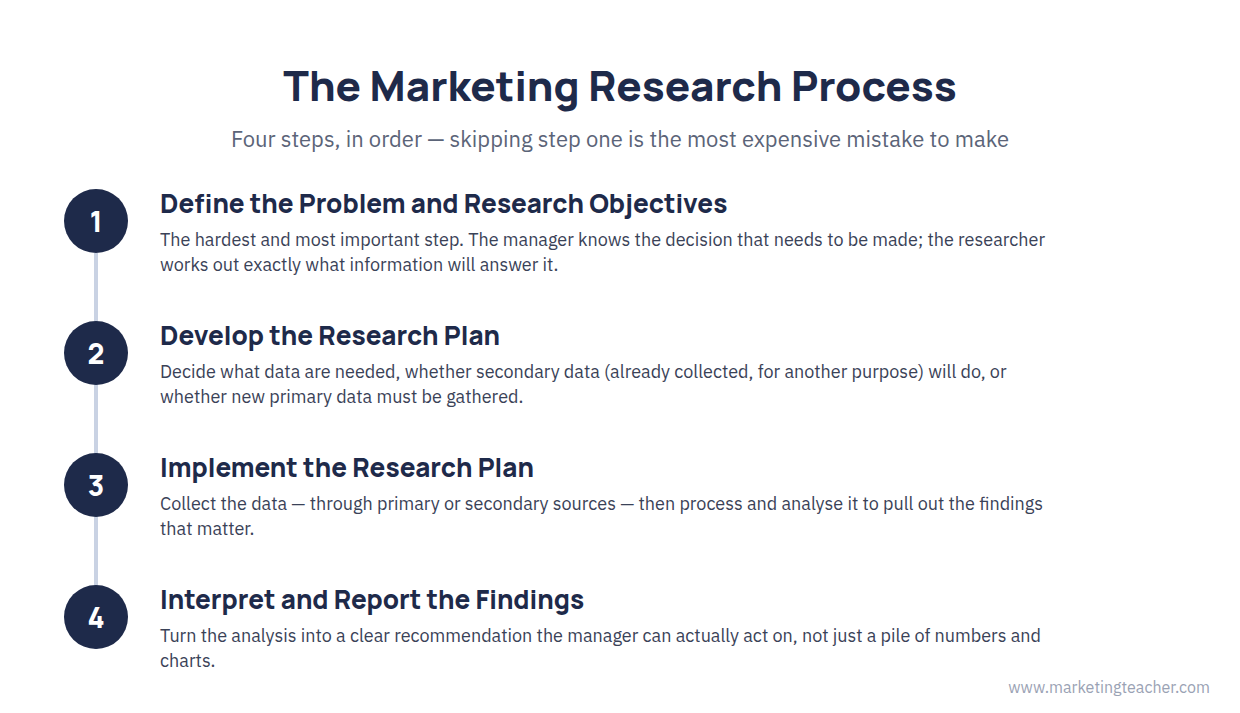
“Market” research and “marketing” research are often confused. Market research is a narrow concept: research into one specific market. Marketing research is much broader. Kotler and Armstrong (2018) define it as the systematic design, collection, analysis, and reporting of data relevant to a specific marketing situation facing an organization — which covers market research, but also research into new products, pricing, distribution, or promotion. A company wondering how customers would react to a new product, or how many people might buy a next-generation device, needs marketing research to find out.
Who Actually Carries Out Marketing Research?
Some large companies run their own in-house research departments, staffed by researchers who work directly with marketing managers on specific projects. Smaller companies, and often larger ones too, frequently hire outside research specialists to consult on a particular problem or run a study from scratch (Kotler & Armstrong, 2018). A third option skips original data collection altogether: a business can simply buy data that another firm has already collected, when that data covers what’s needed closely enough. Which option makes sense depends on budget, timeline, and how specific the problem is — a highly specific question about one company’s own customers usually calls for original research, while a broader industry trend is often already covered by data someone else has published.
The Four-Step Marketing Research Process
Kotler and Armstrong (2018) set out marketing research as four steps, always in this order: defining the problem and research objectives, developing the research plan, implementing the research plan (collecting and analysing the data), and interpreting and reporting the findings. The first step is usually the hardest, and also the most important: the manager best understands the decision that needs making, while the researcher best understands how to get the right information. Getting this step wrong is expensive — a business can spend real time and money on research that answers the wrong question entirely.
Primary and Secondary Data
Once the research plan is being developed, a business chooses between two broad types of data. Secondary data already exists somewhere, having been collected for another purpose — a government report, a trade association study, or a company’s own past sales records. Primary data is collected fresh, specifically to answer the problem at hand (Kotler & Armstrong, 2018). Researchers usually start with secondary research first, since it’s cheaper and faster to gather, and only move on to primary research once the gaps in the existing data become clear. A company’s own internal records — past sales figures, customer databases, prior research reports — are usually the first place to look, since that data already exists and costs nothing new to obtain. Beyond that, businesses can turn to published industry reports, government statistics, trade association studies, or data purchased from specialist research firms that run their own large-scale consumer panels. Only once those existing sources have been checked, and a real gap remains, does it make sense to design and run new primary research.
Why the Process Matters More Than Any Single Technique
Marketing research is a huge topic with many specific techniques, tools, and terminologies that build on the four steps above. But the process itself is what keeps any of those techniques useful. A business that jumps straight to running a survey (step three) without first agreeing exactly what decision the survey needs to inform (step one) usually ends up with data that doesn’t actually answer anything useful — however well the survey itself was designed. The same discipline applies at the other end of the process too: step four is not just handing over a stack of charts and tables. A good research report translates the analysis into a specific recommendation the manager can act on, and flags any errors or limitations in how the data was collected so they aren’t mistaken for genuine findings.
Summary
Marketing research is broader than market research: it’s the systematic design, collection, analysis, and reporting of data relevant to a specific marketing situation (Kotler & Armstrong, 2018). The process runs in four steps — define the problem, develop the research plan, implement it by gathering primary and/or secondary data, then interpret and report the findings — and getting the first step right is what makes everything that follows worth doing.
The slides, worksheet, lesson plan and poster for this lesson are free to download and free to use in your course — no sign-up, no permission needed. See the teacher resources →
Assign this lesson to your class:
Using Canvas, Blackboard or Moodle? Copy the link and paste it into your course page or assignment. More ways to add lessons to your LMS.

