
What Is the Microenvironment?
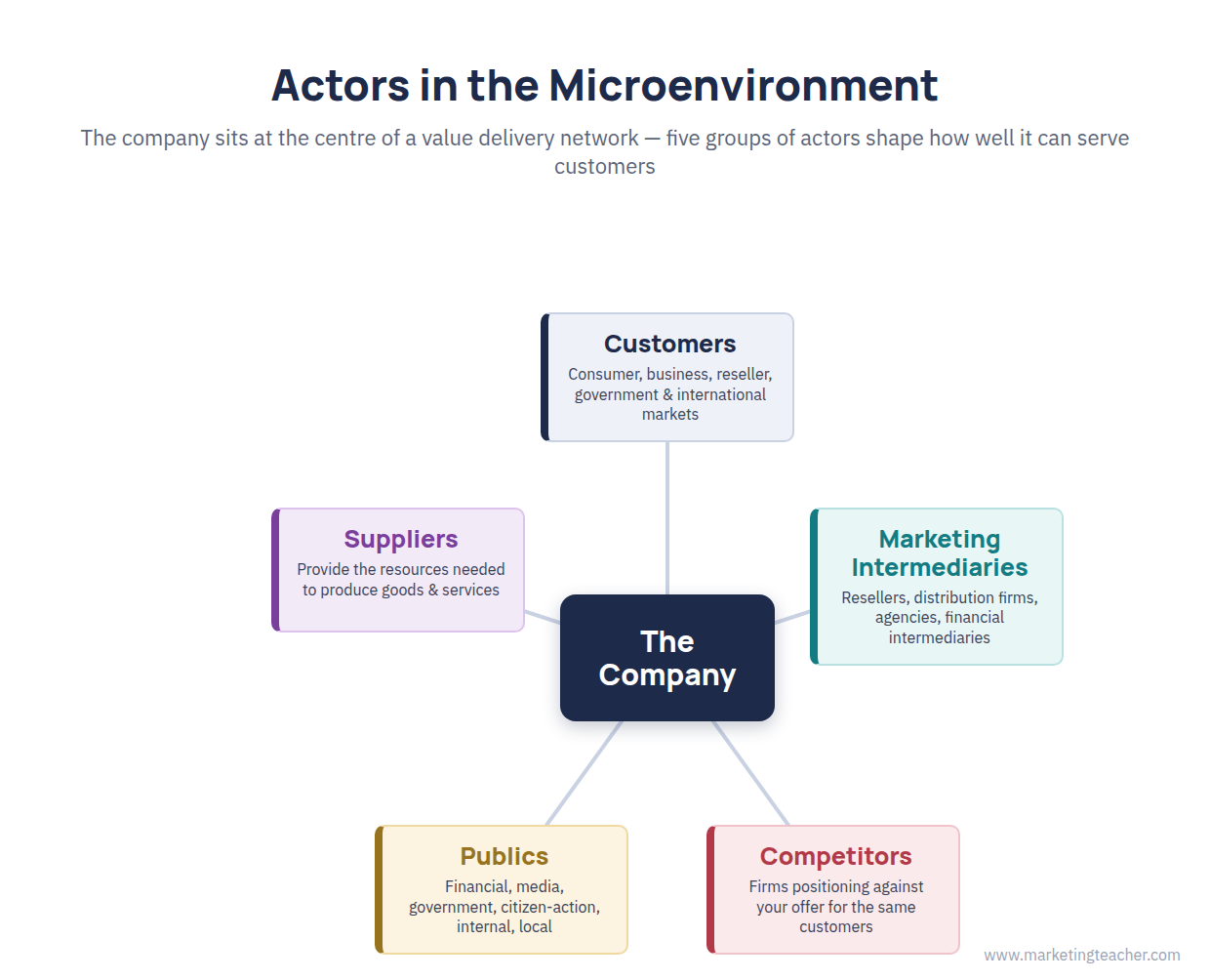
Kotler and Armstrong (2018) define the microenvironment as the actors close to a company that affect, positively or negatively, its ability to build relationships with customers and create value for them. It sits inside the wider marketing environment, alongside the macroenvironment covered by tools such as PESTEL and PEST Analysis. Where the macroenvironment is made up of broad societal forces no single firm controls, the microenvironment is made up of specific, nameable actors: the company itself, its suppliers, its marketing intermediaries, its competitors, various publics, and, at the centre of it all, its customers. Marketing management cannot build customer value alone — success depends on how well the company works with every one of these actors (Kotler & Armstrong, 2018).
The Company and Its Suppliers
Inside the company, marketing plans have to take other departments into account — top management, finance, research and development, purchasing, operations, human resources, and accounting all form what Kotler and Armstrong (2018) call the internal environment. Top management sets the mission, objectives and broad strategy; marketing managers then have to work within that framework and in close cooperation with every other department, since responsibility for understanding and serving the customer is shared across the whole business, not owned by marketing alone.
Suppliers sit just outside the company but are just as important to the value delivery network: they provide the raw materials, components and services a business needs to make what it sells. A shortage, a delay, or a sudden cost increase at a single supplier can damage customer satisfaction or force a price rise long before customers ever see the product. Because of this, most marketers now treat suppliers as partners in creating customer value rather than as interchangeable vendors to be squeezed on price (Kotler & Armstrong, 2018).
Marketing Intermediaries: The Partners Who Get Products to Customers
Marketing intermediaries help a company promote, sell and physically move its products to the people who will actually use them. Kotler and Armstrong (2018) group them into resellers (wholesalers and retailers who buy and resell merchandise), physical distribution firms (which move and store goods), marketing services agencies (research firms, advertising agencies and consultants), and financial intermediaries (banks, insurers and credit providers who fund or de-risk transactions). As with suppliers, the strongest companies treat intermediaries as partners rather than as a pipe the product happens to flow through — a reseller that understands and believes in a brand will represent it far better than one that is simply moving stock.
Competitors and Publics
The marketing concept holds that a company succeeds by creating more customer value and satisfaction than its competitors do, so marketers have to do more than simply meet customer needs — they have to position their offer strongly against specific rival offers in customers’ minds. Kotler and Armstrong (2018) are clear that no single competitive strategy suits every firm: a dominant market leader can use tactics a smaller challenger cannot afford, but size is no guarantee of a winning strategy, and smaller firms can outperform larger ones with the right positioning.
A public, in Kotler and Armstrong’s (2018) definition, is any group with an actual or potential interest in, or impact on, a company’s ability to reach its objectives. They identify seven types: financial publics (banks, investors, analysts), media publics (news outlets and social platforms), government publics (regulators and lawmakers), citizen-action publics (consumer and environmental groups), internal publics (employees and management), the general public, and local publics (the communities a business actually operates in). A company that ignores one of these groups can find a marketing plan derailed by a source that never touched its product at all.
Customers: The Centre of the Value Delivery Network
Everything above exists to serve customers, which is why Kotler and Armstrong (2018) treat them as the single most important actor in the microenvironment. They describe five customer market types worth distinguishing: consumer markets (individuals and households buying for personal use), business markets (organisations buying to use in their own production), reseller markets (buying to resell at a profit), government markets (public bodies buying to deliver public services), and international markets (any of the above operating across borders). Each type behaves differently and calls for its own careful study — a business market buyer weighing a bulk contract makes decisions very differently from a consumer choosing a subscription on impulse.
Summary
The microenvironment is made up of six close-in actors that shape a company’s ability to create customer value: the company itself and its internal departments, its suppliers, its marketing intermediaries, its competitors, the seven types of publics, and, at the centre, its five types of customers (Kotler & Armstrong, 2018). Mapping these actors deliberately, the way Riverside Roasters does above, makes it far easier to spot where a business is exposed — and where it has genuine partners worth investing in. For the wider societal forces surrounding this network, see the macroenvironment covered in The Marketing Environment and audited directly with PESTEL.
The slides, worksheet, lesson plan and poster for this lesson are free to download and free to use in your course — no sign-up, no permission needed. See the teacher resources →
Assign this lesson to your class:
Using Canvas, Blackboard or Moodle? Copy the link and paste it into your course page or assignment. More ways to add lessons to your LMS.

